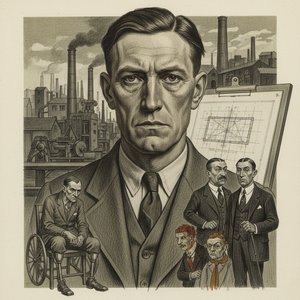
The Architect of Fragments: The Life and Legacy of Hannah Höch
In the fractured landscape of post-World War I Germany, where the old certainties of the imperial era had been violently dismantled, a new kind of art emerged from the debris. At the heart of this aesthetic revolution stood Hannah Höch, a visionary who did not merely paint or sculpt, but reconstructed reality itself. Born Anna Therese Johanne Höch in 1889 in Gotha, her early life was shaped by the quiet domesticity of familial duty, yet her spirit was destined for the radical avant-garde. While her initial training in graphic arts and glass design in Berlin was partially a concession to her father’s wishes, it provided her with the precise technical mastery required for her most profound contribution to art history: the invention and perfection of photomontage.
As the Weimar Republic struggled through political upheaval and social transformation, Höch became a central, albeit often overlooked, figure in the Berlin Dada movement. Alongside collaborators like Raoul Hausmann, she embraced the chaotic energy of the era, rejecting traditional fine art in favor of a medium that utilized the very tools of modern mass media. By cutting, tearing, and reassembling photographs from newspapers and magazines, she created works that mirrored the fragmented, dizzying experience of urban life. Her technique was more than a stylistic choice; it was a political act. Through the meticulous arrangement of disparate images, she could expose the contradictions of a society in flux, stripping away the polished veneer of propaganda to reveal the raw, often jarring truths beneath.
Subverting the Gaze: Gender and the New Woman
Perhaps the most enduring dimension of Höch’s work is her profound interrogation of gender roles and identity. During a period when the concept of the "New Woman"*—an energetic, professional, and increasingly independent female figure—was being debated in every corner of German society, Höch used her scissors to dissect these very constructs. Her montages often featured a surreal juxtaposition of masculine and feminine attributes, creating androgynine figures that challenged the rigid binaries of the time. She explored the tension between biological reality and the media-constructed image, using the fragmented body as a metaphor for the fractured identity of women navigating a patriarchal world.
Her artistic development was characterized by an uncanny ability to blend political critique with a deeply personal exploration of femininity. In masterpieces such as "Cut with the Kitchen Knife Dada through the Last Weimar Beer-Belly Cultural Epoch of Germany," she navigated the complex intersections of class, gender, and politics. Her work did not merely reflect the era; it actively participated in the dismantling of the "fable" of the domestic woman. By repurposing the imagery used to market femininity, she reclaimed agency, turning the tools of mass consumption into instruments of liberation.
A Lasting Impression on the Avant-Garde
The historical significance of Hannah Höch extends far beyond the borders of the Dada movement. She laid the groundwork for much of the contemporary art that followed, influencing everything from Surrealism to Pop Art and even modern digital collage. Her ability to find meaning in the discarded and the fragmented remains a powerful testament to the resilience of the human creative spirit. As we look back on her career, several key elements define her monumental impact:
- Technical Innovation: The elevation of photomontage from a mere craft to a sophisticated medium of high art.
- Social Critique: The use of mass-media imagery to challenge political authority and the propaganda of the Weimar Republic.
- Feminist Pioneering: A radical deconstruction of gendered aesthetics and the exploration of the "New Woman" archetype.
- Aesthetic Fragmentation: The creation of a visual language that captured the psychological disorientation of the early 20th century.
Though she lived through the dark shadows of the subsequent decades, including the rise of National Socialism which suppressed much of the avant-garde, Höch’s voice remained an essential part of the artistic canon. She remains a symbol of resistance and reinvention, reminding us that even from the most broken pieces, a new and profound truth can be assembled.
Spørsmål og svar
Hvordan finner jeg alle verk av Hannah Höch innenfor et bestemt medium?
Siden Alle medier grupperer Hannah Höch sine kunstverk etter teknikk.
Hvor er Hannah Höch sine kunstverk gruppert etter nøkkelord?
Hannah Höch sine verk kan utforskes via nøkkelord på kunstnerens Etter nøkkelord-side. Hvert nøkkelord grupperer de relaterte kunstverkene.
I hvilken historisk periode arbeidet Hannah Höch?
Hannah Höch arbeidet i perioden Modern. Perioden plasserer kunstnerens virke i historien.
Kan jeg bla gjennom verkene til Hannah Höch etter kunstretning?
Verkene til Hannah Höch kan bla gjennom etter kunstretning på Hannah Höch sin Alle retninger-side.
Hvordan er Hannah Höch sin karriere delt inn i perioder?
En kronologisk fremstilling av Hannah Höch sitt arbeid er tilgjengelig på kunstnerens Kronologi-side, hvor verkene presenteres i rekkefølge etter når de ble skapt, kapittel for kapittel.
Kan jeg utforske verkene til Hannah Höch etter tema?
Siden Motivatlas kartlegger Hannah Höch sine kunstverk etter motiv.
Hvor kan jeg se Hannah Höch sine kunstverk i et 3D-galleri?
Et virtuelt besøk er mulig: siden 3D-museum til Hannah Höch presenterer kunstnerens verk i et tredimensjonalt galleri.
Hvor kan jeg se alle kunstverk av Hannah Höch?
Alle verk av Hannah Höch på denne nettsiden kan utforskes via kunstnerens Alle kunstverk-side.