Early Life, Family and Training
François Lafon was born in Paris in 1846. He grew up in a household where the smell of oil and the sight of brushes were constant, as he was the fourth child of the painter Jacques-Émile Lafon. His father, who lived from 1817 to 1886, provided the first lessons, guiding the boy's hand and teaching him the fundamentals of the craft. This early apprenticeship meant that the language of painting was spoken within the family long before he sought formal instruction elsewhere.
As he moved beyond the lessons of his father, François Lafon entered the École des Beaux-Arts de Paris. It was within these walls that his training took a more structured path. He became a student of Alexandre Cabanel, working under the guidance of a man who shaped the direction of his technical development. This period of study at the École des Beaux-Arts provided the foundation for the compositions he would later bring to the Salon.
Professional Career and Recognition
Lafon made his debut at the Salon de Paris in 1875. This period marked the beginning of a steady presence in the French art scene, where he moved between various subjects. He spent his working years navigating the demands of historical scenes and religious compositions, while also turning his attention to portraits and quiet genre scenes. His ability to handle these diverse themes led to his admission as a member of the Société nationale des beaux-arts in 1890.
The French State recognized his skill through several official commissions. These orders brought his work into public collections and museums across the country. While much of his output was released under his own name, he also chose to paint landscapes and marine scenes under the pseudonym Keuleyan or Keuleyan Lafon. This distinction allowed him to explore different moods, particularly those involving moonlight and sunsets, away from the expectations of his more formal academic subjects.
Artistic Style and Technique
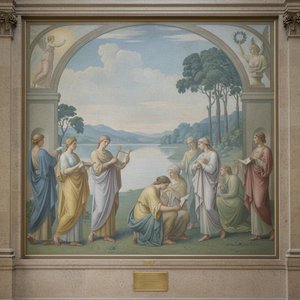
Lafon’s brushwork follows the traditions of late 19th-century academic painting. His compositions lean toward the classical, favoring a sense of order and balance in how figures and spaces are arranged. There is a certain slenderness to his figures, a grace that avoids heavy or bulky forms. Instead, he focuses on a lightness of touch that often carries a sense of dreamy nostalgia, as if the scenes are being viewed through a soft, receding memory.
He frequently turned his attention to the quiet shifts of light. In his landscapes and marine scenes, he sought out the specific, fleeting qualities of the sky, particularly during sunsets or under the pale glow of moonlight. This interest in light allowed him to explore how it settles on water or moves through a landscape, creating a mood that feels both still and deeply personal. His ability to capture these moments suggests a patient observation of the natural world.
His technical approach varied depending on the subject, moving between the structured requirements of historical or religious scenes and the more fluid needs of a landscape. Whether working on a large-scale commission or a smaller study, the elegance of his lines remained a constant. He often worked with oil on canvas to achieve the subtle gradations required for his preferred subjects, such as:
- Dancing Nymphs
- Léda : Japonaise à l'éventail
- Sitzende Nymphe an der Quelle
- Femmes musiciennes
Notable Works and Commissions
Lafon’s early career was marked by significant recognition from the French State. In 1875, he exhibited Saint Étienne at the Salon. That same year, he completed The Martyrdom of Saint Cecilia, a copy after Francia, which was commissioned by the State for the museum of Chateauroux. His ability to handle historical and religious subjects led to further official interest; in 1895, the State purchased his work In Constantinople in the 4th century during the reign of the Empress Eudoxia following its exhibition at the Salon.
His brush often turned toward more lyrical or mythological subjects. He painted Les Baigneuses and explored literary themes in works such as Dante et Virgile sur les rives du Purgatoire. These pieces reflect a focus on the human form and classical settings. His output also included various portraits and scenes of daily life, such as La demande en mariage and Femme ramassant des branches dans la forêt.
- Jeune italienne endormie
- La toilette de Vénus
- Bacchantes
- L'enfance de Bacchus
- Sainte à la lyre
Where to See the Works Today
Tracing the presence of his canvases requires a trip through several French cities. His paintings have found permanent homes in various regional collections, ensuring his hand remains visible in the public sphere. In Chateauroux, his work is held within the museum there, much like the pieces kept in the museum of Bourges. These locations hold the physical traces of his time spent working in the late nineteenth century.
Other collections preserve his output in different parts of the country. You can find his paintings in the museum of Rouen and the museum of Saint-Brieuc. The museum of Périgueux also maintains works from his hand. Additionally, the museum of Tours holds pieces that reflect his specific approach to composition and subject matter. These museums serve as the primary places where his brushwork can be observed in person.
Spørsmål og svar
Hvor kommer François Lafon fra?
François Lafon ble født i France.
Hvor mange kunstverk av François Lafon er tilgjengelige å bla gjennom?
Du kan bla gjennom 21 kunstverk verk av François Lafon på siden Alle kunstverk.
Finnes det en kronologisk oversikt over François Lafon?
Karriereløp til François Lafon er en rullebar tidslinje som presenterer kunstnerens verk i kronologisk rekkefølge, gruppert i kapitler etter ulike perioder i karrieren.
Hvor finner du François Lafon sine kunstverk organisert etter farge?
Sorter etter farge for François Lafon er en side som organiserer kunstnerens verk etter farge.