Portrett av Carlo Maratta

De 100 mest kjente Carlo Maratta-maleriene, hvert og ett unikt

Oppdatert November 2026 · rangert etter vår popularitetsscore (søk, besøk og bestillinger for hvert verk) · 130 verk av Carlo Maratta i vår katalog

Kort fortalt

André Le Nôtre (1681) er maleriet av Carlo Maratta som vekker mest oppmerksomhet; originalen befinner seg i Château de Versailles, Versailles. Deretter går blikket til Apollo Chasing Daphne (1681) og Saint John the Baptist Pointing to Christ in a Landscape (1656). Blant de 130 verkene til Carlo Maratta i vår katalog, er disse 100 de mest kjente – hver og en et unikt originalverk presentert med sitt årstall, sitt museum og årsaken til at det består.

1625 – 1713, Camerano Baroque Flest verk: Bavarian State Painting Collections

Topp 10 malerier av Carlo Maratta, sett gjennom galleriets øyne

1
André Le Nôtre (1681) av Carlo Maratta

André Le Nôtre

1681 · Acrylic On Canvas · Château de Versailles, Versailles

André Le Nôtre’s portrait, painted in 1681 by Carlo Maratta, offers a glimpse into the mind of a man who fundamentally reshaped the landscape of Europe. More than simply a gardener, Le Nôtre was the “King of Gardeners,” Controller General of Buildings, Arts and Manufactures for France, and, crucially, Gardener to the King – a position that afforded him unparalleled influence over the aesthetic sensibilities of his era. The painting…

2
Apollo Chasing Daphne (1681) av Carlo Maratta

Apollo Chasing Daphne

1681 · Acrylic On Canvas · Musées Royaux des Beaux-Arts, Brussel

Carlo Maratta’s “Apollo Chasing Daphne,” completed in 1681, isn't merely a depiction of Greek mythology; it’s an exquisitely crafted distillation of humanist ideals within the Baroque aesthetic. Hanging proudly at the Musées Royaux des Beaux-Arts in Brussels—a testament to Belgian cultural heritage—the canvas commands attention with its serene composure and subtle dynamism.

3
Saint John the Baptist Pointing to Christ in a Landscape (1656) av Carlo Maratta

Saint John the Baptist Pointing to Christ in a Landscape

1656 · Oil · Harvard Art Museums, Cambridge

A single arm cuts through the air, a diagonal line of intent that directs the eye from the rugged foreground toward a distant, blue-mantled figure. Saint John the Baptist reclines in the landscape, his body angled toward the viewer while his gaze seeks something beyond the immediate frame. He wears a heavy, magenta cloak that anchors the composition, a deep splash of color against the earthy browns and muted greens…

4
Saint John the Evangelist on Patmos (1700) av Carlo Maratta

Saint John the Evangelist on Patmos

1700 · Oil On Canvas · Rijksmuseum, Amsterdam

The oil on canvas titled Saint John the Evangelist on Patmos is a work by the Roman painter Carlo Maratta. Created between about 1680 and about 1720, the painting captures a moment of divine transcription. The subject focuses on the evangelist Johannes as he writes upon the island of Patmos.

5
Death of Saint Joseph (1676) av Carlo Maratta

Death of Saint Joseph

1676 · Oil On Canvas · Kunsthistorisches Museum, Wien

The air in the room feels heavy with the weight of a final breath. In this 1676 oil painting, the earthly realm and the heavens collide in a single, breathless moment. Below, the mortal figures gather around the bed where Saint Joseph lies in his final hours. The Virgin Mary, Jesus, and Joseph form a central triangle of light, their faces illuminated by a theatrical glow that cuts through the…

7
The Flight into Egypt (1664) av Carlo Maratta

The Flight into Egypt

1664 · Oil On Canvas · Metropolitan Museum of Art, New York

The air feels heavy with the weight of a sudden departure. In this scene, the Holy Family moves through a landscape that seems to pulse with both urgency and divine grace. The Virgin Mary sits upon a rocky bank, her form draped in a deep blue mantle that rests heavily over a pink robe. She cradles the Christ Child closely, her gaze fixed on the path ahead. To her side,…

8
Madonna and Child (1660) av Carlo Maratta

Madonna and Child

1660 · Oil On Canvas · Kunsthistorisches Museum, Wien

This oil painting on canvas presents a close-up view of the upper bodies of the Madonna and Child. The figures are positioned along a diagonal axis that moves from the top left toward the bottom right of the frame. A beam of light descends from the upper left corner, striking the faces of both the mother and the infant. This lighting creates a chiaroscuro effect, where bright highlights on skin…

9
The Painter Andrea Sacchi (1661) av Carlo Maratta

The Painter Andrea Sacchi

1661 · Oil On Canvas · Museo del Prado, Madrid

The light enters from the upper left, striking a face etched with quiet intelligence. It is the portrait of Andrea Sacchi, captured in the year 1661. A sharp white collar cuts through the darkness, providing a crisp boundary between the skin and the deep blacks of his clothing. The subject sits slightly off-center, his gaze meeting the viewer with a solemn weight. Dark, wavy hair falls in soft, blended strands…

10
The Vanity of the Earthly (1669) av Carlo Maratta

The Vanity of the Earthly

1669 · Oil · Bavarian State Painting Collections, München

The scene unfolds within The Vanity of the Earthly, an allegorical oil painting that captures a moment of profound stillness and reflection. Created by Carlo Maratta, the work emerges from the mid-seventeenth century, dating to about 1669. It exists as a window into the Baroque era, where the weight of existence meets the fleeting nature of worldly pursuits. The subject matter invites a quiet wonder regarding the transient beauty of…

Carlo Marattas berømte malerier, nummer 11 til 100

11Madonna and Child Enthroned with Angels and Saints (1680) av Carlo MarattaMadonna and Child Enthroned with Angels and Saints1680 · Santa Maria in Vallicella 12Virgin and Child with St John (1704) av Carlo MarattaVirgin and Child with St John1704 · Kunsthistorisches Museum 13Adoration of the Shepherds (1690) av Carlo MarattaAdoration of the Shepherds1690 · Eremitasjen 14Rebecca and Eliezer at the Well (1655) av Carlo MarattaRebecca and Eliezer at the Well1655 · Museum of Art 15Portrait of a Cardinal (Barberini) (1650) av Carlo MarattaPortrait of a Cardinal (Barberini)1650 16Prédication de Saint Jean Baptiste (1655) av Carlo MarattaPrédication de Saint Jean Baptiste1655 · Musée des Beaux-Arts de Pau 17Portrait of Giovanni Pietro Bellori (1650) av Carlo MarattaPortrait of Giovanni Pietro Bellori1650 18Magdalene in the desert (1650) av Carlo MarattaMagdalene in the desert1650 · Museo del Prado 19The Angel of the Annunciation in a Garland of Flowers (1651) av Carlo MarattaThe Angel of the Annunciation in a Garland of Flowers1651 20Study for the altarpiece of Saint Rosalie among the Plague-Stricken (1658) av Carlo MarattaStudy for the altarpiece of Saint Rosalie among the Plague-Stricken1658 · Yale University Art Gallery 21Portrait of a gentleman (1650) av Carlo MarattaPortrait of a gentleman1650 22Christ and the Samaritan woman. (1650) av Carlo MarattaChrist and the Samaritan woman.1650 23Alpheus and Arethusa (1655) av Carlo MarattaAlpheus and Arethusa1655 24Depiction in the Temple (1669) av Carlo MarattaDepiction in the Temple1669 · Bavarian State Painting Collections 25Sleeping, Naked Child (1669) av Carlo MarattaSleeping, Naked Child1669 · Bavarian State Painting Collections 26Christ on the Mount of Olives (1669) av Carlo MarattaChrist on the Mount of Olives1669 · Bavarian State Painting Collections 27Mary with Child and Infant John (1669) av Carlo MarattaMary with Child and Infant John1669 · Bavarian State Painting Collections 28Madonna and Child (1669) av Carlo MarattaMadonna and Child1669 · Bavarian State Painting Collections 29Pope Clement IX (1669) av Carlo MarattaPope Clement IX1669 · Bavarian State Painting Collections 30Carolus (1669) av Carlo MarattaCarolus1669 · Bavarian State Painting Collections 31Bathing wood nymph (1669) av Carlo MarattaBathing wood nymph1669 · Bavarian State Painting Collections 32Caritas by Carlo Maratti (1669) av Carlo MarattaCaritas by Carlo Maratti1669 · Bavarian State Painting Collections 33Portrait of Maria Madalena Rospigliosi (1664) av Carlo MarattaPortrait of Maria Madalena Rospigliosi1664 34Portrait of Giovanna Garzoni (1665) av Carlo MarattaPortrait of Giovanna Garzoni1665 35Portrait of Maria Maddalena Rospigliosi Panciatichi (1664) av Carlo MarattaPortrait of Maria Maddalena Rospigliosi Panciatichi1664 36The Rape of Europa (1682) av Carlo MarattaThe Rape of Europa1682 · National Gallery of Ireland 37The Flight into Egypt (1677) av Carlo MarattaThe Flight into Egypt1677 38The Vision of Saint Stanislas Kostka (1685) av Carlo MarattaThe Vision of Saint Stanislas Kostka1685 · Royal Collection 39The Origin of the Red Rose (1676) av Carlo MarattaThe Origin of the Red Rose1676 · Statens Museum for Kunst 40The finding of Romulus and Remus (1686) av Carlo MarattaThe finding of Romulus and Remus1686 41Bath of Diana (1684) av Carlo MarattaBath of Diana1684 42Flora (1690) av Carlo MarattaFlora1690 43Virgin and Child (1697) av Carlo MarattaVirgin and Child1697 · Statens Museum for Kunst 44The Adoration of the Shepherds (1689) av Carlo MarattaThe Adoration of the Shepherds1689 · Statens Museum for Kunst 45Cupids and Garlands of Flowers with a Parrot (1694) av Carlo MarattaCupids and Garlands of Flowers with a Parrot1694 46Portrait of Francesca Gommi Maratti (1701) av Carlo MarattaPortrait of Francesca Gommi Maratti1701 · Cleveland Museum of Art 47Marchese Niccolò Maria Pallavicini (1650-1714) guided to the Temple of Virtù by Apollo with a Self-portrait of the Artist (1705) av Carlo MarattaMarchese Niccolò Maria Pallavicini (1650-1714) guided to the Temple of Virtù by Apollo with a Self-portrait of the Artist1705 48Madonna and Child (1711) av Carlo MarattaMadonna and Child1711 · Minneapolis Institute of Art 49The Judgment of Paris (1708) av Carlo MarattaThe Judgment of Paris1708 · Tsarskoye Selo 50Assumption of Mary (1713) av Carlo MarattaAssumption of Mary1713 · Fries Museum 51Annunciation (1713) av Carlo MarattaAnnunciation1713 52Hagar and Ishmael (1701) av Carlo MarattaHagar and Ishmael1701 · Museo del Prado 53Saint John on Patmos (1669) av Carlo MarattaSaint John on Patmos1669 · Bavarian State Painting Collections 54The Virgin and Child in Glory (1680) av Carlo MarattaThe Virgin and Child in Glory1680 · Museo del Prado 55Portrait of Count Franz Anton Berka of Dubá (1670) av Carlo MarattaPortrait of Count Franz Anton Berka of Dubá1670 · National Gallery Prague 56Adoration of the Shepherds (1690) av Carlo MarattaAdoration of the Shepherds1690 · Eremitasjen 57A Young Man (1663) av Carlo MarattaA Young Man1663 · Staatliche Museen zu Berlin 58Virgin in contemplation av Carlo MarattaVirgin in contemplationMuseo del Prado 59Self-portrait (1684) av Carlo MarattaSelf-portrait1684 · British Museum 60Adoração dos Magos (em Garland) av Carlo MarattaAdoração dos Magos (em Garland)Eremitasjen 61Time driving a boat ferries the four seasons and a sleeping figure toward death (1713) av Carlo MarattaTime driving a boat ferries the four seasons and a sleeping figure toward death1713 · Civic Museums of Reggio Emilia 62The Holy Night (The Nativity) (1656) av Carlo MarattaThe Holy Night (The Nativity)1656 · Staatliche Kunstsammlungen Dresden 63Retrato de Faustina Maratti. (1686) av Carlo MarattaRetrato de Faustina Maratti.1686 64The Virgin Appearing to St Philip Neri (1675) av Carlo MarattaThe Virgin Appearing to St Philip Neri1675 · Galleria Palatina 65St. Mark the Evangelist av Carlo MarattaSt. Mark the EvangelistThyssen-Bornemisza-museet 66Self-portrait av Carlo MarattaSelf-portrait 67Assumption and the Doctors of the Church (1689) av Carlo MarattaAssumption and the Doctors of the Church1689 · Santa Maria del Popolo 68The Virgin teaching the infant Christ to read av Carlo MarattaThe Virgin teaching the infant Christ to readFitzwilliam Museum 69The Annunciation av Carlo MarattaThe AnnunciationRoyal Collection 70Virgin and Child av Carlo MarattaVirgin and ChildFinnish National Gallery 71The Flagellation of Christ av Carlo MarattaThe Flagellation of ChristMuseum of Fine Arts 72Virgin Mary av Carlo MarattaVirgin Mary 73Nativity av Carlo MarattaNativityNasjonalmuseet i Kraków 74The Visitation av Carlo MarattaThe Visitation 75The Martyrdom of St. Andrew av Carlo MarattaThe Martyrdom of St. Andrew 76The Holy Family With Angels av Carlo MarattaThe Holy Family With Angels 77Annunciation av Carlo MarattaAnnunciation 78The Birth of the Virgin av Carlo MarattaThe Birth of the Virgin 79The Assumption of the Virgin av Carlo MarattaThe Assumption of the Virgin 80The Adoration of the Magi av Carlo MarattaThe Adoration of the Magi 81The Madonna with the Young Christ Sleeping av Carlo MarattaThe Madonna with the Young Christ Sleeping 82The Virgin and Child with the Young St. John the Baptist av Carlo MarattaThe Virgin and Child with the Young St. John the Baptist 83Christ and the Samaritan Woman av Carlo MarattaChrist and the Samaritan Woman 84Studies for the head of Jael av Carlo MarattaStudies for the head of Jael 85Painter Andrea Sacchi av Carlo MarattaPainter Andrea Sacchi 86The Madonna and Child av Carlo MarattaThe Madonna and Child 87Rebecca and Eliezer at the Well av Carlo MarattaRebecca and Eliezer at the Well 88Madonna and Child av Carlo MarattaMadonna and Child 89Judith av Carlo MarattaJudithCapitoline Museums 90Madonna and Child with the Young Saint John the Baptist av Carlo MarattaMadonna and Child with the Young Saint John the BaptistDetroit Institute of Arts 91Arcangelo Corelli (1700) av Carlo MarattaArcangelo Corelli1700 · Royal College of Music Museum 92The Holy Family av Carlo MarattaThe Holy FamilyToledo Museum of Art 93The Sleep of the Infant Jesus, with Musician Angels (1697) av Carlo MarattaThe Sleep of the Infant Jesus, with Musician Angels1697 · Louvre 94Study for a Statue of the Apostle Peter (1703) av Carlo MarattaStudy for a Statue of the Apostle Peter1703 · Kunstpalast 95Maria Immaculata (1688) av Carlo MarattaMaria Immaculata1688 · Bildergalerie (Sanssouci) 96Hercules and Onfalia av Carlo MarattaHercules and Onfalia 97Madonna with Saints Verso av Carlo MarattaMadonna with Saints Verso 98The Annunciation av Carlo MarattaThe Annunciation 99Holy Family av Carlo MarattaHoly Family 100Faith and Justice Enthroned av Carlo MarattaFaith and Justice Enthroned

Carlo Marattas berømte malerier, periode for periode

Motivene som fanget Carlo Marattas blikk

De fire motivene som går igjen hyppigst i disse originalverkene, hver med sitt fremste eksempel.

Museene som har Carlo Marattas originalverk

De 8 museene som innehar flest av maleriene på denne siden.

Museum By Verker av Carlo Maratta Malerier fra denne listen
Bavarian State Painting Collections, MünchenBavarian State Painting Collections München 11 The Vanity of the Earthly, Depiction in the Temple, Sleeping, Naked Child
Museo del Prado, MadridMuseo del Prado Madrid 5 The Painter Andrea Sacchi, Magdalene in the desert, Hagar and Ishmael
Statens Museum for Kunst, KøbenhavnStatens Museum for Kunst København 4 Portrait of Cavalier Burnes, The Origin of the Red Rose, Virgin and Child
Eremitasjen, St. PetersburgEremitasjen St. Petersburg 4 Adoration of the Shepherds, Adoration of the Shepherds, Adoração dos Magos (em Garland)
Kunsthistorisches Museum, WienKunsthistorisches Museum Wien 3 Death of Saint Joseph, Madonna and Child, Virgin and Child with St John
Royal Collection, LondonRoyal Collection London 2 The Vision of Saint Stanislas Kostka, The Annunciation
National Gallery of Ireland, DublinNational Gallery of Ireland Dublin 2 The Rape of Europa
Fitzwilliam MuseumFitzwilliam Museum 2 The Virgin teaching the infant Christ to read

Carlo Maratta gjennom tiårene: ett unikt originalverk for hvert tiår

Verk fordelt på tiår

Velg et tiår for å se originalverket som definerer det.

Carlo Marattas malerier: spørsmål til galleriet

Hva er det mest kjente verket til Carlo Maratta?Avslør svaret

André Le Nôtre (1681), Château de Versailles, Versailles. Deretter følger Apollo Chasing Daphne (1681) og Saint John the Baptist Pointing to Christ in a Landscape (1656).

Hvor gammel var Carlo Maratta da André Le Nôtre ble skapt?Avslør svaret

56 år gammel: André Le Nôtre er fra 1681, og Carlo Maratta ble født i 1625.

Hvilke ti malerier av Carlo Maratta er de mest kjente?Avslør svaret

André Le Nôtre, Apollo Chasing Daphne, Saint John the Baptist Pointing to Christ in a Landscape, Saint John the Evangelist on Patmos, Death of Saint Joseph, Portrait of Cavalier Burnes, The Flight into Egypt, Madonna and Child, The Painter Andrea Sacchi og The Vanity of the Earthly. Rangeringen ovenfor viser årstall og museum for hvert verk.

Hvor mange verk av Carlo Maratta er kjent?Avslør svaret

Vår katalog inneholder 130 verk av Carlo Maratta, datert fra 1650 til 1713.

Hvor kan de mest kjente originalverkene til Carlo Maratta ses?Avslør svaret

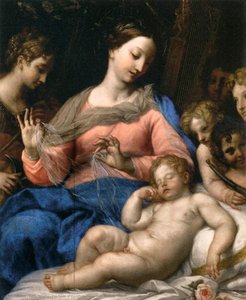
Hovedsakelig i Bavarian State Painting Collections (München), Museo del Prado (Madrid) og Statens Museum for Kunst (København). Museumslisten ovenfor viser alle.

I hvilken periode malte Carlo Maratta sine mest kjente malerier?Avslør svaret

I 1660s: 18 av de 100 verkene på denne siden ble laget da, The Flight into Egypt av dem.

Hvilket kjent maleri av Carlo Maratta er det eldste, og hvilket er det nyeste?Avslør svaret

På denne siden er det eldste Portrait of a Cardinal (Barberini) (1650) og det nyeste Assumption of Mary (1713).

Hvilke motiver foretrakk Carlo Maratta?Avslør svaret

Woman (38), Man (22) og Clouds (18), fordelt på 100 verk på denne siden.

Hvilke materialer brukte Carlo Maratta mest av?Avslør svaret

Oil On Canvas, for 36 av de 100 verkene på denne siden.

Hvilken kunstretning tilhører verkene til Carlo Maratta?Avslør svaret

Baroque, basert på originalene på denne siden.

Hvilke originalverk av Carlo Maratta kan jeg se på Bavarian State Painting Collections?Avslør svaret

The Vanity of the Earthly, Depiction in the Temple og Sleeping, Naked Child: Bavarian State Painting Collections, München har 11 av verkene på denne siden.

Carlo Maratta: et portrett av kunstneren

Carlo Maratta: The Quintessential Classicizing Baroque

Carlo Maratta, often known as Maratti, stands as a pivotal figure in 17th-century Italian painting, embodying the transition from the High Baroque to a more refined and classically inspired aesthetic. Born on May 15, 1625, in Camerano, within the Papal States—now part of Italy—his artistic journey began with an early move to Rome at the age of eleven. This relocation proved transformative, as he entered the studio of Andrea Sacchi, a painter renowned for his measured compositions and commitment to classical ideals. Sacchi’s influence would profoundly shape Maratta's developing style, instilling in him a dedication to clarity, balance, and a restrained emotionalism that distinguished him from more flamboyant Baroque contemporaries. This apprenticeship wasn’t merely technical training; it was an immersion into a philosophical approach to art, one prioritizing intellectual rigor and harmonious design over dramatic spectacle. He absorbed these principles, yet he wouldn't remain solely within their confines, demonstrating a remarkable ability to synthesize classical foundations with the prevailing currents of Baroque sensibility.
  • Early Life and Education:
  • The Studio of Andrea Sacchi: Shaping Maratta’s Style
  • A Flourishing Career in Rome: Patronage and Prestige
  • Synthesis of Styles: Classical Ideals Embraced with Baroque Sensibility
  • Legacy and Influence: An Enduring Artistic Vision

The Studio of Andrea Sacchi: Shaping Maratta’s Style

Maratta's formative years were spent under the tutelage of Andrea Sacchi, a painter whose artistic philosophy mirrored Maratta’s own. Sacchi championed a style characterized by meticulous observation and careful execution—a deliberate contrast to the exuberant theatricality favored by many Baroque artists. This mentorship instilled in Maratta a profound respect for proportion, perspective, and idealized beauty, elements that would become hallmarks of his oeuvre. Sacchi's insistence on restraint and intellectual contemplation served as an anchor against the excesses of the era, guiding Maratta toward a style rooted in humanist ideals—a cornerstone of classical art. The influence extended beyond mere technique; Sacchi instilled in Maratta a belief that painting should elevate the intellect alongside the senses, reflecting a broader cultural preoccupation with reason and order.

A Flourishing Career in Rome: Patronage and Prestige

By the mid-1650s, Maratta’s talent swiftly gained recognition, attracting commissions from prominent Roman families and, crucially, the papacy itself. This sustained papal support wasn't merely a matter of financial stability; it positioned him at the very heart of Rome’s artistic and cultural life—a circumstance that fostered collaboration with leading intellectuals and architects. Over six decades, he received patronage from no fewer than six popes—a testament to his artistic prowess and astute political maneuvering. This consistent papal backing enabled Maratta to undertake ambitious projects, securing him a place among the most celebrated painters of his time. His works adorned churches and palaces throughout Rome, showcasing not only his artistic skill but also his ability to navigate the complex social landscape of the Baroque court.

Synthesis of Styles: Classical Ideals Embraced with Baroque Sensibility

Maratta’s distinctive style—often termed “classicizing Baroque”—represents a masterful reconciliation between two artistic traditions. While deeply indebted to Raphael and other classical masters, he skillfully incorporated elements of Baroque dynamism and theatricality. He achieved this balance through meticulous attention to detail, employing subtle gradations of light and shadow to create an illusionistic depth that captivated viewers—a technique honed during his apprenticeship with Sacchi. Unlike many Baroque painters who prioritized emotional expression above all else, Maratta sought harmony between intellect and feeling, producing images that were both aesthetically pleasing and intellectually stimulating. This approach is evident in works such as *The Mystery of the Trinity Revealed to St. Augustine*, where classical idealism blends seamlessly with Baroque grandeur.

Legacy and Influence: An Enduring Artistic Vision

Maratta’s contribution extended beyond creating individual masterpieces; he established a stylistic paradigm that resonated throughout the 18th century, influencing generations of artists. His emphasis on clarity, balance, and harmonious composition—principles championed by Giovanni Bellori—became foundational to Neoclassical art. He remains a significant figure for understanding the evolution of Italian painting and its enduring legacy on Western artistic tradition. Today, his paintings can be found in museums worldwide, ensuring that his artistic vision continues to inspire and captivate audiences for years to come. His influence is palpable in the works of artists who followed him, demonstrating the lasting impact of a painter who successfully bridged two eras—a true innovator within the context of Baroque art history.