Portrett av Altobello Melone

Altobello Melones malerier: De 13 mest kjente, sett gjennom et galleris øyne

Oppdatert November 2026 · rangert etter vår popularitetsscore (søk, besøk og bestillinger for hvert verk) · 13 verk av Altobello Melone i vår katalog

Kort fortalt

Etter galleriets vurdering er Altobello Melones mest kjente maleri The Transfiguration (1512), hvis original henger i Szépművészeti Múzeum, Budapest. Portrait of Alda Gambara (1515) og Tobias and the Angel (1521) fullfører trioen som alle kjenner igjen. Av de 13 verkene til Altobello Melone i vår katalog, presenterer galleriet de 13 mest kjente nedenfor; hvert originalverk med årstall, museum og hva som gjør det unikt.

1485 – 1543, Cremona Renaissance Flest verk: Szépművészeti Múzeum

Galleriets 10 beste malerier av Altobello Melone

1
The Transfiguration (1512) av Altobello Melone

The Transfiguration

1512 · Szépművészeti Múzeum, Budapest

Created in 1512, The Transfiguration represents a significant moment in the career of Altobello Melone. Born in Cremona, Italy, Melone developed a style that bridged the gap between the harmonious traditions of the Lombard school and the emerging complexities of Mannerism. This specific work reflects the artist's ability to navigate these shifting aesthetic currents, moving toward a more sophisticated use of light and shadow to define form and presence.

2
Portrait of Alda Gambara (1515) av Altobello Melone

Portrait of Alda Gambara

1515 · Oil On Canvas · Pinacoteca di Brera, Milano

To stand before this portrait is to step directly into the opulent, yet intensely private world of the early sixteenth century Italian aristocracy. Altobello Melone’s depiction of Alda Gambara is far more than a mere likeness; it is a carefully constructed tableau vivant, rich with the textures of wealth and the weight of societal expectation. The subject herself commands attention with her direct, serious gaze—an arresting look that seems to…

3
Tobias and the Angel (1521) av Altobello Melone

Tobias and the Angel

1521 · Oil On Panel · Ashmolean Museum, Oxford

Altobello Melone's “Tobias and the Angel,” painted in 1521, is a captivating testament to the flourishing artistic spirit of the Italian Renaissance. This exquisite oil-on-panel painting, now residing within the Ashmolean Museum’s collection in Oxford, offers a profound meditation on faith, protection, and innocence through its meticulously rendered figures and evocative use of color and light. Measuring 112 x 48 cm, the artwork immediately draws the viewer into a scene…

4
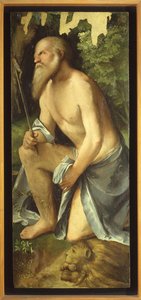
Saint Jerome (1512) av Altobello Melone

Saint Jerome

1512 · Oil On Panel · Castelvecchio Museum, Verona

In the quiet intensity of Altobello Melone’s Saint Jerome, we are invited into a moment of profound spiritual introspection. Painted around 1512, this evocative panel serves as a window into the soul of one of Christianity's most revered scholars. The saint is depicted not in the grandeur of a cathedral, but grounded in the raw, natural world, his nakedness symbolizing a stripping away of worldly vanity to reveal the pure…

5
Massacre of the Innocents (1517) av Altobello Melone

Massacre of the Innocents

1517 · Fresco · Katedralen i Cremona, Cremona

The Massacre of the Innocents is a significant fresco executed by Altobello Melone. This work is situated within the Cremona Cathedral, where it forms part of a larger, cohesive decorative program. It is one of seven scenes realized by the artist to illustrate the Life of Mary and Christ. Through this specific narrative, Melone contributes to the sacred storytelling that lines the walls of the cathedral's nave.

6
Flight to Egypt (1517) av Altobello Melone

Flight to Egypt

1517 · Katedralen i Cremona, Cremona

The painting Flight to Egypt by Altobello Melone is a remarkable work of art that showcases the artist's skill and attention to detail. Created in 1517, this fresco painting is located in the Cathedral of Cremona, Italy and depicts a scene from Christian art history, where Mary, Joseph, and baby Jesus are on their journey into Egypt to escape Herod's slaughter of infants. Composition and Symbolism The painting is rich…

7
Christ Carrying the Cross (1515) av Altobello Melone

Christ Carrying the Cross

1515 · Fresco · National Gallery, London

In the quiet corridors of The National Gallery in London, there exists a window into the turbulent soul of the High Renaissance—Altobello Melone’s Christ Carrying the Cross. Painted around 1515, this masterpiece is far more than a mere religious illustration; it is a profound psychological drama captured in pigment. As the viewer approaches, they are immediately struck by the sheer emotional weight of the scene. Christ, bearing the heavy timber…

Altobello Melone sine malerier, rangert fra 11 til 13

Altobello Melones berømte malerier, periode for periode

Motivene som fanget Altobello Melones blikk

De fire motivene som går igjen hyppigst i disse originalverkene, hver med sitt fremste eksempel.

Museene som har Altobello Melones originalverk

De 8 museene som innehar flest av maleriene på denne siden.

Museum By Verker av Altobello Melone Malerier fra denne listen
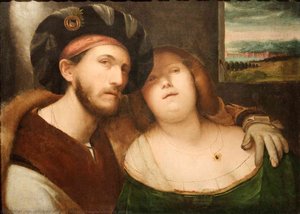
Szépművészeti Múzeum, BudapestSzépművészeti Múzeum Budapest 2 The Transfiguration, A loving couple, altobello melone
Katedralen i Cremona, CremonaKatedralen i Cremona Cremona 2 Massacre of the Innocents, Flight to Egypt
National Gallery, LondonNational Gallery London 2 Christ Carrying the Cross, The Road to Emmaus
Pinacoteca di Brera, MilanoPinacoteca di Brera Milano 1 Portrait of Alda Gambara
Ashmolean Museum, OxfordAshmolean Museum Oxford 1 Tobias and the Angel
Castelvecchio Museum, VeronaCastelvecchio Museum Verona 1 Saint Jerome
Harvard Art Museums, CambridgeHarvard Art Museums Cambridge 1 Portrait of a young Man
Städel Museum, FrankfurtStädel Museum Frankfurt 1 Narcissus at the Fountain

Altobello Melone, årets signaturmalerier

Noen ti år, fra 1512 til 1521, var nok for Altobello Melone: galleriet går gjennom dem år for år, ett berømt originalverk etter det andre.

Verk per år

Velg et år for å se originalverkene.

Altobello Melones malerier: galleriets svar

Hvilket maleri av Altobello Melone er det mest kjente av alle?Avslør svaret

The Transfiguration (1512), Szépművészeti Múzeum, Budapest. Deretter følger Portrait of Alda Gambara (1515) og Tobias and the Angel (1521).

Hvor gammel var Altobello Melone da The Transfiguration ble ferdigstilt?Avslør svaret

27 år gammel: The Transfiguration er fra 1512, og Altobello Melone ble født i 1485.

Hvilke er de 10 beste maleriene til Altobello Melone?Avslør svaret

The Transfiguration, Portrait of Alda Gambara, Tobias and the Angel, Saint Jerome, Massacre of the Innocents, Flight to Egypt, Christ Carrying the Cross, Portrait of a young Man, Narcissus at the Fountain og The Journey of Saint Helen to Jerusalem in Search of the True Cross.. Rangeringen ovenfor viser årstall og museum for hvert verk.

Hvor mange verk skapte Altobello Melone?Avslør svaret

Vår katalog inneholder 13 verk av Altobello Melone, datert fra 1512 til 1521.

Hvor henger de mest kjente originalverkene til Altobello Melone?Avslør svaret

Hovedsakelig i Szépművészeti Múzeum (Budapest), Katedralen i Cremona (Cremona) og National Gallery (London). Museumslisten ovenfor viser alle.

Når malte Altobello Melone sine mest kjente malerier?Avslør svaret

I 1512: 2 av de 13 verkene på denne siden ble laget da, The Transfiguration av dem.

Hvilke er Altobello Melones tidligste og nyeste berømte verk?Avslør svaret

På denne siden er det eldste The Transfiguration (1512) og det nyeste Tobias and the Angel (1521).

Hvilke motiver vendte Altobello Melone oftest tilbake til?Avslør svaret

Man (3), Men (3) og Religious art (2), fordelt på 13 verk på denne siden.

Hvilket medium arbeidet Altobello Melone mest med?Avslør svaret

Oil On Panel, for 2 av de 13 verkene på denne siden.

Hvilken kunstretning er Altobello Melone tilknyttet?Avslør svaret

Renaissance, basert på originalene på denne siden.

Hvilke originalverk av Altobello Melone har Szépművészeti Múzeum i sin samling?Avslør svaret

The Transfiguration og A loving couple, altobello melone: Szépművészeti Múzeum, Budapest har 2 av verkene på denne siden.

Altobello Melone: kunstneren

The Renaissance Visionary of Cremona

In the heart of the Italian Renaissance, amidst the vibrant cultural resurgence of Cremona, the name Altobello Melone emerges as a profound bridge between the harmonious traditions of Lombardy and the burgeoning complexity of Mannerism. Born around 1491, Melone’s early life was shaped by the intellectual currents of his era, particularly the humanist ideals flowing from Ferrara under the influence of Cesare Borgia. This exposure to classical aesthetics provided the foundational bedrock upon which he would build a career defined by both meticulous detail and an expressive, almost restless, grandeur. His artistic journey was not merely a solitary pursuit but a deep immersion into the stylistic evolution of Northern Italy, where the grace of the High Renaissance began to yield to the more dramatic and elongated forms of the later sixteenth century.

The development of Melone’s unique hand is inextricably linked to the mentorship of Girolamo Romanino. It was through this connection that Melone absorbed a sense of monumental scale and an ability to imbue frescoes with a palpable, living energy. While his early training focused on the precision and balanced compositions characteristic of the Lombard school, he gradually moved toward a more sophisticated use of light and shadow. This transition is nowhere more evident than in his mastery of chiaroscuro, a technique that allowed him to sculpt figures out of darkness, lending his religious narratives a sense of profound psychological depth and physical presence.

Masterworks and Monumental Commissions

The true measure of Melone’s legacy lies in the monumental scale of his public works, most notably his ambitious contributions to the Cremona Cathedral. Beginning in December 1516, Melone undertook a massive fresco cycle that sought to surpass the established greatness of Boccaccio Bicentino. This endeavor was more than a mere commission; it was a bold artistic statement that solidified his reputation as a master of large-scale narrative painting. Within these sacred walls, works such as Flight to Egypt (1517) showcase his ability to weave complex symbolism with the tender, humanized depictions of Mary and Joseph, creating scenes that are as much about divine grace as they are about earthly journeying.

Beyond the cathedral, Melone’s oeuvre is scattered across the Lombardy region, leaving behind a trail of masterpieces that continue to captivate the modern eye. His ability to navigate different artistic modes allowed him to produce works of varying emotional intensities:

  • The Lamentation: Housed in the prestigious Brera Art Gallery, this work exemplifies his capacity for profound sorrow and dramatic composition.
  • Christ Carrying the Cross: A striking example of his 1515 period, where the use of light creates a hauntingly dramatic atmosphere.
  • The Road to Emmaus: A vibrant display of his Mannerist tendencies, capturing movement and interaction through a more fluid, expressive lens.
  • The Seven Scenes: Adorning the chapel of Saint Lorenzo in Brescia, these frescoes demonstrate his skill in large-scale storytelling and architectural integration.

Legacy and Historical Significance

Altobello Melone did not exist in a vacuum; he was a central node in a dynamic creative network that shaped the Cremonese art scene. Through collaborations with artists like Giovanni Francesco Bembo and Paolo da Drizzona, he helped foster an environment where stylistic innovation could flourish. His influence extended to the next generation of painters, most notably Francesco Prata, who absorbed Melone’s vision of expressive gestures and classical themes. This lineage ensured that the specific nuances of the Cremonese style—a blend of Lombard precision and Mannerist drama—would persist through the sixteenth century.

Today, Melone is remembered not just as a painter of religious devotion, but as a pivotal figure who navigated the transition between two great eras of Italian art. His work remains a testament to a period of intense experimentation, where the stability of the Renaissance was beginning to fracture into the beautiful, distorted, and emotionally charged world of Mannerism. To study Melone is to witness the very moment when the classical ideal met the human impulse for drama, leaving an indelible mark on the history of European painting.