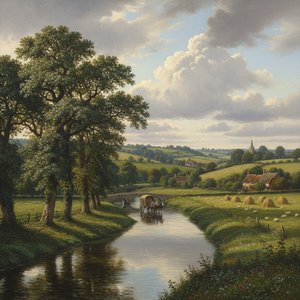
A classical landscape (William Linton)
William Linton (1791–1876) har skapt A classical landscape.

 Forhåndsvisning

 Håndmalt oljemaleri
 Send
 Del
 Faktablad for elever


 Last ned bilde
 Liknende objekter
 Røntgenundersøkelse
 Lysbildefremvisning
 Spørsmål og svar

 Statistikk
A classical landscape, kort fortalt
- Tittel
- A classical landscape
- Kunstner
- William Linton (1791–1876)
- Kunstner født i
- Liverpool, United Kingdom
- Motiv
- landscape
Høyoppløselige bilder av A classical landscape
Fritlig eiendom: kunstneren døde i 1876.
William Linton, A classical landscape. Fri tilgjengelighet
Spørsmål om A classical landscape, besvart
Hva forestiller "A classical landscape" av William Linton?
Temaene i "A classical landscape" av William Linton inkluderer landscape. Sammen oppsummerer de verkets motiv.
Er "A classical landscape" fri for opphavsrett?
"A classical landscape" av William Linton er fritt tilgjengelig – opphavsretten har utløpt. Denne statusen avgjør hvordan bildet av verket kan reproduseres.
Hvem har skapt "A classical landscape"?
"A classical landscape" ble skapt av William Linton. Informasjonen på denne siden beskriver William Linton sitt originale verk.
Hva er årsaken til opphavsrettssituasjonen for "A classical landscape" av William Linton?
Opphavsrettslig status for "A classical landscape" – fritt tilgjengelig – opphavsretten har utløpt – følger av kunstnerens dødsår, 1876.
Om kunstneren, William Linton

1791–1876, United Kingdom
William Linton
The Romantic Visionary of Classical Landscape William Linton, born in the maritime atmosphere of Liverpool in 1791, emerged as a pivotal figure in British landscape painting during the Victorian era—a period defined by a profound fascination with both scientific observation and idealized beauty. His artistic journey began not with the grand gestures of a master, but through the humble and disciplined practice of copying the works of legends like Claude Lorrain and Richard Wilson. These early encounters were transformative, instilling in Linton a deep-seated appreciation for the interplay of natural light and the sweeping grandeur of panoramic compositions. This foundational period shaped his distinctive style, allowing him to weave classical sensibilities into the fabric of 19th-century Romanticism.
Andre verk av William Linton
 Cottages By A River
 The Bathing Pool
 View Of Edinburgh; And View Of Stirling
 An Italianate Landscape, With Peasants And Livestock In The Foreground
Essays om A classical landscape
 British Landscapes: The Enduring Spirit of the Countryside in Art and Interior DesignExplore the mastery of British landscape art from Constable to Cartlidge. Discover timeless beauty for your home today.
 John Constable: Nature, Light & the Romantic Vision of Rural EnglandExplore the life & art of John Constable, the Romantic painter who revolutionized landscape with emotive scenes of rural England. Discover …
 Atmospheric Vistas: A Study of Notable Landscape CompositionsExplore a masterclass on atmospheric landscapes from Patinir to Monet. Discover the evolution of light and texture in art history.