
 Forhåndsvisning
 Send
Send Del
Del
 Vis detaljer
 Utskriftsvennlig guide

 Last ned bilde
 Liknende objekter
 Røntgenundersøkelse
 Lysbildefremvisning
 Spørsmål og svar
 Statistikk
Friedrich rauert

 Vis hele teksten
Giclée / Kunsttrykk
Giclée- eller lerretsprint av museumskvalitet med rask produksjon og fleksible valgmuligheter for etterbehandling. ( Kjøp håndmalt maleri Bytt til digitalt bilde)




































Velg mellom våre forhåndsdefinerte størrelser som bevarer kunstverkets opprinnelige proporsjoner.

Skriv inn ønsket bredde og høyde for å tilpasse trykket til din ramme eller vegg. Et trykk kan kun beskjæres, aldri skaleres opp utover motivets opprinnelige størrelse, noe som betyr at et format med andre proporsjoner vil føre til tap av deler av bildet. Vi sender deg en digital mockup for godkjenning før vi starter trykkeprosessen. Bildet som vises på denne siden viser ikke den faktiske beskjæringen — det er kun mockuppen som viser dette.
Verdensomspennende levering () på 2 uker i stedet for standard 4/5 uker. (5 November)

Gratis ekspressfrakt over hele verden

Lerretsduk av lin av høy kvalitet

Full transportforsikring

Garanti for refusjon av toll og importavgifter

Garantert fargegjengivelse

100 dagers returrett ved fabrikasjonsfeil

100% pengene tilbake-garanti

Rabatt ved flere kjøp
 Glassalternativet er kun tilgjengelig i størrelser under 110 cm

Friedrich rauert
Giclée / Kunsttrykk
Størrelse på reproduksjon
-


Totalpris for valgte alternativer
Nkr 776
Om kunstneren
A Life Rooted in Realism: Wilhelm Leibl and the Depiction of Bavarian Existence
Wilhelm Maria Hubertus Leibl, born in Cologne in 1844, emerged as a pivotal figure in German painting during a period grappling with artistic identity. His father’s position as director of the cathedral choir instilled an early appreciation for discipline and form, yet Leibl's path wasn’t immediately destined for canvas. An apprenticeship to a locksmith preceded his formal artistic training under Hermann Becker in 1861, signaling a pragmatic grounding before embracing creative pursuits. This initial experience perhaps contributed to the solidity and directness that would later characterize his work. In 1864, he entered the Munich Academy, immersing himself in the established art world but soon seeking alternatives to prevailing Romantic sensibilities. His studies with artists like Carl Theodor von Piloty provided technical foundation, yet it was the arrival of Gustave Courbet in Munich around 1869 that proved truly transformative.The Influence of Courbet and the Pursuit of ‘Alla Prima’
Courbet's exhibition and demonstrations of *alla prima* painting – working directly from nature with bold, immediate brushstrokes – resonated deeply with Leibl and a cohort of young German artists. This approach liberated them from the meticulous academic style then dominant, encouraging a more visceral connection to their subjects. Leibl’s existing admiration for Dutch Old Masters, particularly their mastery of light and character, found new expression through Courbet's influence. His paintings began to loosen in style, embracing thicker applications of paint against darker backgrounds, capturing fleeting moments with an unprecedented immediacy. A brief sojourn to Paris in 1869, facilitated by Courbet’s suggestion, introduced Leibl to Édouard Manet, further broadening his artistic horizons. However, the outbreak of the Franco-Prussian War forced a premature return to Germany in 1870, curtailing what might have been an extended period of Parisian immersion.Bavarian Landscapes and the Essence of Peasant Life
In 1873, Leibl deliberately retreated from Munich’s artistic center, seeking solitude and authenticity in the isolated Bavarian countryside. This marked a turning point in his career. He dedicated himself to depicting the lives of local peasants, not with romanticized idealization, but with unflinching realism. He eschewed sentimentality or anecdotal storytelling, instead focusing on capturing the dignity and hardship inherent in their daily existence. The sketchlike quality of his earlier works gave way to greater precision and a meticulous attention to drawing. Living in Berbling from 1878 to 1882, he produced some of his most celebrated paintings, including Three Women in Church, now housed at the Kunsthalle Hamburg. This masterpiece exemplifies his intensely realistic style, recalling the clarity and psychological depth of Hans Holbein.A Legacy of Realism: The Leibl Circle and Lasting Impact
Leibl’s commitment to representing reality as he perceived it – without embellishment or pretense – earned him recognition as a leading figure in German art. He became the central influence for a group known as the “Leibl-Kreis” (Leibl Circle), which included artists such as Carl Schuch, Wilhelm Trübner, Otto Scholderer, and Hans Thoma. These artists shared Leibl’s dedication to realism and his rejection of academic conventions. He painted directly with color, without preliminary drawings, a technique paralleling the innovations of Impressionism while remaining firmly rooted in observational accuracy. His later works, created during periods living in Bad Aibling and Kutterling, demonstrated a refined balance between disciplined drawing and a newfound luminosity. Wilhelm Leibl died in Würzburg in 1900, leaving behind a body of work that continues to resonate for its honesty, technical mastery, and profound empathy for the lives of ordinary people. His paintings stand as powerful testaments to the beauty and dignity found within the everyday realities of Bavarian existence.
Wilhelm Maria Hubertus Leibl
1844 - 1900 , Germany
Kort om kunstneren
- Full Name: Wilhelm Maria Hubertus Leibl
- Nationality: German
- Date Of Birth: 1844
- Date Of Death: 1900
- Place Of Birth: Cologne, Germany
- Notable Artworks:
- Three Women in Church
- Friedrich rauert
- The spinner
- In der Bauernstube
- Artistic Movement Or Style: Realism
- Artists Who Influenced This Artist:
- Gustave Courbet
- Hans Holbein
- Artists Or Movements Influenced By This Artist: ['Leibl Circle']
Relaterte artikler
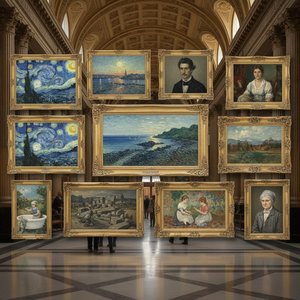
1800-tallets Mesterverk: 10 Kunstverk som Definerer Epoken – OriginalUniqueArt.no
Opplev 1800-tallets kunst gjennom 10 ikoniske mesterverk! Fra romantikk til impresjonisme – lær om Munch, Van Gogh og Monet. Finn museumskvalitets reproduksjoner & interiørinspirasjon på OriginalUniqueArt.com. Utforsk samlingen online!

The Timeless Charm of Oil on Board: Reimagining Texture and Light through the Impressionist Lens
Discover the profound intimacy of oil on panel. Explore how Impressionist masters used rigid supports to capture light, texture, and impasto depth through exquisite, handmade oil reproductions for discerning collectors.

Oil on Canvas: A Historical & Technical Exploration of a Timeless Artistic Medium
Explore the rich history & enduring techniques of oil painting on canvas. Discover the science behind its longevity, conservation practices, and contemporary relevance. Expert insights for art enthusiasts.

The Enduring Power of Painting: A Historical & Contemporary Exploration of Form and Emotion
Explore the rich history & enduring techniques of oil painting with OriginalUniqueArt. Discover masterpieces, learn about art collecting, and find authentic handmade reproductions crafted by skilled artists.

The Enduring Legacy of Oil on Canvas: Technique, History & Aesthetic Impact
Explore the rich history & techniques of oil painting – from Renaissance masters to Impressionism. Discover pigments, layering methods, and why this timeless medium endures. Expert insights for artists & art enthusiasts.
