Bytt til trykk
 Vis hele teksten







































 For kunstverk eller reproduksjoner som er større enn 105 cm (ca. 41 tommer) på noen side, vil rammen bli sendt som et sett som må monteres. Denne metoden sikrer trygg levering og forhindrer skader under transport.


A Window into Edo Tranquility: Examining Hiroshige’s “Akasaka, No. 37”
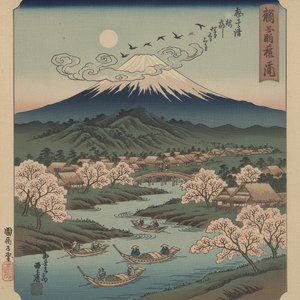
Utagawa Hiroshige's "Akasaka, No. 37," part of the celebrated *Fifty-three Stations of the Tokaido*, transcends mere depiction; it embodies a profound poetic vision of Edo Japan—the capital city during the Tokugawa shogunate’s reign. This meticulously crafted woodblock print captures a moment of everyday life within a beautifully rendered landscape, offering viewers an unparalleled glimpse into the aesthetic sensibilities of its time. Produced around 1847/52, “Akasaka” exemplifies Hiroshige's mastery of *ukiyo-e*, transforming observation into artful expression.The Landscape as Meditation
Hiroshige’s genius lies in his ability to distill the essence of Japanese landscape painting—known as *sumōka*—into a single image. The scene unfolds within Akasaka, one of the stations along the Tokaido highway connecting Edo and Kyoto, presenting a serene vista dominated by lush foliage and distant mountains. Unlike earlier landscapes that prioritized grandeur and dramatic vistas, Hiroshige favors subtlety and atmospheric perspective. Notice how he employs tonal gradation—the careful layering of colors to create depth—to convey the coolness of autumn air and the misty haze characteristic of this region. This technique wasn’t merely stylistic; it reflected a broader philosophical preoccupation with capturing the ephemeral beauty of nature and fostering contemplation.Detailed Composition & Symbolism
The print's composition is deliberately balanced, guiding the viewer's eye across the scene. A small group of figures—likely travelers or locals—are positioned amidst the trees, adding human scale to the expansive landscape. The placement of chairs and tables within a room subtly reinforces the idea of domestic tranquility juxtaposed with the grandeur of the natural world. These elements aren’t accidental; Hiroshige consciously incorporated symbolic gestures that resonated with Edo society's values – harmony, respect for tradition, and appreciation for seasonal beauty. The distant mountains symbolize permanence and stability, anchoring the fleeting presence of human activity within a timeless framework.Technique & Impressionistic Influence
Hiroshige’s meticulous attention to detail—evident in the rendering of individual leaves and branches—is characteristic of *ukiyo-e* craftsmanship. However, his approach differs significantly from earlier prints, anticipating the stylistic innovations of Impressionism. Hiroshige prioritized capturing fleeting impressions rather than striving for photographic realism. He achieved this through rapid brushwork and a focus on color harmonies that prioritize mood and atmosphere over precise representation. This pioneering technique undeniably influenced artists like Claude Monet and Vincent van Gogh, establishing Hiroshige as an important precursor to Western modern art.A Legacy of Beauty & Emotion
“Akasaka, No. 37” continues to captivate audiences today not only for its aesthetic qualities but also for the profound emotional resonance it evokes. It invites us to pause and appreciate the quiet grandeur of Edo Japan—a world striving for balance amidst rapid change. Reproductions of this iconic print offer a tangible connection to artistic history, allowing collectors and interior designers alike to infuse their spaces with the spirit of Hiroshige’s enduring vision.Spørsmål og svar
Hvilken stemning formidler Ukiyo-e-verket "Akasaka, No. 37"?
Den Calm stemningen i "Akasaka, No. 37" ledsager dens Ukiyo-e-stil.
Finnes det et faktablad om "Akasaka, No. 37" av Utagawa Hiroshige for studenter?
Faktablad for studenter-siden for "Akasaka, No. 37" av Utagawa Hiroshige tilbyr et utskrivbart faktaark på to sider: kunstverket med sin identitetstabell, en tidslinje som plasserer det i kunstnerens levetid, andre verk av kunstneren, den målte fargepaletten og ferdigformaterte kildehenvisninger i fire stiler.
Hvor plasserer "Akasaka, No. 37" seg i Utagawa Hiroshige sitt samlede kunstnerskap?
"Akasaka, No. 37" deler med Utagawa Hiroshiges andre verk sin Ukiyo-e-stil og de gjentakende temaene: ukiyo-e tradition, edo period life, social scenes depicted, japanese daily routines, hiroshige's landscapes, tokaido journey theme, woodblock printing technique, popular art form".
 Forhåndsvisning
 Send
Send Del
Del
 Vis detaljer
 Utskriftsvennlig guide

 Last ned bilde
 Liknende objekter
 Røntgenundersøkelse
 Lysbildefremvisning
 Q&A
Q&A Statistikk