Romanticism
A gun crew (Thomas Stothard)
Thomas Stothard (1755–1834) har skapt A gun crew. Det tilhører Romanticism-bevegelsen. Laget i Oil On Canvas.
- Oil On Canvas

 Forhåndsvisning

 Håndmalt oljemaleri
 Send
 Del
 Faktablad for elever


 Last ned bilde
 Liknende objekter
 Røntgenundersøkelse
 Lysbildefremvisning
 Spørsmål og svar

 Statistikk
A gun crew, kort fortalt
- Tittel
- A gun crew
- Kunstner
- Thomas Stothard (1755–1834)
- Kunstner født i
- London, Storbritannia
- Materiale
- Oil On Canvas
- Bevegelse
- Romanticism
- Tidsperiode
- 19th Century
- Motiv
- maritime struggle, shipwreck rescue, human resilience, dramatic coastline, 18th century seafaring, historical labor
Hva forestiller A gun crew?
The Subject and Artist of the Work
In the dramatic scene of A gun crew, the viewer finds themselves amidst a chaotic struggle on a rugged, rocky shore. Sailors strain with every ounce of their strength, their bodies leaning into the heavy weight of a massive object—perhaps a piece of a shipwreck or a heavy fragment of debris—as they attempt to haul it from the sea. The air feels thick with the exertion of these men, caught in a moment of intense physical toil against the unyielding elements. This struggle highlights the sheer hardship and resilience required to survive the unpredictable nature of the ocean.
The artist behind this intense depiction is Thomas Stothard. Born in London, United Kingdom, Stothard brings a sense of narrative urgency to the canvas, focusing on the human cost of maritime life. He moves away from mere stillness to capture the very essence of desperation and the precariousness of existence at sea. Every figure in the composition seems locked in a battle against overwhelming forces, both natural and man-made, as they fight to reclaim something from the waves.
Composition and Visual Elements
The scene unfolds within a tightly packed space that pulls the viewer directly into the heart of the chaos. Figures cluster together in a frantic mass, their bodies overlapping to convey a sense of urgent, shared struggle. Every movement feels compressed, as if the very air is heavy with the effort of the men. Diagonal lines, formed by the straining ropes and the angled limbs of the sailors, cut through the frame to lead the eye toward the central point of action. This arrangement creates a feeling of immediacy, trapping the viewer within the struggle.
A flattened perspective heightens this sense of claustrophobia, making the rocky shore and the wreckage feel as though they are pressing inward. Light does not merely fall upon the scene; it seems to emanate from multiple sources, pouring down from above and glowing from within the wreckage itself. These light sources cast dramatic shadows that define the rugged textures of the environment and the straining muscles of the crew. The interplay of light and shadow emphasizes the desperation of the moment, highlighting the raw power of nature as it clashes against human resilience.
Technique and Artistic Style
The oil paint clings to the canvas with a heavy, impasto-like texture, particularly where the wreckage meets the shore. This thick application of pigment gives the scene a tactile, rugged quality, making the struggle feel physically present. The brushwork is not precise; instead, it is loose and expressive, using energetic strokes to capture the sudden movement and the chaotic energy of the sailors. Every layer of paint contributes to a sense of depth and turmoil, as if the medium itself is caught in the same upheaval as the figures on the rocks.
The style leans heavily into Romanticism, prioritizing raw emotion and the intensity of the moment over clinical realism. This emotional weight is carried by a dark and earthy color palette. Deep browns and blacks dominate the shadows, while strong, sudden bursts of red pull the eye through the darkness. Light emanates from multiple sources, appearing to glow from within the wreckage itself and from above, casting dramatic shadows that heighten the sense of urgency. The result is a scene defined by tension and the visceral power of the elements.
Høyoppløselige bilder av A gun crew
Fritlig eiendom: kunstneren døde i 1834.
Thomas Stothard, A gun crew. Fri tilgjengelighet
Spørsmål om A gun crew, besvart
Hvilken teknikk er brukt i "A gun crew" av Thomas Stothard?
Thomas Stothard brukte Oil On Canvas-teknikken i "A gun crew". Teknikken definerer det materielle uttrykket til det originale verket.
Hva forestiller "A gun crew" av Thomas Stothard?
"A gun crew" av Thomas Stothard avbilder: maritime struggle, shipwreck rescue, human resilience, dramatic coastline, 18th century seafaring, historical labor, force of nature.
Er bildet av "A gun crew" av Thomas Stothard i det frie domene?
Når det gjelder opphavsrett, er "A gun crew" fritt tilgjengelig – opphavsretten har utløpt.
Hvem er kunstneren bak "A gun crew"?
"A gun crew" ble skapt av Thomas Stothard. Informasjonen på denne siden beskriver Thomas Stothard sitt originale verk.
Hvilken stilart tilhører "A gun crew"?
"A gun crew" er et verk innenfor Romanticism. Retningen angir den kunstneriske tradisjonen verket er en del av.
Hvilken periode i Thomas Stothard sin karriere tilhører "A gun crew"?
"A gun crew" tilhører Mature Period i Thomas Stothard sin karriere. Denne klassifiseringen knytter verket til kunstnerens utvikling.
Hva er årsaken til opphavsrettssituasjonen for "A gun crew" av Thomas Stothard?
"A gun crew" av Thomas Stothard er fritt tilgjengelig – opphavsretten har utløpt. Opphavsretten beregnes fra kunstnerens dødsår, og Thomas Stothard døde i 1834.
Hvor plasserer "A gun crew" seg i Thomas Stothard sitt samlede kunstnerskap?
"A gun crew" er et verk fra Thomas Stothard sin periode innen Romanticism, der de dokumenterte temaene inkluderer classical & romantic blend, seafaring hardship depicted, humanity vs. nature's force, british maritime history, stothard's sentimental style, illustrative historical scenes, moralizing narrative art.
Er "A gun crew" typisk for det Thomas Stothard vanligvis skapte?
Blant Thomas Stothard sine dokumenterte temaer – classical & romantic blend, seafaring hardship depicted, humanity vs. nature's force, british maritime history, stothard's sentimental style, illustrative historical scenes, moralizing narrative art – retter "A gun crew" sitt eget fokus mot maritime struggle, shipwreck rescue, human resilience, dramatic coastline, 18th century seafaring, historical labor, force of nature.
Om kunstneren, Thomas Stothard

1755–1834, Storbritannia
Thomas Stothard
Thomas Stothard: Vevers av drømmer og historiske ekkoer Født i Londons pulserende hjerte i 1755, var Thomas Stothards liv en gobelin vevd av tråder fra delikat skjønnhet, kunstnerisk lærlingtid og en uforgjengelig fascinasjon for historiefortelling. Hans tidlige år var preget av skjør helse – en barndom tilbrakt i stor grad borte fra hjemmet på grunn av sin sårbarhet – men denne perioden fostret i ham en dyp verdsettelse for den stille kontemplasjonen som senere skulle prege hans kunst. Han begynte sin kunstneriske reise som mønstertegner for brokadert silke, en ferdighet som ga ham et skarpt øye for detaljer og en dyp forståelse for tekstur og farge – kvaliteter han senere overførte til sine berømte illustrasjoner. Stothards formelle utdanning begynte ved Royal Academy i 1778, et avgjørende øyeblikk som drev ham mot en karriere dedikert til visuell narrativ.
Andre verk av Thomas Stothard
 The Supper by the Fountain1820
 Portrait Of General Francis Marion )1732
 The Return of Othello, 'Othello,' Act II, Scene II1799
 The Horrors of War, Sketch for Burghley House Mural1800
Essays om A gun crew
 Emotion vs. Observation: A Guide to Romanticism and RealismMaster the differences between Romanticism and Realism through expert analysis. Discover the art of emotion versus observation now.
 Echoes of Conflict: A Curated Exploration of Art Capturing the Intensity of War and Human ResilienceExplore a profound collection of historical war art. From visceral realism to poignant depictions of human resilience, discover museum-qual…
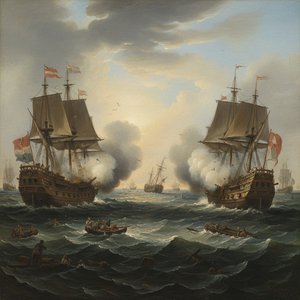 Masterpieces of Maritime Warfare: The Artistry and Intensity of Naval Combat in Historical PaintingExplore the dramatic intensity of naval combat through art history. From Romanticism to classical maritime masterpieces, discover how legen…