Send
Send Del
Del
 Vis detaljer
 Utskriftsvennlig guide

 Last ned bilde
 Liknende objekter
 Lysbildefremvisning
 Spørsmål og svar
 Statistikk
Miraculous Mass (scene 7)

- 390.0 x 200.0 cm


 Vis hele teksten
Giclée / Kunsttrykk
Giclée- eller lerretsprint av museumskvalitet med rask produksjon og fleksible valgmuligheter for etterbehandling. ( Kjøp håndmalt maleri Bytt til digitalt bilde)




































Velg mellom våre forhåndsdefinerte størrelser som bevarer kunstverkets opprinnelige proporsjoner.

Skriv inn ønsket bredde og høyde for å tilpasse trykket til din ramme eller vegg. Et trykk kan kun beskjæres, aldri skaleres opp utover motivets opprinnelige størrelse, noe som betyr at et format med andre proporsjoner vil føre til tap av deler av bildet. Vi sender deg en digital mockup for godkjenning før vi starter trykkeprosessen. Bildet som vises på denne siden viser ikke den faktiske beskjæringen — det er kun mockuppen som viser dette.
Verdensomspennende levering () på 2 uker i stedet for standard 4/5 uker. (7 November)

Gratis ekspressfrakt over hele verden

Lerretsduk av lin av høy kvalitet

Full transportforsikring

Garanti for refusjon av toll og importavgifter

Garantert fargegjengivelse

100 dagers returrett ved fabrikasjonsfeil

100% pengene tilbake-garanti

Rabatt ved flere kjøp
 Glassalternativet er kun tilgjengelig i størrelser under 110 cm

Miraculous Mass (scene 7)
Giclée / Kunsttrykk
Størrelse på reproduksjon
-


Totalpris for valgte alternativer
Nkr 775
The Composition of the Fresco
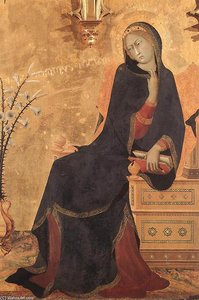
In the middle level of the San Martino Chapel within the Lower Church of San Francesco in Assisi, the fresco Miraculous Mass (scene 7) presents a religious narrative through a precise arrangement of figures and objects. Two men dressed in robes occupy the central space. One figure holds a cross while the other raises his hands toward the sky. The scene is set within an outdoor environment where a dining table and chairs are positioned near the subjects. Several birds are distributed across the composition, settled among the architectural and natural elements of the painting. The technique utilizes fresco, applying pigment directly onto the wet plaster of the wall to create a permanent bond with the structure.
The physical dimensions of this work measure approximately 390 x 200 cm. The artist employs a line-driven approach characteristic of the International Gothic style, utilizing flowing lines and decorative details. The color palette consists of various tones that define the folds in the robes and the textures of the surrounding setting. The arrangement of the altar cloth and candlesticks provides a structured, linear element that contrasts with the organic forms of the birds and the human figures.
Historical Context and Narrative Detail
Created around 1312, this work belongs to a larger cycle of frescoes depicting episodes from the life of Saint Martin. This specific scene depicts an event in Albenga where two angels appear during the elevation of the host to present Martin with a piece of fabric. The painting reflects the Sienese tradition of the early fourteenth century, a period marked by the influence of French manuscript illumination and ivory carving brought to Italy via the Via Francigena pilgrimage route.
The movement of the figures conveys a specific moment of transition. As the deacon reaches out toward his bishop, his gesture captures an expression of surprise. This interaction between the human subjects and the celestial elements—the appearing angels and the birds—integrates the spiritual event into a tangible, earthly setting. The work exists as part of a larger decorative program in the Cappella di San Martino, situated alongside other scenes such as the Miracle of the Resurrected Child and the Miracle of Fire.
Spørsmål og svar
Hvordan kan jeg se "Miraculous Mass (scene 7)" av Simone Martini som en lysbildefremvisning?
Se lysbildefremvisningen her: Bildekarusell for "Miraculous Mass (scene 7)" av Simone Martini.
Hva forestiller "Miraculous Mass (scene 7)", og hvilken stemning formidler den?
"Miraculous Mass (scene 7)" av Simone Martini kombinerer religious scene, fresco painting, simone martini, medieval art, cross symbolism, siena artists, courtly refinement med en Elegant atmosfære.
Er fargene i "Miraculous Mass (scene 7)" av Simone Martini mettede eller dempede?
"Miraculous Mass (scene 7)" av Simone Martini er gjengitt med en Subtle Color metning.
Om kunstneren
A Sienese Master of Elegance and Grace
Simone Martini, born around 1284 in the heart of Siena, Italy, stands as a pivotal figure in the transition from medieval to Renaissance art. He wasn’t merely a painter; he was an architect of elegance, a master of line and color who infused his works with a courtly refinement that distinguished him from contemporaries like Giotto. While historical accounts vary regarding his early training—some suggest apprenticeship under Duccio di Buoninsegna, the leading Sienese artist of the time, while others point to Florence and the influence of Giotto—Martini undeniably forged a unique artistic path. His brother-in-law, Lippo Memmi, was also an artist with whom he frequently collaborated, further enriching the vibrant artistic landscape of Siena. The city itself played a crucial role in shaping Martini’s aesthetic; Siena, a thriving center of commerce and culture, fostered an environment where art flourished, blending religious devotion with worldly sophistication.
The Flourishing of International Gothic
Martini's style is immediately recognizable for its departure from the more monumental forms favored in Florence. He embraced a delicate sensibility, characterized by flowing lines, soft decorative details, and an overall sense of grace. This aesthetic wasn’t born in isolation; it was profoundly influenced by external forces. The Via Francigena, a major pilgrimage route traversing Europe, brought with it artistic currents from France—particularly the refined elegance of French manuscript illumination and ivory carving. These influences are readily apparent in Martini's work, manifesting as intricate patterns, elongated figures, and a heightened attention to surface ornamentation. He didn’t simply copy these styles; he synthesized them with existing Sienese traditions, creating something entirely new. His paintings weren’t merely representations of religious scenes but rather elegant narratives imbued with emotional depth and visual poetry.
From Siena to Avignon: A Courtly Appointment
Martini's reputation extended beyond the borders of Italy, leading to a significant turning point in his career. In 1336, he accepted a commission from Pope Benedict XII to create frescoes for the Papal Palace in Avignon, France—a move that placed him at the heart of European power and patronage. This appointment wasn’t merely about artistic skill; it was a testament to Martini's ability to cater to the tastes of a sophisticated courtly audience. While in Avignon, he entered into a remarkable intellectual circle, befriending Francesco Petrarca—better known as Petrarch, the renowned humanist poet. The connection with Petrarch is particularly poignant, as Vasari and other sources suggest that Martini painted a portrait of Laura de Noves, Petrarch’s lifelong muse. Though the portrait itself is lost to time, its very existence speaks volumes about Martini's status as a celebrated artist capable of capturing not only physical likeness but also the essence of beauty and inspiration. The Annunciation with St. Margaret and St. Ansanus, created during his time in Florence before moving to Avignon, is a testament to this period, showcasing delicate beauty and refined aesthetic.
Key Works and Techniques
Martini’s artistic output spanned a wide range of subjects and formats, reflecting the diverse demands of his patrons and his own creative explorations. His *Maestà*, painted in 1315 for the Sienese city hall, remains one of his most celebrated works—a monumental altarpiece that exemplifies the International Gothic style’s emphasis on elegance, color, and intricate detail. The work showcases a complex narrative, blending religious symbolism with courtly splendor. Other notable paintings include *Saint Louis Crowning Robert*, a vibrant depiction of a historical event commissioned for Naples, and a series of panels illustrating the life of Saint Martin, demonstrating his mastery of both narrative and decorative elements. Martini’s use of color was particularly noteworthy—he favored rich, luminous hues that created a sense of depth and atmosphere. His meticulous attention to detail, evident in the rendering of fabrics, jewelry, and architectural settings, further enhanced the visual impact of his paintings.
Legacy and Enduring Influence
Simone Martini’s impact on the development of European art cannot be overstated. He played a crucial role in disseminating the International Gothic style—a movement characterized by its elegance, refinement, and emphasis on decorative detail—across the continent. His influence extended to generations of artists who followed, shaping the course of late medieval and early Renaissance painting. Martini’s work wasn’t simply about technical skill; it was about creating a visual language that resonated with the sensibilities of his time—a language of beauty, grace, and spiritual devotion. Even today, his paintings continue to captivate viewers with their exquisite detail, harmonious compositions, and enduring sense of elegance. His frescoes in San Francesco d’Assisi demonstrate his mastery of large-scale decorative painting, while works like the Saint Catherine of Alexandria Polyptych showcase his unparalleled command of color and form. Simone Martini died in Avignon in 1344, leaving behind a legacy that continues to inspire awe and admiration centuries later—a testament to the enduring power of art to transcend time and touch the human spirit.

Simone Martini
1284 - 1344 , Italia
Kort om kunstneren
- Artistic Movement Or Style: Internasjonalt gotikk
- Artists Or Movements Influenced By This Artist: ['Internasjonalt gotikk']
- Artists Who Influenced This Artist:
- Duccio di Buoninsegna
- Giotto
- Date Of Birth: c. 1284
- Date Of Death: 1344
- Full Name: Simone Martini
- Nationality: Italiensk
- Notable Artworks:
- Maestà
- St. Louis
- Annunciatio
- Place Of Birth: Siena, Italia
Relaterte artikler

Simone Martini: Innovation, Spirituality & Courtly Refinement in Sienese Painting
Explore the captivating world of Simone Martini, a pivotal figure in Sienese painting & the International Gothic style. Discover his innovative techniques, spiritual depth, and lasting influence on early Renaissance art.

The Enduring Legacy of Fresco: Technique, History & Artistic Expression Across Cultures
Explore the rich history & enduring legacy of fresco painting! Discover ancient techniques, Giotto's masterpieces, and modern applications. Expert insights for art lovers & professionals.

Kunsten som lever med deg: Den emosjonelle kraften i et skreddersydd interiørfresko
Utforsk den emosjonelle kraften i skreddersydde interiørfresker. Ekspertise, håndverk og tidløs skjønnhet for ditt hjem. Få et unikt kunstverk – kontakt oss!
Fresko som Familiens Arv: Bevar Historien i Veggene
Lær om freskomaleriets historie og teknikk! Oppdag ikoniske verk og få tips til bevaring. Finn din perfekte freskoreproduksjon hos – kvalitet og ekspertise garantert.
The Enduring Legacy of Fresco Painting: Techniques, History & Contemporary Relevance
Explore the rich history & enduring artistry of fresco painting – from Giotto to Michelangelo! Discover techniques, conservation efforts, & modern applications. Learn how OriginalUniqueArt brings this timeless art form to your home.