Bytt til trykk
 Vis hele teksten







































 For kunstverk eller reproduksjoner som er større enn 105 cm (ca. 41 tommer) på noen side, vil rammen bli sendt som et sett som må monteres. Denne metoden sikrer trygg levering og forhindrer skader under transport.


Primavera (Botticelli): A Celebration of Renewal
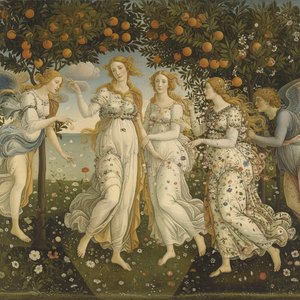
Sandro Botticelli’s *Primavera*, completed around 1482, stands as an emblem of the Florentine Renaissance and continues to captivate audiences centuries later. More than just a beautiful depiction of springtime flora—though its vibrant blossoms undeniably dominate the canvas—the painting operates on multiple levels of symbolic meaning, reflecting humanist ideals and artistic innovation.
- Subject Matter: The artwork portrays a lavish garden scene populated by mythological figures representing Venus, Zephyr, Chloris, Mercury, Juno, Flora, Cupid, and the Three Graces. These characters embody concepts of love, fertility, beauty, intellect, and divine grace—themes central to Renaissance thought.
- Style: Botticelli’s style is characterized by graceful lines, delicate coloration, and an ethereal quality that distinguishes it from earlier Florentine painting traditions. He employs a flattened perspective, prioritizing elegance and harmony over realistic representation, aligning with the influence of Neoplatonic philosophy.
- Technique: Executed in tempera paint on poplar wood—a technique favored for its durability and luminosity—*Primavera* showcases Botticelli’s meticulous attention to detail. The artist skillfully blended pigments to achieve subtle gradations of color, creating a luminous surface that captures the essence of springtime light.
- Historical Context: Created during Lorenzo de Medici's reign, *Primavera* reflects the humanist revival occurring in Florence—a period marked by renewed interest in classical learning and artistic ideals. The painting served as a visual manifesto for these intellectual currents, celebrating human potential and beauty.
The composition itself is carefully orchestrated to convey a sense of movement and balance. From right to left, the figures advance across the garden, mirroring the cyclical rhythm of seasonal change. Venus occupies the central position, radiating serenity and embodying feminine virtue—a deliberate allusion to classical mythology’s portrayal of Aphrodite as the goddess of love and beauty.
Botticelli's masterful use of color contributes significantly to the painting’s emotional impact. The dominant hues—greens, yellows, reds, and blues—evoke the vibrancy of springtime blossoms and create an atmosphere of joyous celebration. Furthermore, the idealized figures convey a profound sense of spiritual contemplation, inviting viewers to contemplate themes of renewal and harmony.
*Primavera* remains one of Botticelli’s most celebrated works, admired for its artistic brilliance and enduring symbolic resonance. Its exquisite beauty continues to inspire artists and collectors alike, cementing its place as an iconic masterpiece of the Renaissance.
Spørsmål og svar
Hvor kan jeg finne kunstverk som ligner på "Primavera (detail) (14)" av Sandro Botticelli?
Verker som ligner på "Primavera (detail) (14)" er oppført på verkets Lignende verk-side.
Hvilket medium er "Primavera (detail) (14)" av Sandro Botticelli utført i?
"Primavera (detail) (14)" er utført i Acrylic On Canvas.
Hvilken teknikk ble brukt for "Primavera (detail) (14)", og når ble den laget?
"Primavera (detail) (14)" ble skapt i 1482 med teknikken Acrylic On Canvas. Materiale og dato beskriver hvordan og når originalen ble laget.
 Forhåndsvisning
 Send
Send Del
Del
 Vis detaljer
 Utskriftsvennlig guide

 Last ned bilde
 Liknende objekter
 Røntgenundersøkelse
 Lysbildefremvisning
 Q&A
Q&A Statistikk