Pop Art · 1962
Grepet (Roy Lichtenstein, 1962)
Roy Lichtenstein (1923–1997) har skapt Grepet. Den er fra 1962. Det tilhører Pop Art-bevegelsen. Laget i Olje på lerret.
- 1962
- Olje på lerret

 Forhåndsvisning

 Håndmalt oljemaleri
 Send
 Del
 Faktablad for elever


 Last ned bilde
 Liknende objekter
 Røntgenundersøkelse
 Lysbildefremvisning
 Spørsmål og svar

 Statistikk
Grepet, kort fortalt
- Tittel
- Grepet
- Kunstner
- Roy Lichtenstein (1923–1997)
- Kunstner født i
- Manhattan, USA
- Dato
- 1962
- Materiale
- Olje på lerret
- Bevegelse
- Pop Art
- Tidsperiode
- Moderne tid
- Motiv
- hand, trumpet, red background, halftone pattern, mechanical reproduction, control
Hva forestiller Grepet?
The Grip: A Bold Statement in Pop Art
‘The Grip,’ created in 1962, stands as a cornerstone of Roy Lichtenstein’s revolutionary contribution to the Pop Art movement—a testament to his masterful transformation of commonplace imagery into profound artistic exploration. This striking work presents a dramatically cropped view of a hand firmly grasping a trumpet against a vibrant red background; an image deliberately devoid of subtlety, prioritizing form and color above all else. It embodies the dynamism and energy characteristic of mid-century modern aesthetics, challenging traditional notions of artistic value and inviting viewers to reconsider their perceptions of art’s role in society. ### Pop Art & The Mechanics of Reproduction Lichtenstein's decision to employ techniques reminiscent of commercial printing processes was no accident. He consciously sought to blur the boundaries between “high” art and popular culture, mirroring the visual language of comic books and advertisements—specifically those utilizing halftone patterns. These tiny dots meticulously recreate tone and shading, mimicking the process of silk screening or offset printing. This wasn’t merely stylistic imitation; it represented a deliberate critique of artistic conventions. Lichtenstein elevates an everyday subject – a musician's instrument – through scale and careful stylistic choices, forcing us to confront the influence of industrial production on artistic expression. The stark contrast between the white hand and trumpet against the intense red backdrop amplifies this effect, creating an immediate visual impact designed to grab attention and provoke contemplation. ### Symbolism: Control, Performance & Mechanical Reproduction Beyond its aesthetic qualities, ‘The Grip’ is laden with symbolic significance. The hand's unwavering grip on the trumpet speaks volumes about control, mastery, and perhaps even the pressure inherent in achieving success—themes powerfully conveyed through Lichtenstein’s deliberate use of geometric forms and simplified lines. The trumpet itself serves as a potent emblem of music, communication, and artistic performance; representing aspiration and expression. Furthermore, the almost robotic quality of the hand and instrument reinforces Lichtenstein's preoccupation with mechanical reproduction and its implications for human creativity. Scholars have argued that he was exploring how mass production shapes our visual experience, questioning whether art can truly escape the pervasive influence of industrial processes. ### Emotional Impact & Artistic Legacy The artwork’s emotional resonance stems from its directness and uncompromising clarity—a characteristic hallmark of Lichtenstein's style. The bold colors – particularly the dominant red – generate a palpable sense of urgency and intensity, mirroring the anxieties of the era while simultaneously elevating the mundane to the level of artistic contemplation. ‘The Grip’ solidified Lichtenstein’s position as an icon of Pop Art, demonstrating his ability to transform familiar subjects into symbols ripe with intellectual and emotional depth. It remains a compelling example of how art can engage with broader cultural concerns—a reminder that beauty can coexist with critique. ### Technical Considerations: Reproduction & Artistic Intent This reproduction utilizes techniques mirroring Lichtenstein’s original approach – primarily digital raster graphics – ensuring faithful representation of the artwork's distinctive halftone pattern and vibrant color palette. The materials employed would have been carefully selected to achieve optimal print quality, prioritizing archival stability and capturing the nuances of Lichtenstein’s artistic vision. Like the artist himself, this reproduction seeks not merely to depict ‘The Grip,’ but to communicate its essence—a bold statement about art's relationship with popular culture and a celebration of graphic design as a powerful form of visual expression.Høyoppløselige bilder av Grepet
Beskyttet av opphavsrett: disse filene er kun til personlig bruk og utgjør ikke en lisens for gjenopptrykk.
Roy Lichtenstein, Grepet (1962).
Spørsmål om Grepet, besvart
Hva er dateringen til "Grepet" av Roy Lichtenstein?
"Grepet" dateres til 1962. Denne datoen plasserer verket innenfor Roy Lichtenstein sin karriere og sin epoke.
Hvilket medium er "Grepet" av Roy Lichtenstein utført i?
Roy Lichtenstein brukte Olje på lerret-teknikken i "Grepet". Teknikken definerer det materielle uttrykket til det originale verket.
Hva forestiller "Grepet"?
"Grepet" av Roy Lichtenstein avbilder: hand, trumpet, red background, halftone pattern, mechanical reproduction, control, performance.
Er bildet av "Grepet" av Roy Lichtenstein i det frie domene?
Når det gjelder opphavsrett, er "Grepet" fortsatt beskyttet av opphavsretten.
Hvem har skapt "Grepet"?
"Grepet" ble skapt av Roy Lichtenstein. Informasjonen på denne siden beskriver Roy Lichtenstein sitt originale verk.
Hvilken stilart tilhører "Grepet"?
"Grepet" av Roy Lichtenstein tilhører Pop Art-retningen. Denne retningen gir det stilistiske kontekstet til verket.
Hvilken fase av Roy Lichtenstein sin kunstneriske utvikling representerer "Grepet"?
I Roy Lichtenstein sin karriere tilhører "Grepet" Mature Period. Denne perioden gjør det mulig å sammenligne verket med kunstnerens øvrige arbeider.
Hvor gammel var Roy Lichtenstein da "Grepet" ble skapt i 1962?
Roy Lichtenstein laget "Grepet" i en alder av 39. Kunstneren ble født i 1923, og verket er datert 1962.
Er "Grepet" av Roy Lichtenstein i det frie domene (public domain), og hvorfor?
Opphavsrettslig status for "Grepet" – fortsatt beskyttet av opphavsretten – følger av kunstnerens dødsår, 1997.
Om kunstneren, Roy Lichtenstein

1923–1997, USA
Roy Lichtenstein
Livet til Roy Lichtenstein Manhattan, New York City, 27. oktober 1923. Roy Lichtenstein trer inn i verden som sønn av Milton og Beatrice. Storbyens urbane energi danner bakteppet for et liv som til slutt skal utfordre grensene for finkunst.
Andre verk av Roy Lichtenstein
 Whaam!1963
 Se Mickey1961
 Drowning Girl1963
 Jente med ball1961
Essays om Grepet
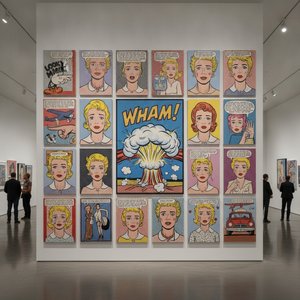 25 Iconic Roy Lichtenstein Masterpieces That Defined Pop ArtImmerse yourself in the vibrant world of Pop Art with our curated guide to Roy Lichtenstein's top 25 masterpieces. From iconic Ben-Day dots…
 Rhythms of Pop Art: Deconstructing Form and Musicality in Roy Lichtenstein’s The ViolinExplore the Cubist roots and Ben-Day dot technique in Lichtenstein's The Violin. Discover the rhythm of Pop Art mastery now.
 The Psychology of the Palette: Decoding Roy Lichtenstein's Bold Color TheoryExplore the psychological depth of Roy Lichtenstein's color theory. An expert analysis for art students and collectors on Ben-Day dots, pri…