Oljeversjon
 Alt om Rythm







































 For kunstverk eller reproduksjoner som er større enn 105 cm (ca. 41 tommer) på noen side, vil rammen bli sendt som et sett som må monteres. Denne metoden sikrer trygg levering og forhindrer skader under transport.


The Composition of Form and Color
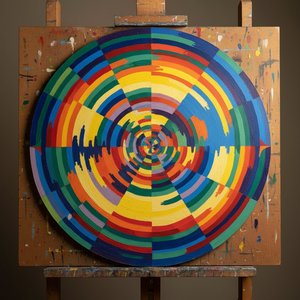
The painting Rythm, dated 1939, presents a central circular structure composed of intersecting geometric shapes and varied color segments. This primary circle is divided into multiple sections, each containing distinct patterns and internal designs. Smaller circles are nested within the larger circular framework, creating a layered effect of concentricity. Two additional circles appear in the periphery: one in the upper right corner and another in the lower left corner. The arrangement of these shapes suggests a spiral or a swirling motion. The surface is characterized by a variety of hues that interact through their proximity, creating a sense of movement across the canvas.
The technique relies on the application of color to define form rather than using line to outline recognizable objects. The artist utilizes the principles of Orphism, focusing on the interaction of light and chromatic intensity. The shapes are not static; they are organized to create a visual rhythm through the interplay of curves and counter-curves. This method uses the physical action of looking to activate the vision, as the eye moves between the contrasting colors and the varying thicknesses of the circular discs.
Historical Context and Artistic Intent
Created in 1939, this work belongs to a period when the artist had moved toward a more radical, non-objective form of abstraction. This phase of production followed a return to the circular forms that characterized earlier explorations of harmony. The composition reflects a departure from figurative subjects, focusing instead on the expressive potential of color alone. The organization of these shapes and their spatial relationships determine the visual tempo of the piece.
The work is situated within the School of Paris movement. It reflects a theoretical interest in how color functions as an active force capable of shaping perception. By utilizing contrasting complementary colors, such as red and green or blue and orange, the painting creates a synchromic effect. This approach seeks to move beyond the representation of the physical world, aiming instead to establish a direct connection between the viewer's eye and the agitation of light and color.
Spørsmål og svar
Er Rythm malt for hånd eller er det et trykk?
Håndmalt: en utdannet kunstner kopierer Rythm i olje på linlerret.
Hvilken størrelse bør jeg velge for Rythm?
Størrelsene varierer fra 30.2 x 33.2 cm (Nkr1859) til 218.9 x 240.7 cm (Nkr17805); tabellen på denne siden viser de viktigste alternativene og deres priser.
Hvor lang tid tar leveringen?
Levering tar 4 til 5 uker med gratis ekspressfrakt over hele verden; en mulighet for hurtigproduksjon tilbys på denne siden. Du kan returnere varen innen 100 dager for full refusjon, uten betingelser.
Hvor befinner originalen av Rythm seg?
Originalen er i samlingen til Musée d'Art Moderne de la Ville de Paris, Paris.
Hvilket medium brukte Robert Delaunay for Rythm?
Oil On Canvas
 Forhåndsvisning

 Send
 Del
 Vis detaljer
 Faktablad


 Last ned bilde
 Liknende objekter
 Røntgenundersøkelse
 Lysbildefremvisning
 Spørsmål og svar

 Statistikk