

 Se i rommet
 Del som digitalt kort
 Del
Del
 Detaljer
 Studentguide

 Last ned
 Liknende objekter
 Røntgen
 Lysbildefremvisning
 Besøksstatistikk
Heaps of Ashes V


 Les mer
Giclée / Kunsttrykk
Giclée- eller lerretsprint av museumskvalitet med rask produksjon og fleksible valgmuligheter for etterbehandling. ( Bestill håndmalt reproduksjon Gå til digitalt bilde)




































Velg mellom våre forhåndsdefinerte størrelser som bevarer kunstverkets opprinnelige proporsjoner.

Du kan oppgi egne mål for å tilpasse en spesifikk ramme eller et bestemt område. Dersom den valgte størrelsen ikke samsvarer med det originale bildets proporsjoner, vil vi enten beskjære kunstverket eller utvide bildet med en speilet eller ensfarget kant. En digital mockup vil bli sendt til din godkjenning før produksjonen starter.
Vennligst merk at forhåndsvisningen på skjermen ikke gjenspeiler den faktiske beskjæringen eller utvidelsen. Kun mockuppen vil vise den endelige komposisjonen nøyaktig.
Selv om tilpassede størrelser er tilgjengelige, anbefaler vi å velge et mål fra den forhåndsdefinerte listen for å bevare de originale proporsjonene.
Verdensomspennende levering () på 2 uker i stedet for standard 4/5 uker. (26 September)

Gratis ekspressfrakt over hele verden

Lerretsduk av høykvalitets lin

Full transportforsikring

Garanti for refusjon av toll og importavgifter

Garantert fargeekthet

100 dagers returrett ved fabrikasjonsfeil

100% pengene tilbake-garanti

Mengderabatt
 Glassalternativet er kun tilgjengelig i størrelser under 110 cm

Heaps of Ashes V
Giclée / Kunsttrykk
Format på reproduksjon
-


Totalpris
$ 80
Kunstnerbiografi
The Architecture of Absence: The Life and Legacy of Reiner Ruthenbeck
Emerging from the transformative artistic landscape of post-war Germany, Reiner Ruthenbeck (1937–2016) carved a singular path through the realms of sculpture and conceptual art. His journey began not with the chisel or the mold, but through the lens of a camera. In his early years, Ruthenbeck acted as a vital witness to the avant-garde, using photography to document the ephemeral performances of the Fluxus movement and the Zero Group. This formative period allowed him to inhabit the very pulse of experimental art, capturing the fleeting energy of movements that sought to redefine the boundaries of creativity. It was this deep immersion in the spirit of performance that would later inform his profound understanding of space, presence, and the weight of what is left unsaid.
The trajectory of Ruthenbeck’s career underwent a seismic shift when he moved to study painting under the legendary Joseph Beuys at the Düsseldorf Kunstakademie. While the mentorship of Beuys provided him with a philosophical foundation rooted in existential inquiry, Ruthenbeck eventually found himself moving away from the canvas. By 1968, he had abandoned painting as a primary medium, turning instead toward a diverse and tactile vocabulary of sculptural materials. He began to explore the physical properties of the world around him, seeking to reveal the hidden tensions within matter itself. His work became a dialogue between the organic and the industrial, where the soft vulnerability of felt or paper could meet the rigid permanence of steel mesh or glass.
Materiality and the Poetics of the Void
Ruthenbeck’s sculptural practice was characterized by an unwavering commitment to simplicity and a mastery of reductive forms. He did not seek to decorate space, but rather to interrogate it. Drawing significant inspiration from Arte Povera and Minimalism, he utilized materials such as rubber, wood, metal, and ash to create works that functioned as meditations on emptiness and silence. His approach was never about grand, sweeping gestures; instead, it was a meticulous consideration of how mass, geometry, and scale influence our perception of the void. Through the juxtaposition of contrasting elements, he could make the invisible felt, turning the "nothingness" of a space into a tangible, heavy presence.
One of his most evocative contributions to the history of contemporary sculpture can be found in his series “Kegel und Haufen” (Cones and Piles). A profound example is his work “Heaps of Ashes V,” which features a sheet metal structure partially submerged within a pile of ash, rising in a honeycomb pattern. This piece serves as a powerful intersection of formal experimentation and historical memory. The very scent of the slag and ash evokes the industrial soul of the Ruhr Area, the German region where Ruthenbeck was born and raised. In this way, his work transcends mere abstraction, anchoring itself in the socio-industrial history of Germany—a landscape defined by coal mining, metallurgy, and the transformative power of industry.
A Lasting Impression on Contemporary Thought
Throughout his decades-long career, Ruthenbeck’s influence resonated far beyond the borders of Germany. His exhibitions in major institutions, such as Haus Konstruktiv Leipzig and Kunsthalle Düsseldorf, solidified his reputation as a master of conceptual depth. He achieved a rare feat in the art world: creating works that are simultaneously intellectually rigorous and emotionally resonant. To stand before a Ruthenbeck sculpture is to enter a state of contemplative stillness, where the viewer is invited to confront the fundamental nature of existence and the beauty found within the ephemeral.
The historical significance of Reiner Ruthenbeck lies in his ability to bridge the gap between the radical performance art of the 1960s and the disciplined minimalism of later decades. His legacy is defined by several key artistic pillars:
- The Documentation of Fluxus: His early photographic work preserved the ephemeral moments of some of the most important avant-garde movements in history.
- Material Dialogue: His unique ability to draw together contrasting natural and industrial materials to highlight their inherent physical properties.
- The Concept of Absence: His profound exploration of the void, using sculpture to give shape to silence and emptiness.
- Regional Connection: The integration of the industrial identity of the Ruhr Area into the conceptual framework of his art.
Ultimately, Ruthenbeck’s oeuvre remains a testament to the power of reduction. By stripping away the unnecessary, he allowed the essence of material and space to speak, leaving behind a body of work that continues to haunt and inspire the contemporary art landscape.

reiner ruthenbeck
1937 - 2016 , Germany
Kort om kunstneren
- Artistic Movement Or Style: Minimalist sculpture
- Artists Or Movements Influenced By This Artist: ['Arte Povera']
- Artists Who Influenced This Artist: ['Joseph Beuys']
- Date Of Birth: 1937
- Full Name: Reiner Ruthenbeck
- Nationality: German
- Notable Artworks: ['Heaps of Ashes V']
- Place Of Birth: Velbert, Germany
Relaterte artikler
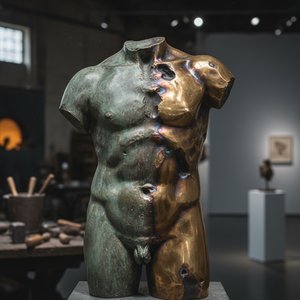
Bronse skulpturers varige arv: Historie, teknikker og samtidstolkninger
Utforsk bronseskulpturers fascinerende historie og teknikker. Ekspertinnsikt for kunstsamlere, investeringstips og moderne tolkninger. Lær mer nå!

Bronseklassikere: 10 skulpturer som revolusjonerte kunsten | OriginalUniqueArt
Utforsk 10 legendariske bronseskulpturer som formet kunsthistorien! Fra Rodin til Michelangelo – oppdag historiene, teknikkene og skjønnheten bak tidløse mesterverk. Finn din perfekte veggkunst eller interiørdekor på OriginalUniqueArt.com.

The Enduring Form: Exploring Themes & Techniques in Sculpture Across Historical Periods
Explore the rich history of sculpture from ancient masterpieces to contemporary innovations. Discover key techniques, influential artists & investment potential for discerning art collectors.

Bronzens Mesterverk: 10 Skulpturer Som Forandret Kunsthistorien | OriginalUniqueArt
Oppdag 10 legendariske bronse skulpturer som revolusjonerte kunsthistorien! Fra Michelangelo til Rodin – lær om teknikker, historier og tidløs skjønnhet. Finn museumskvalitets reproduksjoner & interiørinspirasjon på OriginalUniqueArt.com.

The Enduring Form: Sculpture Across History, Technique & Emotional Resonance
Explore the rich history of sculpture with OriginalUniqueArt. Discover key techniques, influential artists & investment potential for discerning collectors. Expert insights into valuing and collecting timeless masterpieces.