1932
Winter Evening (Raphel Gleitsman, 1932)
Raphel Gleitsman (1910–1995) har laget Winter Evening. Den er fra 1932. Den er laget i Oil. Verket er bevart ved Akron Art Museum i Akron, United States of America.
- 1932
- Oil
- Akron Art Museum

 Forhåndsvisning

 Håndmalt oljemaleri
 Send
 Del
 Faktablad


 Last ned bilde
 Liknende objekter
 Røntgenundersøkelse
 Lysbildefremvisning
 Spørsmål og svar

 Statistikk
Winter Evening, kort fortalt
- Tittel
- Winter Evening
- Kunstner
- Raphel Gleitsman (1910–1995)
- Kunstner født i
- Dayton, United States
- Dato
- 1932
- Medium
- Oil
- Hvor det kan ses
- Akron Art Museum, Akron, United States of America
- Periode
- Modern
- Motiv
- people, pedestrians, building, windows, dog, car
Hva forestiller Winter Evening?
Identification of Winter Evening by Raphel Gleitsman
Winter Evening is an oil painting created by Raphel Gleitsman in 1932. This work originated in Akron, Ohio, and depicts a snow-covered downtown scene from the vantage of Main and Bowery streets. The composition captures a specific urban environment during the winter season.
The piece is a developed work that displays the early characteristics of the artist's mature style. It portrays a city street at night, featuring well-lit store windows and various pedestrians moving along the sidewalks. The scene includes a large building, likely a hotel, and several vehicles, such as a parked car near the center and another further to the right. A dog is also present among the pedestrians, contributing to the movement within the urban setting.
Visual Composition and Subject Matter
The scene depicts a snow-covered downtown Akron from the vantage of Main and Bowery streets. It captures a city street at night during the winter season. A large building with many windows, resembling a hotel or a similar establishment, dominates the composition. Below, well-lit store windows line the sidewalk, casting light onto the pedestrians. Several people walk along the pavement, some of whom carry handbags. A dog moves down the street among the pedestrians.
Vehicles are positioned within the urban landscape. One car is parked near the center of the image, while another is located further back on the right side. In the far background, a patch of sky is rendered in smoldering reds, providing a color contrast to the nocturnal setting. The composition focuses on the intersection of architectural structures and the movement of people through the wintry environment.
Artistic Style and Mature Development
Created about 1932, this oil painting represents a fine achievement for a twenty-two-year-old artist. It functions as a developed piece that already carries the earmarks of the painter's mature style. The work belongs to an early period in which the artist focused on realistic depictions of life in Middle America. During this phase, the subject matter centered on colloquial American scenes, such as town squares on wintry nights.
The execution of the work demonstrates a technical proficiency that anticipates later developments in the artist's career. While the imagery focuses on the everyday existence of a city street, the handling of the medium shows a level of control beyond the artist's years. This specific piece captures a moment of quietness through its structured composition and its focus on the lived experience of the urban environment.
Hvilket museum har Winter Evening?
Akron Art Museum
Akron, United States of America
A Symphony of Steel and Spirit In the industrial heart of Ohio, where the echoes of a storied past meet the bold ambitions of the future, stands the Akron Art Museum —a sanctuary where modernity breathes through glass and light. To step into this institution is to embark on a journey through time, moving from the quiet, dignified halls of its 1899 Italian Renaissance revival foundation into a breathtaking architectural dialogue with the contemporary world. The museum’s evolution, which began in 1922 within the modest confines of a public library basement, mirrors the very essence of artistic growth: a persistent, beautiful striving toward new horizons.


Høyoppløselige bilder av Winter Evening

Protected by copyright: these files are for personal reference, not a licence to republish.
Raphel Gleitsman, Winter Evening (1932), Akron Art Museum.
Spørsmål om Winter Evening, besvart
Hvor kan jeg se originalen av "Winter Evening" av Raphel Gleitsman?
"Winter Evening" av Raphel Gleitsman er utstilt på Akron Art Museum, Akron, United States of America. Museumsoppføringen refererer til originalverket, ikke til reproduksjoner.
Hva er dateringen til "Winter Evening" av Raphel Gleitsman?
"Winter Evening" av Raphel Gleitsman ble skapt i 1932.
Hvilken teknikk er brukt i "Winter Evening" av Raphel Gleitsman?
"Winter Evening" er utført i Oil.
Hva forestiller "Winter Evening"?
Temaene i "Winter Evening" av Raphel Gleitsman inkluderer people, pedestrians, building, windows, dog, car, city street, night. Sammen oppsummerer de verkets motiv.
Er "Winter Evening" av Raphel Gleitsman i det frie domene?
"Winter Evening" av Raphel Gleitsman er fortsatt beskyttet av opphavsretten. Denne statusen avgjør hvordan bildet av verket kan reproduseres.
Hvilken kunstner kan "Winter Evening" tilskrives?
Kunstneren bak "Winter Evening" er Raphel Gleitsman. Verket er katalogisert under Raphel Gleitsman sitt navn.
Hvilken periode i Raphel Gleitsman sin karriere tilhører "Winter Evening"?
"Winter Evening" representerer Raphel Gleitsman sin Early Period.
Hvor gammel var Raphel Gleitsman da "Winter Evening" ble skapt i 1932?
Da "Winter Evening" ble skapt i 1932, var Raphel Gleitsman – født i 1910 – 22 år gammel.
Hvorfor er den opphavsrettslige statusen til "Winter Evening" slik den er?
"Winter Evening" av Raphel Gleitsman er fortsatt beskyttet av opphavsretten. Opphavsretten beregnes fra kunstnerens dødsår, og Raphel Gleitsman døde i 1995.
Om kunstneren, Raphel Gleitsman

1910–1995, United States
Raphel Gleitsman
Early Life and Artistic Beginnings in Akron Raphael Gleitsmann, born in Dayton, Ohio in 1910, was a distinctly American artist whose life story is as compelling as the evocative imagery he created. He spent the vast majority of his years in Akron, Ohio, a city that would become both the backdrop and often the subject of his work. Unlike many artists of his generation, Gleitsmann was largely self-taught; his formal training was limited to instruction from Miss Calvin at Central High School and Paul Travis at the Cleveland School of Art. Unable to afford tuition, he cultivated relationships with faculty and students at the school, eventually gaining access to classes without official enrollment—a testament to his innate talent and dedication.
Også av Raphel Gleitsman
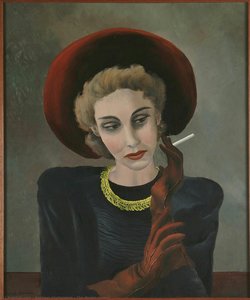 The Brown Gloves1932
 Untitled [Farmhouse and out building]1935
 Untitled [Five railroad workers]1940
Essays om Winter Evening
 25 Masterpieces by Rogier van der Weyden: The Pinnacle of Emotional ArtImmerse yourself in the profound emotion of Rogier van der Weyden’s greatest works. From Northern Renaissance mastery to exquisite textures…
 The Decisive Moment: Capturing the Raw Energy of Urban Street PhotographyExplore the profound history of street photography from Cartier-Bresson to wabi-sabi aesthetics. Discover the art of the decisive moment no…
 The Art of the Glide: Capturing Movement on Frozen Waters within Classical Winter LandscapesExplore the evolution of winter landscapes from Dutch masters to Impressionism. Discover the artistry of frozen motion today.