Bytt til trykk
 Vis hele teksten







































 For kunstverk eller reproduksjoner som er større enn 105 cm (ca. 41 tommer) på noen side, vil rammen bli sendt som et sett som må monteres. Denne metoden sikrer trygg levering og forhindrer skader under transport.


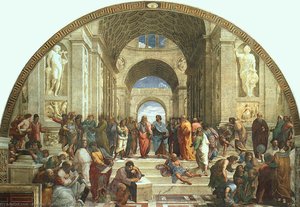
Apollo and Marsyas (ceiling panel) – A Renaissance Triumph of Harmony
Raphael’s Apollo and Marsyas is more than just a depiction of myth; it's a cornerstone of High Renaissance artistic achievement—a testament to Raphael’s mastery of perspective, anatomy, and color theory. Executed between 1509 and 1511 for the Stanza della Segnatura in Vatican City, commissioned by Pope Julius II as part of his ambitious program to decorate the papal palace with frescoes celebrating Christian theology, this monumental panel embodies the humanist ideals that defined the era.
The scene portrays a dramatic confrontation between Apollo, god of music and light—symbolizing divine reason and order—and Marsyas, a satyr who dared to challenge Apollo’s musical supremacy. This narrative draws heavily from Greek mythology, specifically the tale recounted by Apollonius Rhodius, where Marsyas attempted to usurp Apollo's position as patron deity of music by performing a ritualistic hymn that offended Zeus. As punishment for his hubris, Apollo ordered Marsyas’s skin to be flayed alive—a gruesome spectacle designed to reaffirm Apollo’s authority and the sanctity of divine law.
Raphael’s technique is remarkable. He employed fresco painting—applying pigment directly onto wet plaster—ensuring unparalleled durability and luminosity. The artist meticulously crafted every detail, utilizing subtle gradations of color to create a sense of depth and realism that was revolutionary for its time. Observe the careful rendering of musculature, conveying Apollo's regal posture and unwavering confidence. Raphael’s masterful use of chiaroscuro—the interplay between light and shadow—intensifies the drama of the scene, highlighting Marsyas’s agony and emphasizing Apollo’s radiant presence.
The color palette is restrained yet impactful, dominated by golds, browns, and reds—colors associated with divinity and passion. Raphael skillfully blends hues to create a harmonious composition that draws the viewer's eye towards the central figures. The luminous quality of the fresco contributes significantly to its emotional resonance, conveying both grandeur and pathos.
- Composition: Raphael’s balanced arrangement emphasizes Apollo’s dominance while simultaneously portraying Marsyas’s suffering with poignant realism.
- Color Palette: The artist utilizes a carefully considered color scheme that reinforces the thematic significance of the scene—gold representing divine majesty, red symbolizing passion and sacrifice.
- Technique: Fresco painting guarantees exceptional longevity and brilliance, preserving Raphael's artistic vision for centuries to come.
Today, reproductions of Apollo and Marsyas are available on OriginalUniqueArt.com, allowing art enthusiasts to experience the beauty and intellectual depth of this iconic masterpiece.
Considered alongside other works by Raphael—particularly his depictions of biblical scenes—Raphael Maklouf’s reproductions offer a captivating glimpse into the artistic legacy of one of Renaissance Italy's greatest geniuses.
For more information on Raphael and his art, visit OriginalUniqueArt.com.
Spørsmål og svar
Hvor intens er fargebruken i "Apollo og Marsyas (takpanel)" av Rafael?
Fargeintensiteten i "Apollo og Marsyas (takpanel)" er Harmonisk balansert. Intensitet beskriver hvor sterke fargene fremstår.
Hvilken stemning ville "Apollo og Marsyas (takpanel)" tilføre et rom?
Med sin Elegant stemning anbefales "Apollo og Marsyas (takpanel)" for et Stue og oppholdsrom.
Hvor mange ser på "Apollo og Marsyas (takpanel)"?
Statistikk for "Apollo og Marsyas (takpanel)" av Rafael finnes på verkets Besøksstatistikk-side: månedlige visninger av verket, visninger av kunstnerens andre verk, samt en oversikt over nylige besøkende fordelt på land og språk.
 Forhåndsvisning
 Send
Send Del
Del
 Vis detaljer
 Utskriftsvennlig guide

 Last ned bilde
 Liknende objekter
 Røntgenundersøkelse
 Lysbildefremvisning
 Q&A
Q&A Statistikk