
 Forhåndsvisning
 Send
Send Del
Del
 Vis detaljer
 Utskriftsvennlig guide

 Last ned bilde
 Liknende objekter
 Røntgenundersøkelse
 Lysbildefremvisning
 Q&A
Q&A Statistikk
The Visit

- 68.0 x 58.0 cm


 Vis hele teksten
Giclée / Kunsttrykk
Giclée- eller lerretsprint av museumskvalitet med rask produksjon og fleksible valgmuligheter for etterbehandling. ( Kjøp håndmalt maleri Bytt til digitalt bilde)




P118B Nkr10

P118H Nkr10

P118W Nkr10

P438Z Nkr10

P508JH Nkr12

P508YH Nkr12

P805H Nkr10

P805Z Nkr10

P919BZ Nkr10

P919G Nkr10

P919XJ Nkr10

P959ZH Nkr10

P968JZ Nkr12

W106C Nkr8

W218G Nkr10

W218JH Nkr8

W218Y Nkr10

W307PJ Nkr10

W316G Nkr10

W316PJ Nkr8

W316Y Nkr10

W398PJ Nkr8

W4111J Nkr10

W500HY Nkr15

W500JH Nkr15

W692G Nkr12

W849H Nkr8

W940BG Nkr15

W953PJ Nkr8




Velg mellom våre forhåndsdefinerte størrelser som bevarer kunstverkets opprinnelige proporsjoner.

Skriv inn ønsket bredde og høyde for å tilpasse trykket til din ramme eller vegg. Et trykk kan kun beskjæres, aldri skaleres opp utover motivets opprinnelige størrelse, noe som betyr at et format med andre proporsjoner vil føre til tap av deler av bildet. Vi sender deg en digital mockup for godkjenning før vi starter trykkeprosessen. Bildet som vises på denne siden viser ikke den faktiske beskjæringen — det er kun mockuppen som viser dette.
Verdensomspennende levering () på 2 uker i stedet for standard 4/5 uker. (1 November)

Gratis ekspressfrakt over hele verden

Lerretsduk av lin av høy kvalitet

Full transportforsikring

Garanti for refusjon av toll og importavgifter

Garantert fargegjengivelse

100 dagers returrett ved fabrikasjonsfeil

100% pengene tilbake-garanti

Rabatt ved flere kjøp
 Glassalternativet er kun tilgjengelig i størrelser under 110 cm

The Visit
Giclée / Kunsttrykk
Størrelse på reproduksjon
-


Totalpris for valgte alternativer
Nkr 770
A Moment Frozen in Delft Light
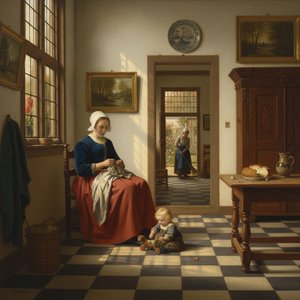
In the quiet, sun-drenched interiors of the seventeenth century, moments of profound connection were often found in the most mundane settings. Pieter de Hooch's "The Visit," painted in 1657, stands as a quintessential emblem of Dutch Baroque artistry—a deceptively simple tableau that speaks volumes about the social fabric and artistic sensibilities of its era. Captured in muted tones of ochre, ivory, and charcoal gray, this masterpiece transports us back to Delft during the zenith of the Dutch Golden Age, offering an intimate glimpse into the daily life of a bourgeois household. The painting’s enduring appeal lies not merely in its visual beauty but also in its masterful execution and subtle symbolic resonance, inviting viewers to step through a doorway into a world of domestic tranquility.
The scene unfolds with a palpable sense of realism, as de Hooch captures a group of individuals gathered around a dining table. There is a quiet drama in the way the figures are positioned; some stand while others sit, their presence suggesting a convivial conversation and shared enjoyment. The table itself is laden with details that ground the scene in reality—multiple wine glasses catch the light, hinting at a celebratory or social meal, while a book rests near one of the guests, perhaps a remnant of a shared intellectual pursuit before dinner began. Even the subtle inclusion of a clock on the wall serves as a poignant reminder of the passage of time, anchoring this fleeting social interaction within the eternal flow of history.
Mastery of Light and Texture
De Hooch's style embodies the Baroque preoccupation with illusionism and chiaroscuro—the dramatic interplay between light and shadow. Unlike the overtly theatrical compositions of his contemporaries, "The Visit" achieves grandeur through the meticulous observation of natural light filtering into a domestic interior. The artist skillfully renders textures with remarkable accuracy; one can almost feel the grain of the worn wooden bench and the crispness of the linen tablecloth. Through subtle gradations of tone, de Hooch sculpts form and conveys a profound sense of depth, drawing the viewer’s eye into the room's corners and through its architectural layers.
This technical precision makes the work an extraordinary subject for high-quality reproductions. For the art collector or interior designer, the painting offers a sophisticated palette that complements a variety of decor styles. Its monochrome-leaning tones of gray and earth colors provide a neutral yet emotionally resonant anchor for a room, bringing a sense of historical weight and calm sophistication to any space. The way de Hooich utilizes light creates an atmospheric quality that can transform a modern living area into a sanctuary of classical elegance.
A Reflection of Golden Age Prosperity
Beyond its aesthetic brilliance, "The Visit" reflects a pivotal moment in Dutch history—the burgeoning prosperity fueled by global trade and exploration. During this era, Delft was a thriving center for craftsmanship and commerce, attracting affluent families eager to establish their social standing through the cultivation of refined domestic environments. De Hooch’s depiction captures the aspirational ideal of bourgeois comfort: a world where peace, plenty, and companionship are the ultimate markers of success.
To possess a reproduction of this work is to invite the spirit of the Dutch Golden Age into one's home. It serves as more than just decoration; it is a window into a vanished era of stability and grace. Whether placed in a sunlit study or a formal dining room, "The Visit" continues to inspire awe through its ability to find the extraordinary within the ordinary, reminding us that true beauty often resides in the quietest moments of human connection.
Spørsmål og svar
Hva har "The Visit" til felles med resten av Pieter de Hooch sin produksjon?
I Pieter de Hooch sitt kunstnerskap befinner "The Visit" seg innenfor Baroque-stilen, sammen med temaene baroque realism, domestic tranquility, dutch society, light’s subtle grace, artistic legacy.
Hvordan kan jeg få tak i en digital fil av "The Visit" av Pieter de Hooch?
Et digitalt bilde av "The Visit" av Pieter de Hooch kan kjøpes på siden for Digitalt kunstverk: nedlasting av et digitalt bilde i høy oppløsning.
Hvem er kunstneren bak "The Visit"?
Kunstneren bak "The Visit" er Pieter de Hooch. Verket er katalogisert under Pieter de Hooch sitt navn.
Om kunstneren
Early Life and Training
Pieter de Hooch, en prominent figur i den nederlandske gullalderen, ble født i Rotterdam den 20. desember 1629. Han var eldste barnet til Hendrick Hendricksz de Hooch, en murmester, og Annetje Pieters, en jordmor. Lite er kjent om hans barndom, men det antas at han arbeidet i Rotterdam, Delft og Amsterdam. De Hoochs kunstneriske utdannelse fant sted i Haarlem under landskapsmaleren Nicolaes Berchem, sammen med Jacob Ochtervelt. Denne perioden la grunnlaget for hans fremtidige suksess som maler av rolige hjemmemiljøer med et åpent vindu. Han ble sett på som en elev av Berchem, og det er antatt at han lærte mye av hans stil og teknikker.Artistic Style and Themes
De Hoochs kunst er preget av sin oppmerksomhet på detaljer, naturalisme og bruk av lys. Hans malerier skildret ofte hverdagsliv, og reflekterte verdiene og ambisjonene til den nye middelklassen. Et tydelig eksempel på denne stilen er "Courtyard of a House in Delft" (1658), som viser hans evne til å fange de vanlige detaljene i dagliglivet. Hans verk deler også temaer og komposisjoner med Emanuel de Witte, men fokuset hans på mennesker og deres relasjoner skiller ham ut. Dette er tydelig i "Woman Nursing" (1658) og "Woman with a Baby on Her Lap" (1658), som demonstrerer hans interesse for hjemmemiljøer. Han var spesielt interessert i å fange lysets spill og hvordan det påvirket overflater og rom, noe som er tydelig i mange av hans mest kjente arbeider.Notable Works and Legacy
Noen av De Hoochs mest kjente verk inkluderer:- "The Merry Drinker" (ca. 1650)
- "Cardplayers in a Sunlit Room" (1658)
- "A Woman Preparing Bread and Butter for a Boy" (1661)
Museums and Collections
De Hoochs verk kan finnes i flere museer, inkludert det kongelige kunstmuséet i Antwerpen, Belgia, som har en omfattende samling av europeisk kunst fra 1500-tallet til 1900-tallet. Hans malerier er verdifulle eksempler på den nederlandske gullalderens kunst og forteller historier om hverdags livet i det gamle Nederland.
Pieter de Hooch
1629 - 1694 , Nederland
Kort om kunstneren
- Artistic Movement Or Style: Dutch Gouden Eeuw
- Artists Or Movements Influenced By This Artist: ['Johannes Vermeer']
- Artists Who Influenced This Artist: ['Nicolaes Pieterszoon Berchem']
- Date Of Birth: 20. desember 1629
- Date Of Death: etter 1684
- Full Name: Pieter Hendricksz de Hooch
- Nationality: Nederlands
- Notable Artworks:
- The Empty Glass
- A Dutch Courtyard
- Woman and Child in a Courtyard
- Place Of Birth: Rotterdam, Nederland
Relaterte artikler

Golden Light & Dutch Skies: The Timeless Magic of Dutch Golden Age Landscapes
Discover the breathtaking beauty of Dutch Golden Age landscapes. Explore the mastery of light, chiaroscuro, and 17th-century realism through an expert art history lens, celebrating the enduring legacy of the Dutch Masters for discerning collectors and art lovers.

Willem van de Velde the Elder: Master of Maritime Painting & Chronicler of the Dutch Golden Age
Discover the captivating maritime paintings of Willem van de Velde the Elder, a master chronicler of the Dutch Golden Age. Explore his unparalleled realism and lasting influence on naval art history.

Mastering Light & Shadow: A Journey Through the Dutch Golden Age's Luminous Legacy
Embark on a cultural journey through the Dutch Golden Age. Explore the masterful interplay of light and shadow in 17th-century masterpieces, from Rembrandt to Vermeer, and discover how this era of profound realism continues to inspire fine art collectors today.
Pieter de Hooch: Illuminating Dutch Domestic Life & Golden Age Charm
Explore the captivating world of Pieter de Hooch, a master of Dutch Golden Age painting. Discover his innovative use of light, intimate domestic scenes, and lasting influence on art history. Learn more at OriginalUniqueArt.

De 10 Mesterverkene som Definerte den Nederlandsk Gyldne Tidsalder – Kunst & Interiør
Oppdag de 10 ikoniske mesterverkene fra den nederlandske gullalderen! Lær om Rembrandt, Vermeer og andre store kunstnere. Finn inspirasjon til klassisk interiørdekorasjon og kjøp museumskvalitets reproduksjoner på OriginalUniqueArt.com.


