Bytt til trykk
 Vis hele teksten







































 For kunstverk eller reproduksjoner som er større enn 105 cm (ca. 41 tommer) på noen side, vil rammen bli sendt som et sett som må monteres. Denne metoden sikrer trygg levering og forhindrer skader under transport.


Place de la Concorde: A Symphony of Balance
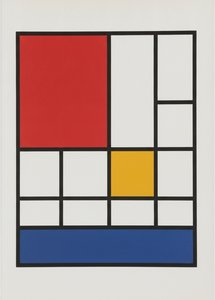
Piet Mondrian’s *Place de la Concorde*, painted between 1938 and 1943, transcends mere geometric representation; it embodies a profound artistic philosophy—a visual distillation of Neoplasticism—and speaks to the anxieties and aspirations of a pivotal moment in European history. Far from depicting the Parisian square faithfully, Mondrian presents us with an abstraction that pulsates with the dynamism of urban life, achieved through a masterful arrangement of black lines enclosing blocks of primary colors: red, yellow, and blue, against a stark white backdrop. This wasn’t simply about capturing a location; it was about distilling its essence into a universal visual language—a bold declaration that art could transcend specific subjects to express fundamental truths. The painting's evolution is particularly noteworthy. Initially conceived in Paris before Mondrian’s evacuation during World War II, it continued to develop after his relocation to New York City, absorbing influences from a new environment characterized by increased pace and energy – subtle adjustments to line weight and color placement that amplify the work’s vitality.The Genesis of Neoplasticism: Mondrian's Artistic Quest
Mondrian’s artistic journey began in Holland, where he honed his skills as a teacher while simultaneously nurturing his passion for painting. His early canvases reflected the stylistic currents of the Hague School and Impressionism – pieces like *The Red Mill*, demonstrating meticulous observation of nature combined with expressive brushstrokes. Yet, even amidst these traditions, Mondrian harbored an insistent desire for simplification—a conviction that art should transcend mere imitation to capture its underlying structure. This impulse drove him toward experimentation with Pointillism and Fauvism, each style offering a distinct perspective on color and form, but none fully satisfied his burgeoning artistic vision. These explorations paved the way for his groundbreaking embrace of abstraction, culminating in the revolutionary aesthetic of Neoplasticism.From Parisian Experimentation to New York’s Influence
Mondrian's relocation to Paris in 1912 marked a transformative juncture in his career. Surrounded by the fervor of the avant-garde movement and captivated by Cubism’s radical fragmentation, he began to dismantle traditional forms, prioritizing geometric abstraction over representational art. This pivotal encounter spurred him toward a more assertive exploration of color and line—a stylistic shift that would solidify his commitment to pure abstraction. The subsequent reworking of *Place de la Concorde* in New York City reflects this influence, subtly enhancing the painting’s visual impact with bolder lines and carefully calibrated color harmonies.Symbolism Beneath the Grid: Exploring Mondrian's Vision
The seemingly austere geometric composition of *Place de la Concorde* belies a complex symbolic underpinning. The black lines represent vertical stability—a grounding force against which the horizontal bands of color assert dynamism—reflecting Mondrian’s belief in the harmonious coexistence of opposing forces. Red, yellow, and blue are chosen not merely for their chromatic qualities but also for their association with fundamental energies – passion, intellect, and serenity—representing a quest for universal order amidst perceived chaos. Ultimately, *Place de la Concorde* serves as a testament to Mondrian’s unwavering dedication to abstraction as a vehicle for conveying profound philosophical ideas.- Explore high-quality reproductions of *Place de la Concorde* at OriginalUniqueArt.com.
- Discover inspiration for interior design projects incorporating Mondrian's iconic style.
Spørsmål og svar
Hvilke farger dominerer i "Place de la Concorde" av Piet Mondrian?
Fargeidentiteten til "Place de la Concorde" av Piet Mondrian: en Nøytrale farger-palett, dominert av Grå (#9f7a7c).
Hvem skapte "Place de la Concorde", og i hvilket år?
Piet Mondrian skapte "Place de la Concorde" i 1943.
Hvordan kan jeg se "Place de la Concorde" av Piet Mondrian som en lysbildefremvisning?
Du kan se diaporamabildet av "Place de la Concorde" på verkets Bildekarusell-side.
 Forhåndsvisning
 Send
Send Del
Del
 Vis detaljer
 Utskriftsvennlig guide

 Last ned bilde
 Liknende objekter
 Røntgenundersøkelse
 Lysbildefremvisning
 Spørsmål og svar
 Statistikk