Se i rommet
 Del som digitalt kort
 Del
Del
 Detaljer
 Studentguide

 Last ned
 Liknende objekter
 Røntgen
 Lysbildefremvisning
 Besøksstatistikk
The Wall


 Les mer
Håndlaget oljereproduksjon
Håndmalt olje på lerret i din valgte størrelse og ramme, laget på bestilling av våre kunstnere. ( Bytt til trykkversjon Gå til digitalt bilde)




P118B Nkr10

P118H Nkr10

P118W Nkr10

P438Z Nkr10

P508JH Nkr12

P508YH Nkr12

P805H Nkr10

P805Z Nkr10

P919BZ Nkr10

P919G Nkr10

P919XJ Nkr10

P959ZH Nkr10

P968JZ Nkr12

W106C Nkr8

W218G Nkr10

W218JH Nkr8

W218Y Nkr10

W307PJ Nkr10

W316G Nkr10

W316PJ Nkr8

W316Y Nkr10

W398PJ Nkr8

W4111J Nkr10

W500HY Nkr15

W500JH Nkr15

W692G Nkr12

W849H Nkr8

W940BG Nkr15

W953PJ Nkr8




Velg mellom våre forhåndsdefinerte størrelser som bevarer kunstverkets opprinnelige proporsjoner.

Skriv inn bredden og høyden du trenger, slik at den passer til din ramme eller vegg. Dette er håndmalt, så for en størrelse med en annen form kan kunstneren male litt mer rundt bildet, eller beskjære det noe — du velger selv. Vi sender deg en digital mockup for godkjenning før maleriet påbegynnes. Bildet som vises på denne siden viser ikke det faktiske resultatet — kun mockuppen gjør det.
Etter bestilling vil OriginalUniqueArt.com-teamet sende e-post til kunden for instruksjoner og sende et utkast (mockup) som forhåndsvisning.
Verdensomspennende levering () på 3–4 uker i stedet for standard 5 uker. (22 October). Ingen kompromisser med kvaliteten.

Gratis ekspressfrakt over hele verden

Lerretsduk av høykvalitets lin

Full transportforsikring

Garanti for refusjon av toll og importavgifter

Garantert fargeekthet

100 dagers returrett ved fabrikasjonsfeil

100% pengene tilbake-garanti

Mengderabatt
 Glassalternativet er kun tilgjengelig i størrelser under 110 cm

The Wall
Reproduksjonsmetode
Format på reproduksjon
-


Totalpris
Nkr 2844
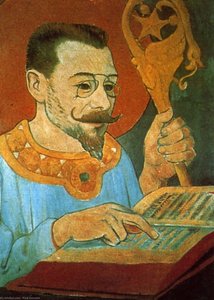
A Visionary Echo of Gauguin's Influence
Paul Sérusier’s “The Wall,” painted in 1890, stands as a testament to the burgeoning spirit of abstraction within Post-Impressionism and represents a crucial juncture in artistic history. Executed during his formative years alongside Vincent van Gogh and Paul Gauguin at Pont-Aven, Brittany, this unassuming landscape transcends mere depiction; it embodies a deliberate quest for expressive simplification—a technique championed by Gauguin himself—that would profoundly shape the trajectory of modern art.
- Subject Matter: The painting captures a tranquil rural scene featuring a man seated beside a weathered fence, framed against a backdrop of lush greenery and scattered trees.
- Style: Sérusier’s style aligns squarely with Synthetism, an avant-garde movement born from Gauguin's exploration of pure color and form. It eschews meticulous realism in favor of conveying emotion and spiritual resonance through flattened planes of pigment.
Technique: Cloisonnism – A Bold Departure From Tradition
Sérusier’s masterful application of cloisonnism—a technique popularized by Gauguin—is immediately apparent. Unlike traditional oil painting, where colors blend seamlessly, cloisonnism employs thin layers of pigment separated by lines of white gesso or bole. This method creates a mosaic-like effect, emphasizing distinct areas of color and enhancing the textural quality of the artwork. The deliberate use of white adds luminosity and contributes to the overall sense of serenity.
Historical Context: Gauguin’s Pont-Aven Circle & The Seeds of Abstraction
“The Wall” emerged from the influential Pont-Aven circle, where Sérusier collaborated closely with Gauguin on groundbreaking artistic experiments. Gauguin's unwavering belief in the power of color and symbolic representation served as a catalyst for artists like Sérusier to push beyond Impressionistic conventions. This painting represents not merely a beautiful landscape but also an active engagement with philosophical ideas concerning spirituality and the relationship between humanity and nature—themes central to the broader artistic discourse of the period.
Symbolism & Emotional Resonance: Beyond Representation
The composition itself speaks volumes about Sérusier’s intentions. The solitary figure, positioned near the fence, suggests contemplation and introspection. While seemingly simple in its visual elements, “The Wall” vibrates with emotional depth—a quiet stillness punctuated by the vibrant hues of the surrounding landscape. It invites viewers to consider not what is seen but what is felt; a subtle echo of Gauguin’s desire to capture the essence of experience rather than merely reproducing it.
A Legacy of Influence
"The Wall" solidified Sérusier's position as one of the foremost figures in Synthetism and profoundly impacted subsequent generations of artists. Its understated beauty combined with its innovative technique continues to inspire admiration and serves as a poignant reminder of the transformative potential inherent within artistic exploration—a legacy that resonates powerfully even today.
Spørsmål og svar
Hva er "The Wall" laget med?
Mediet i "The Wall" av Paul Sérusier er Oil On Canvas. Reproduksjonene har som mål å gjengi utseendet til denne teknikken.
Hvilken atmosfære har "The Wall"?
"The Wall" av Paul Sérusier beskrives med en Serene stemning. Denne klassifiseringen kan bidra til å matche verket med et passende miljø.
Hvilken atmosfære ville en reproduksjon av "The Wall" av Paul Sérusier tilføre et rom?
Med sin Serene stemning, anbefales "The Wall" for et Living Room.
Kunstnerbiografi
Early Life and Artistic Foundations
Paul Sérusier, born on November 9th, 1864, in the heart of Paris, was a painter whose journey toward abstract art began within the vibrant artistic circles of late 19th-century France. His upbringing, rooted in a prosperous middle-class family with Flemish heritage, provided him with both stability and exposure to cultural refinement. Unlike his father’s aspirations for a business career, young Paul harbored an unwavering passion for painting, a desire that led him to enroll at the Académie Julian in 1885. This institution, known for its progressive approach to art education, offered a space where he could hone his skills and encounter fellow artists who would profoundly influence his artistic development. Crucially, it was during this period that Sérusier encountered Maurice Denis, a kindred spirit who would later become a key figure in the revival of religious imagery within French painting. The Académie Julian’s environment fostered experimentation and challenged traditional academic styles, laying the groundwork for Sérusier's future explorations into new forms of expression.The Pont-Aven Years: Cloisonnism and Gauguin’s Influence
Sérusier’s artistic trajectory took a decisive turn in the summer of 1888 when he traveled to Pont-Aven, a small coastal village in Brittany. This location held particular significance as it served as a gathering place for a group of artists—including Paul Gauguin, Émile Bernard, and others—who were seeking inspiration from the region’s rugged landscapes and timeless traditions. Under the watchful eye of Gauguin, Sérusier embarked on a period of intense artistic experimentation, culminating in the creation of *Bois d’Amour* (The Lovers' Wood), often referred to as “The Talisman.” This painting stands as a pivotal work in Sérusier’s career, embodying the principles of cloisonnism—a technique characterized by bold, flat forms delineated by dark contours. Gauguin encouraged Sérusier to move beyond traditional representation and embrace a more symbolic approach, emphasizing color and form over precise detail. The influence of this period is undeniable; *Bois d’Amour* represents a radical departure from academic painting, foreshadowing the development of abstract art and establishing Sérusier as a pioneer in this nascent movement.The Nabis: A Collective Pursuit of Synthesis
Following his time at Pont-Aven, Sérusier became a founding member of the *Nabis*, a small but influential group of artists who sought to synthesize diverse artistic influences—including Post-Impressionism, Symbolism, and Japanese art. The name “Nabis” derives from the Hebrew word for “prophet,” reflecting the group’s ambition to create works that possessed spiritual depth and conveyed profound emotions. Alongside figures such as Paul Gauguin, Pierre Bonnard, Édouard Vuillard, and Maurice Denis, Sérusier explored themes of color, pattern, and decorative design, often employing a flattened perspective and simplified forms. The Nabis aimed to move beyond mere imitation of nature, instead focusing on capturing the essence of their subjects through evocative color palettes and symbolic imagery. Their work was characterized by a quiet intensity and a subtle sense of mystery, inviting viewers to engage with the paintings on an emotional level.Notable Works and Lasting Legacy
Throughout his career, Sérusier produced a body of work that is both visually striking and intellectually stimulating. Key works include *L’aversé* (The Shower), exhibited at the Musée d'Orsay in Paris, which showcases his masterful use of color and composition; *Portrait of Paul Ranson*, also held within the Musée d'Orsay, demonstrating his ability to capture personality through subtle gestures and expressions; and *Le Serpent Étranglement* (The Snake Eaters), a powerful depiction of a Breton legend housed at the National Museum in Warsaw. Beyond these individual pieces, Sérusier’s legacy lies in his pioneering role as a precursor to abstract art and his influence on subsequent generations of artists. His exploration of cloisonnism, his embrace of color and pattern, and his willingness to challenge conventional artistic norms paved the way for the development of modern art movements such as Synthetism and Cubism. Sérusier’s later years were dedicated to teaching at the École Ranson, where he imparted his knowledge and inspired a new cohort of artists. He passed away on October 7th, 1927, in Morlaix, leaving behind a rich artistic legacy that continues to resonate with art lovers today.Artistic Influences and Connections
Paul Sérusier’s artistic development was profoundly shaped by a confluence of influences. The teachings of Paul Gauguin at Pont-Aven were particularly transformative, encouraging him to prioritize color and form over traditional representation. Furthermore, his exposure to Japanese prints—which were gaining popularity in Europe during this period—inspired him to experiment with flattened perspectives and simplified compositions. Sérusier’s work also reflects the broader artistic currents of the late 19th century, including Post-Impressionism, Symbolism, and the Arts and Crafts movement. His connection to Maurice Denis was especially significant; Denis's emphasis on religious imagery and his belief in the power of color and line profoundly influenced Sérusier’s approach to painting. The Nabis group itself served as a crucible for artistic exchange, fostering experimentation and pushing the boundaries of contemporary art.
Paul Sérusier
1864 - 1927 , Frankrike
Kort om kunstneren
- Artistic Movement Or Style: Post-Impressionisme
- Artists Or Movements Influenced By This Artist: ['Les Nabis']
- Artists Who Influenced This Artist:
- Paul Gauguin
- Maurice Denis
- Date Of Birth: 9. november 1864
- Date Of Death: 7. oktober 1927
- Full Name: Louis-Paul-Henri Sérusier
- Nationality: Fransk
- Notable Artworks:
- L'averse (1893)
- Portrett av Paul Ranson (1890)
- Melancholy (1890)
- Slangeeterne (1894)
- Place Of Birth: Paris, Frankrike
Relaterte artikler
Paul Sérusier: Pioneering Synthetism & The Nabis’ Symbolic Revolution
Discover Paul Sérusier's pivotal role in the Nabis movement & the birth of Synthetism. Explore 'The Talisman,' his influence on modern art, and a deeper understanding of this symbolic revolution. Expert analysis & insights.

Paul Cézannes 25 Mesterverk: En Kunstnerisk Reise for Ditt Hjem
Utforsk Paul Cézannes 25 mest ikoniske malerier! Oppdag historien bak impresjonismens mesterverk, fra stilleben til landskap. Finn kunsttrykk av høy kvalitet og interiørinspirasjon på OriginalUniqueArt.com.
Capturing the Soul: The Most Emotionally Moving Impressionist and Post-Impressionist Masterpieces
Discover the profound emotional depth of Impressionist and Post-Impressionist masterpieces. Explore how legends like Monet, Van Gogh, and Gauguin captured light and soul through evocative landscapes and vibrant brushwork for a timeless connection to art history.
Paul Klees 25 Mesterverk: En Reise i Farge og Form | OriginalUniqueArt.no
Utforsk Paul Klees 25 mest ikoniske malerier! Fordyp deg i hans abstrakte verden, fargerike ekspresjonisme og unike stil. Finn inspirasjon til interiørdesign & kjøp museumskvalitets reproduksjoner på OriginalUniqueArt.com. Oppdag mesterverkene nå!

Postimpresjonismens 10 Mesterverk: Kunst som Forandret Verden – OriginalUniqueArt.no
Oppdag postimpresjonismens 10 mest ikoniske mesterverk! Van Gogh, Monet, Cézanne og Gauguin – lær historien bak disse fargerike maleriene. Finn museumskvalitets kunsttrykk & inspirasjon til ditt hjem på OriginalUniqueArt.com.