
 Forhåndsvisning
 Send
Send Del med andre
 Vis detaljer

 Last ned bildet
 Liknende objekter
 Røntgenundersøkelse
 Lysbildefremvisning
The Anti-Clock Project


 Vis hele teksten
Kjøp et høyoppløselig, forbedret digitalt bilde som er langt bedre enn forhåndsvisningen på nettet.
Hver fil er omhyggelig klargjort av våre egne spesialister ved hjelp av avanserte verktøy og profesjonell manuell retusjering. Vi sørger for at hvert bilde har eksepsjonell klarhet, presis fargegjengivelse og fine detaljer.
Den endelige filen leveres via e-post innen 72 timer, optimalisert for umiddelbar bruk i profesjonelle, redaksjonelle og trykte miljøer. Dette er den samme kvaliteten som benyttes av ledende designstudioer, utgivere og gallerier.
Digitalt bilde
Last ned en høyoppløselig fil for personlig bruk, utskrift og kreative prosjekter. ( Kjøp trykk Kjøp håndlaget maleri)
Inkludert i alle bestillinger av digitale bilder
Ekspert digital levering, garantert
Når du velger OriginalUniqueArt.com, får du ikke bare et bilde – du mottar et profesjonelt forbedret digitalt kunstverk, skapt med presisjon og med en garantert tilfredshetsgaranti. Her er alt som automatisk følger med din bestilling:

Rask digital levering
Din høyoppløselige digitale bildefil sendes til din e-post innen 72 timer etter bestilling – klar til umiddelbar bruk.

KI-forbedret digital fil
Ditt kunstverk blir profesjonelt optimalisert ved hjelp av avanserte AI-verktøy og manuell redigering, noe som sikrer maksimal detaljrikdom, klarhet og fargegjengivelse.

Gratis livslang nyutlevering
Har du ved et uhell slettet eller mistet filen din? Ingen bekymring – vi sender den på nytt når som helst, helt gratis.

Ingen importavgifter – noen gang
Nyt ditt kunstverk umiddelbart uten toll, avgifter eller leveringskostnader – digitale nedlastinger er alltid avgiftsfrie.

Garantert fargenøyaktighet
Vi sikrer at ditt digitale bilde gjenspeiler de originale fargene så nøyaktig som mulig ved hjelp av profesjonelle verktøy og fargehåndtering.

60 dagers tilfredshetsgaranti
Hvis du ikke er fornøyd med ditt digitale bilde, vil vi revidere det eller refundere 100% innen 60 dager – uten spørsmål.

100% Penggaranti
Ikke fornøyd? Få full refusjon innen 60 dager etter at du har mottatt din digitale fil – uten spørsmål.

Rabatt ved storkjøp
Kjøp 3 bilder, spar 10% - Kjøp 5, spar 15% - Kjøp 10+, spar 20%. Ideelt for kreative prosjekter, gallerier og byråer.
Beskrivelse av samlerobjektet
Om kunstneren
The Somatic Resonance of Nidhal Chamekh
Born in Menzel Bouarab, Tunisia, in 1985, Nidhal Chamekh has emerged as a profound voice in contemporary visual art, weaving together the visceral realities of the human body with the heavy, often scarred, landscapes of political history. His artistic journey is one marked by intellectual rigor and a deep-seated engagement with the legacies of power and resistance. From his formative training at the Institut Supérieur des Beaux-Arts Tunis to his advanced doctoral research at Sorbonne Université in Paris, Chamekh has cultivated a practice that transcends mere representation, seeking instead to uncover the subcutaneous layers of memory and identity.
Chamekh’s work is deeply rooted in a lineage of activism; born into a family whose history is intertwined with prominent Tunisian figures who challenged established power structures, he channels this inherited spirit into a visual language that is both haunting and transformative. His practice is not confined to a single medium but flows through drawing, sculpture, video, and complex mixed-media installations. This versatility allows him to navigate the delicate boundary between the anatomical and the political, using the somatic—the lived experience of the body—as a primary site for exploring how historical traumas are etched into our very flesh.
Symbolism and the Weight of Memory
At the heart of Chamekh’s aesthetic is a preoccupation with forms that evoke vulnerability and resilience. He is masterfully skilled in utilizing resin to create ultrarealistic, almost fossilized, anatomical elements. These figures often appear as if they are emerging from or being reclaimed by the earth, serving as silent witnesses to the passage of time and the persistence of struggle. In his most striking works, one might encounter severed human fingers rendered in resin, tipped with gold-plated 9mm bullets—a jarring juxtaposition of the biological and the ballistic that forces a confrontation with the material reality of violence.
His installations frequently utilize symbolic imagery to provoke contemplation on the legacies of colonialism and oppression. By referencing ancient monuments and architectural structures, Chamekh interrogates how these permanent markers shape our collective memory. His work often presents a tension between the monumental and the intimate, where large-scale landscapes or blueprints are interrupted by the fragile, visceral presence of human remains or anatomical sketches. This creates an unsettling atmosphere, much like a dreamscape where the political becomes deeply personal.
Major Achievements and Global Dialogue
Chamekh’s contribution to the contemporary art canon has been recognized on the world's most prestigious stages. His participation in the Venice Biennale stands as a landmark achievement, particularly through his groundbreaking series, De quoi rêvent les martyrs? (What do martyrs dream of?). This collection of twelve drawings, produced during the height and aftermath of the Arab Spring, utilizes scientific sketches, Arabic script, and dystopian imagery to articulate the steep human cost of revolution. The work serves as a poignant meditation on the dream of martyrdom and the enduring scars left by social upheaval.
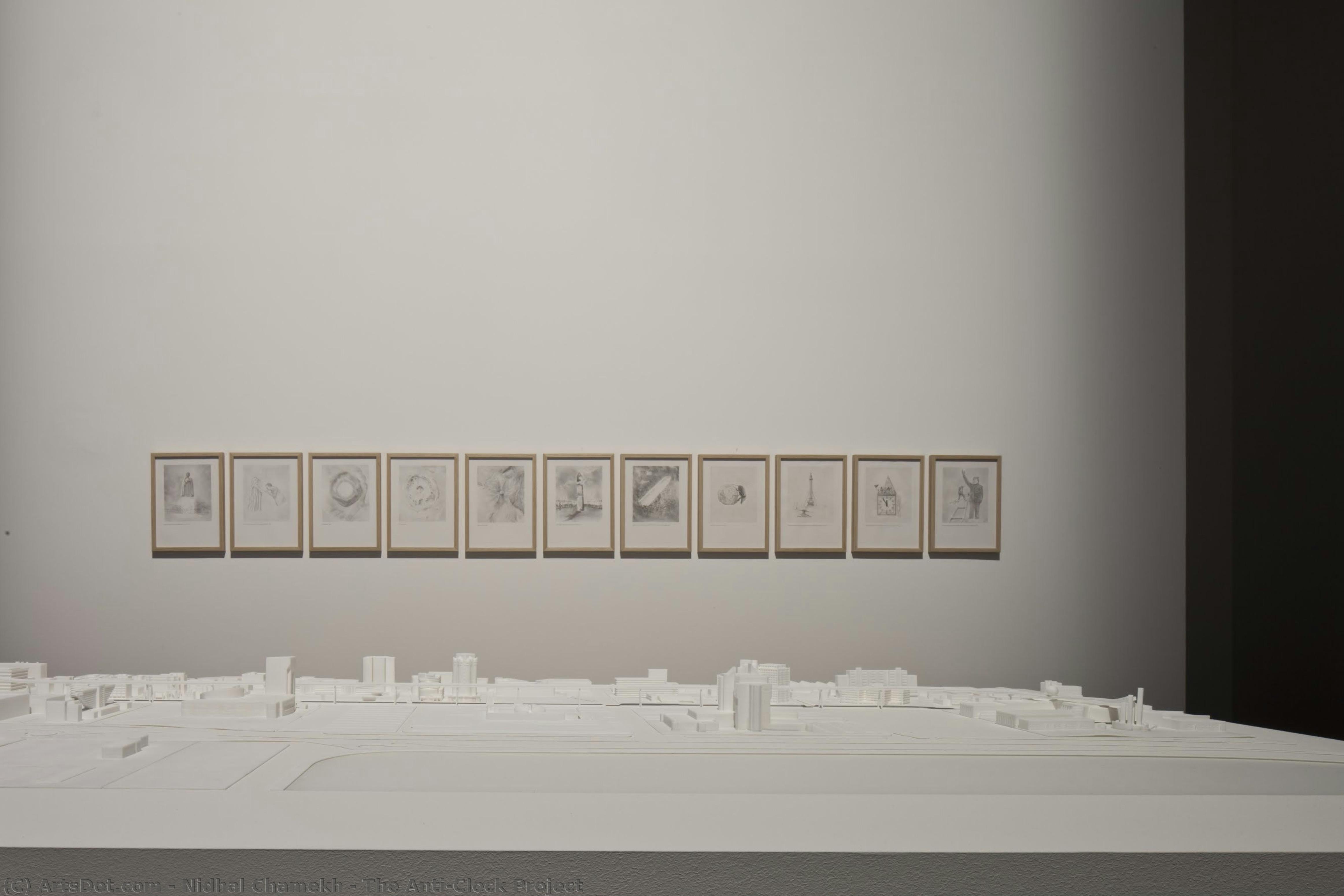
Beyond the Biennale, his exhibitions at the Musée d'Art Moderne de Paris and the musée national de Carthage underscore his role in fostering critical global dialogues. One of his most ambitious undertakings, “The Anti-Clock Project” (2015), serves as an unsettling meditation on resistance. Through a meticulously constructed tableau involving maps of urban decay and lifelike resin figures, Chamekh challenges the viewer to look beyond the surface of history and confront the unresolved conflicts that continue to haunt our modern landscape.
Through his evocative use of medium and theme, Nidhal Chamekh continues to push the boundaries of contemporary art, ensuring that the voices of the past and the struggles of the present are never truly silenced. His work remains a vital, breathing testament to the power of art to act as both a mirror to our trauma and a conduit for our collective remembrance.

nidhal chamekh
1985 - , Tunisia
Kort om kunstneren
- Artistic Movement Or Style: Contemporary drawing & installations
- Date Of Birth: 1985
- Full Name: nidhal chamekh
- Nationality: Tunisian
- Notable Artworks: ['The Anti-Clock Project']
- Place Of Birth: Menzel Bouarab, Tunisia

