Bytt til trykk
 Vis hele teksten







































 For kunstverk eller reproduksjoner som er større enn 105 cm (ca. 41 tommer) på noen side, vil rammen bli sendt som et sett som må monteres. Denne metoden sikrer trygg levering og forhindrer skader under transport.


Michelangelo Buonarroti’s Doni Tondo: A Renaissance Echo in Circular Form
The *Doni Tondo*, completed between 1506 and 1507 by Michelangelo Buonarroti, stands as a singular achievement within the artist's oeuvre – his only surviving finished panel painting. This circular tempera on wood masterpiece, measuring 120 cm in diameter and residing within the esteemed Galleria degli Uffizi in Florence, transcends mere visual beauty; it’s a profound meditation on Renaissance ideals: familial devotion, divine grace, and artistic innovation. Commissioned by Agnolo Doni, a prosperous Florentine merchant, to commemorate his marriage to Maddalena Strozzi in 1504, the painting wasn't simply decorative—it was a deliberate statement of status and piety, reflecting the vibrant cultural landscape of Florence during its High Renaissance zenith.- A Celebration of Love & Family: The commission itself speaks volumes about the values cherished during this period. Marriage represented not just companionship but also the continuation of lineage and prosperity—themes powerfully conveyed through the central figures.
- Innovative Composition: Michelangelo boldly departed from conventional portraiture by employing a *tondo*, or circular format, an unusual choice that immediately evokes notions of harmony, perfection, and eternity – concepts paramount to Renaissance artistic thought. This deliberate decision elevates the image beyond the mundane, suggesting it aspires to capture something transcendent.
- Symbolic Depth: The painting’s iconography is rich with layered meanings. At its core lies the Holy Family—Mary cradling Christ—a depiction imbued with tenderness and strength simultaneously. Surrounding them are four nude male figures, whose identities remain debated amongst art historians but are widely interpreted as representing Old Testament prophets or pagan ancestors – symbolizing the pivotal transition from antiquity to Christianity.
Style & Technique: Bridging Antiquity and Mannerism
Michelangelo’s approach in the *Doni Tondo* marks a crucial juncture in art history, foreshadowing the emergence of Mannerism—a stylistic movement characterized by elongated forms, dramatic poses, and meticulous detail. Unlike earlier Renaissance styles that prioritized idealized beauty and balance, Michelangelo embraced expressive distortion, pushing boundaries to convey emotion and psychological complexity. The artist skillfully utilized tempera paint on wood, a technique known for its luminosity and durability, achieving remarkable textural richness through careful layering and modeling—a testament to his unparalleled sculptural training informing his painting practice.
- Classical Influence: Michelangelo’s meticulous study of classical sculptures profoundly shaped his artistic vision. The anatomical precision evident in the figures' musculature reflects the humanist fascination with human form, mirroring ideals championed by artists like Leonardo da Vinci.
- Dynamic Movement & Emotion: Observe how Michelangelo captures movement and emotion through dynamic poses—the Virgin Mary’s serene gaze contrasts sharply with Christ’s youthful vitality. These gestures convey a palpable sense of drama and spiritual fervor.
- Atmospheric Perspective: The subtle gradations of color in the background landscape create an illusion of depth, reinforcing the circular frame's symbolic representation of eternity—a technique characteristic of Renaissance panel painting.
Historical Context & Legacy The *Doni Tondo* stands as a beacon of Florentine artistic excellence during the High Renaissance – a period defined by intellectual curiosity and artistic experimentation. Its creation coincided with the patronage of influential families like the Medici, who actively fostered artistic innovation and celebrated humanist ideals. Michelangelo’s masterpiece continues to inspire awe and admiration centuries later, serving as a cornerstone of Western art history and demonstrating the enduring power of artistic expression to convey profound spiritual truths. It remains a captivating subject for contemplation and reproduction—a tangible connection to one of the greatest artists of all time.
Spørsmål og svar
Kan jeg bestille en olje-reproduksjon av "Doni Tondo"?
Du kan bestille en håndmalt reproduksjon av "Doni Tondo" av Michelangelo Buonarroti direkte på siden for Håndmalt oljereproduksjon: en håndmalt oljereproduksjon på linlerret, laget etter bestilling.
Hvor anbefales det å stille ut Kvadratisk format-formatet av "Doni Tondo"?
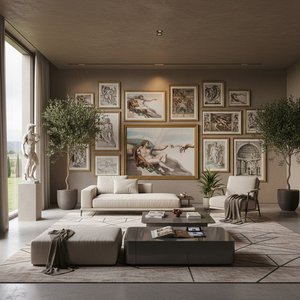
Format (Kvadratisk format) og anbefalt rom (Stue og oppholdsrom) er de to plasseringsegenskapene som er registrert for "Doni Tondo" av Michelangelo Buonarroti.
Hvilke farger dominerer "Doni Tondo" av Michelangelo Buonarroti?
"Doni Tondo" av Michelangelo Buonarroti bruker en Nøytrale farger-palett, med Rosabrun (#bba685) som den dominerende fargen.
 Forhåndsvisning
 Send
Send Del
Del
 Vis detaljer
 Utskriftsvennlig guide

 Last ned bilde
 Liknende objekter
 Røntgenundersøkelse
 Lysbildefremvisning
 Q&A
Q&A Statistikk