Surrealist Expressionism · 1927
The Forest (Max Ernst, 1927)
Max Ernst (1891–1976) har skapt The Forest. Den er fra 1927. Det tilhører Surrealist Expressionism-bevegelsen. Laget i Acrylic On Canvas. Verket er bevart ved Tel Aviv Museum of Art i Tel Aviv, Israel. Mål: 25 × 36 cm
- 1927
- Acrylic On Canvas
- 25 × 36 cm
- Tel Aviv Museum of Art

 Forhåndsvisning

 Håndmalt oljemaleri
 Send
 Del
 Faktablad for elever


 Last ned bilde
 Liknende objekter
 Røntgenundersøkelse
 Lysbildefremvisning
 Spørsmål og svar

 Statistikk
The Forest, kort fortalt
- Tittel
- The Forest
- Kunstner
- Max Ernst (1891–1976)
- Kunstner født i
- Brühl, Tyskland
- Dato
- 1927
- Materiale
- Acrylic On Canvas
- Mål
- 25 × 36 cm
- Utstillingssted
- Tel Aviv Museum of Art, Tel Aviv, Israel
- Bevegelse
- Surrealist Expressionism
- Tidsperiode
- Early Modern
- Motiv
- moonlit cityscape, surreal forest, urban night, max ernst, german art, 1927 painting
Hva forestiller The Forest?
A Nocturne of Dreams: Max Ernst’s “The Forest”
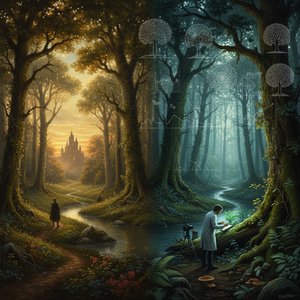
Max Ernst's "The Forest," painted in 1927, isn’t merely a depiction of a landscape; it’s an immersion into the subconscious, a carefully constructed dreamscape rendered with the unsettling beauty characteristic of the artist’s early Surrealist explorations. This intimate canvas – measuring just 25 x 36 cm – holds within its borders a potent collision of natural and urban elements, inviting viewers to contemplate the anxieties and aspirations simmering beneath the surface of modern life. The painting immediately draws the eye upward to a luminous moon dominating the sky, casting an ethereal glow upon the sprawling cityscape below. Buildings rise from the darkness, not as symbols of progress or order, but as strangely distorted monoliths, hinting at a world both familiar and profoundly alien.
Ernst’s technique is deliberately evocative, employing a layered approach that anticipates techniques he would later refine in his collage work. He utilizes loose, expressive brushstrokes, building up the forms of trees and buildings with a sense of urgency and movement. The color palette leans heavily into cool blues and greens, punctuated by the stark white of the moon and the muted tones of the city lights – colors that contribute to the painting’s nocturnal atmosphere and imbue it with a feeling of quiet mystery. Notice how he doesn't meticulously render detail; instead, he favors suggestion and mood, allowing the viewer’s imagination to fill in the gaps.
The Seeds of Surrealism: Ernst’s Intellectual Landscape
Understanding “The Forest” requires acknowledging Max Ernst’s unique artistic trajectory. Born in Brühl, Germany, in 1891, Ernst wasn't a traditional painter; his path was forged through rigorous academic study – philosophy, art history, literature, psychology, and psychiatry at the University of Bonn. This intellectual grounding profoundly shaped his approach to art, moving him beyond mere representation towards exploring the realm of dreams, memory, and the irrational. His father, a teacher of the deaf, instilled in him a sensitivity to the world and a rebellious spirit – qualities that would become central to Ernst’s artistic vision. He was deeply influenced by thinkers like Freud and Jung, particularly their theories on the unconscious mind, which he sought to translate into visual form.
The year 1927 is crucial within this context. It represents a pivotal moment in Ernst's development as a Surrealist, a period marked by experimentation with automatism – a technique of spontaneous creation designed to bypass conscious control and tap directly into the subconscious. "The Forest," therefore, can be seen as a product of this process, a visual manifestation of his inner world.
Symbolic Echoes: Nature Versus Urbanity
The juxtaposition of the forest and the city is laden with symbolic weight. The forest, traditionally associated with nature, instinct, and the primal, stands in stark contrast to the rigid geometry and artificial light of the urban landscape. This isn’t a harmonious blend; rather, it's a tension – a suggestion that the encroachment of modernity threatens to overwhelm the natural world. The moon itself is a potent symbol, often linked to cycles, intuition, and the hidden realms of the unconscious. Its presence elevates the scene beyond a simple cityscape, transforming it into a dreamlike tableau.
Furthermore, consider the distorted forms of the buildings. They aren’t simply architectural structures; they seem to lean inward, almost collapsing under their own weight, mirroring perhaps a sense of unease or anxiety about the future. The trees, though present, are somewhat obscured by the city's glow, hinting at a diminishing connection with nature.
A Timeless Resonance: Reproduction and Artistic Legacy
"The Forest" continues to resonate with viewers today because it taps into fundamental human experiences – the longing for escape, the anxieties of urban life, and the enduring power of the subconscious. OriginalUniqueArt’s meticulously crafted hand-painted reproductions capture not only the visual details of Ernst's original but also its emotional depth and atmospheric quality. Each reproduction is created with the same attention to texture and color as the original, ensuring a faithful representation of this iconic Surrealist masterpiece. Whether you are an art collector seeking to expand your collection or an interior designer searching for a unique piece to elevate a space, a OriginalUniqueArt reproduction of “The Forest” offers a captivating glimpse into the mind of one of 20th-century’s most visionary artists.
Hvilket museum har The Forest?
Tel Aviv Museum of Art
Tel Aviv, Israel
Et fyrtårn av kreativitet ved Middelhavets bredder Dypt inne i det pulserende hjertet av Tel Aviv, en by som vibrerer av kunstnerisk energi og historisk betydning, står Tel Aviv Museum of Art —et sant vitnesbyrd om Israels blomstrende kulturlandskap. Mer enn bare et depot for mesterverk, puster TAMA, som det kjærlig kalles, liv i kunsten ved å fremme dialog, inspirere generasjoner og fungere som en vital lenke mellom nasjonens fortid og dens dynamiske nåtid. Historien begynner ikke i storslåtte saler, men innenfor de beskjedne veggene i hjemmet til Tel Avivs første borgermester, et rom gjennomsyret av ekkoene fra en nasjon som formet sin egen identitet.


Høyoppløselige bilder av The Forest

Beskyttet av opphavsrett: disse filene er kun til personlig bruk og utgjør ikke en lisens for gjenopptrykk.
Max Ernst, The Forest (1927), Tel Aviv Museum of Art.
Spørsmål om The Forest, besvart
Hvor kan "The Forest" av Max Ernst sees utstilt i dag?
Du kan se originalen av "The Forest" på Tel Aviv Museum of Art, Tel Aviv, Israel.
Hva er dateringen til "The Forest" av Max Ernst?
"The Forest" av Max Ernst ble skapt i 1927.
Hvilken teknikk er "The Forest" laget med?
Max Ernst brukte Acrylic On Canvas-teknikken i "The Forest". Teknikken definerer det materielle uttrykket til det originale verket.
Hva er målene på det originale verket "The Forest" av Max Ernst?
De registrerte målene for "The Forest" av Max Ernst er 25 x 36 cm. Reproduksjoner kan bestilles i andre størrelser med de samme proporsjonene.
Hva forestiller "The Forest"?
Temaene i "The Forest" av Max Ernst inkluderer moonlit cityscape, surreal forest, urban night, max ernst, german art, 1927 painting, dreamlike scene. Sammen oppsummerer de verkets motiv.
Er bildet av "The Forest" av Max Ernst i det frie domene?
Når det gjelder opphavsrett, er "The Forest" fortsatt beskyttet av opphavsretten.
Hvem er kunstneren bak "The Forest"?
"The Forest" tilskrives Max Ernst.
Hvilken stilart tilhører "The Forest"?
Kunstretningen knyttet til "The Forest" av Max Ernst er Surrealist Expressionism. Denne klassifiseringen plasserer verket sammen med relaterte kunstnere og kunstverk.
Hvilken periode i Max Ernst sin karriere tilhører "The Forest"?
I Max Ernst sin karriere tilhører "The Forest" Early Surrealism. Denne perioden gjør det mulig å sammenligne verket med kunstnerens øvrige arbeider.
Om kunstneren, Max Ernst

1891–1976, Tyskland
Max Ernst
Livet og opprinnelsen til Max Ernst Max Ernst trådte inn i verden den 2. april 1891 i Brühl, Tyskland. Han vokste opp i en katolsk middelklassefamilie som det tredje av ni barn. Oppveksten ble formet av den stille og disiplinerte atmosfæren i hjemmet, der faren, Philipp, arbeidet som lærer for døve.
Andre verk av Max Ernst
 Célèbes eller Elefant Célèbes1921
 Elefant Celebes1921
 Europa etter regnet II1942
 Av dette skal ingen vite1923
Essays om The Forest
 Symphony of Sunlight: The Luminous Legacy of Pine Tree Landscapes in Art HistoryExplore the luminous history of pine landscapes through Sorolla and Shishkin. Discover the magic of forest art today.
 Unlocking the Unconscious: The Top 25 Surrealist Masterpieces by Max ErnstStep into the dreamscapes of Max Ernst. Explore 25 iconic Surrealist masterpieces, from pioneering collages to haunting landscapes. Find in…
 The Enchanted Canopy: Exploring Forests in Art History – From Romantic Idealization to Ecological ConsciousnessExplore the rich history of forests in art! Discover Romantic masterpieces by Friedrich & Monet, Symbolist depths, and contemporary visions…