Oljeversjon
 Alt om Trinity







































 For kunstverk eller reproduksjoner som er større enn 105 cm (ca. 41 tommer) på noen side, vil rammen bli sendt som et sett som må monteres. Denne metoden sikrer trygg levering og forhindrer skader under transport.


A Portal to the Divine: The Dawn of Renaissance Realism
To step before Masaccio’s Holy Trinity is to witness the exact moment when the flattened, symbolic world of the Middle Ages dissolved into the profound, breathing reality of the Renaissance. Painted between 1425 and 1427 within the hallowed walls of Santa Maria Novella in Florence, this fresco does not merely depict a religious scene; it carves a hole in the very wall of the chapel, inviting the viewer to step into a sacred, three-dimensional space. At its heart lies a revolutionary commitment to humanism—the belief that the divine can be understood through the lens of human experience and physical truth. Through his masterful command of light and form, Masaccio transformed a static icon into a living drama of salvation.
The composition is anchored by the central figure of Jesus Christ, depicted with a startling naturalism that was unprecedented for his era. He stands as the axis of the universe, flanked by the Virgin Mary and Saint John the Evangelist. Unlike the ethereal, weightless figures of the preceding Gothic period, Masaccio’s subjects possess a palpable sense of mass and gravity. Their robes fall with heavy, realistic folds, and their faces carry an emotional depth that speaks to the viewer across centuries. This is not art meant for distant adoration alone; it is art designed to resonate with the human soul, making the theological mysteries of the Trinity feel intimately present within our own physical realm.
The Architecture of Illusion: Mastery of Perspective
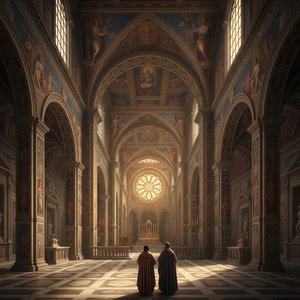
Perhaps the most enduring legacy of this masterpiece is Masaccio’s pioneering use of linear perspective. By employing a single vanishing point, he created an architectural illusion so convincing that contemporary viewers felt they were looking into a real, deep chapel rather than at a painted surface. The coffered barrel vault above the figures recedes with mathematical precision, guiding the eye upward and inward. This technical triumph was not merely a display of skill; it served a profound symbolic purpose. By placing the holy figures within a believable, structured environment, Masaccio bridged the gap between the earthly and the divine, suggesting that the sacred exists within the very geometry of our world.
This sense of depth is further enhanced by his sophisticated use of chiaroscuro. The subtle interplay of light and shadow—the way light seems to strike the figures from a consistent source—gives them a sculptural quality. This technique breathes life into the flesh, defining the musculature of Christ and the gentle contours of Mary’s face. For the modern collector or interior designer, this mastery of volume offers a sense of structural elegance and intellectual depth, making it a piece that commands attention through its quiet, commanding presence.
A Timeless Legacy for the Discerning Collector
Beyond the technical brilliance, the Holy Trinity remains an emotional powerhouse. It captures the tension between human mortality and eternal hope. At the base of the composition, the inclusion of the donors—the mortal figures who commissioned the work—serves as a poignant reminder of our own place in the grand tapestry of history. They stand at the threshold, looking up toward the divine, mirroring the journey of every viewer who encounters this fresco.
For those seeking to adorn a space with art that inspires contemplation and awe, a high-quality reproduction of this Masaccio masterpiece offers more than mere decoration. It brings into a home or gallery a piece of the very foundation of Western art. Whether placed in a study filled with books or as a focal point in a grand living space, the Holy Trinity provides an atmosphere of profound stability, historical richness, and enduring beauty. It is an invitation to pause, to look deeper, and to rediscover the breathtaking realism that first ignited the Renaissance.
Spørsmål og svar
Er Trinity malt for hånd eller er det et trykk?
Håndmalt: en utdannet kunstner kopierer Trinity i olje på linlerret.
Hvilken størrelse bør jeg velge for Trinity?
Originalen måler 640 x 317 cm. Størrelsene varierer fra 43.1 x 23.2 cm (Nkr1856) til 241.4 x 130.1 cm (Nkr11267); tabellen på denne siden viser de viktigste alternativene og deres priser.
Hvor lang tid tar leveringen?
Levering tar 4 til 5 uker med gratis ekspressfrakt over hele verden; en mulighet for hurtigproduksjon tilbys på denne siden. Du kan returnere varen innen 100 dager for full refusjon, uten betingelser.
Hvor befinner originalen av Trinity seg?
Originalen er i samlingen til Santa Maria Novella, Firenze.
Hvilket medium brukte Masaccio for Trinity?
Fresco
 Send
 Del
 Vis detaljer
 Faktablad


 Last ned bilde
 Liknende objekter
 Lysbildefremvisning
 Spørsmål og svar

 Statistikk