

 Forhåndsvisning
 Send
Send Del med andre
 Vis detaljer

 Last ned bildet
 Liknende objekter
 Røntgenundersøkelse
 Lysbildefremvisning
 Statistikk
About Young Sister
 Oil On Canvas
- WallArt
- Expressionism
 1911
1911- Modern
 73.0 x 60.0 cm
 Vis hele teksten
Kjøp et høyoppløselig, forbedret digitalt bilde som er langt bedre enn forhåndsvisningen på nettet.
Hver fil er omhyggelig klargjort av våre egne spesialister ved hjelp av avanserte verktøy og profesjonell manuell retusjering. Vi sørger for at hvert bilde har eksepsjonell klarhet, presis fargegjengivelse og fine detaljer.
Den endelige filen leveres via e-post innen 72 timer, optimalisert for umiddelbar bruk i profesjonelle, redaksjonelle og trykte miljøer. Dette er den samme kvaliteten som benyttes av ledende designstudioer, utgivere og gallerier.
Digitalt bilde
Last ned en høyoppløselig fil for personlig bruk, utskrift og kreative prosjekter. ( Bytt til trykk Kjøp håndlaget maleri)
Inkludert i alle bestillinger av digitale bilder
Ekspert digital levering, garantert
Når du velger OriginalUniqueArt.com, får du ikke bare et bilde – du mottar et profesjonelt forbedret digitalt kunstverk, skapt med presisjon og med en garantert tilfredshetsgaranti. Her er alt som automatisk følger med din bestilling:

Rask digital levering
Din høyoppløselige digitale bildefil sendes til din e-post innen 72 timer etter bestilling – klar til umiddelbar bruk.

KI-forbedret digital fil
Ditt kunstverk blir profesjonelt optimalisert ved hjelp av avanserte AI-verktøy og manuell redigering, noe som sikrer maksimal detaljrikdom, klarhet og fargegjengivelse.

Gratis livslang nyutlevering
Har du ved et uhell slettet eller mistet filen din? Ingen bekymring – vi sender den på nytt når som helst, helt gratis.

Ingen importavgifter – noen gang
Nyt ditt kunstverk umiddelbart uten toll, avgifter eller leveringskostnader – digitale nedlastinger er alltid avgiftsfrie.

Garantert fargenøyaktighet
Vi sikrer at ditt digitale bilde gjenspeiler de originale fargene så nøyaktig som mulig ved hjelp av profesjonelle verktøy og fargehåndtering.

100 dagers tilfredshetsgaranti
Hvis du ikke er fornøyd med ditt digitale bilde, vil vi revidere det eller refundere 100% innen 100 dager – uten spørsmål.

100% Penggaranti
Ikke fornøyd? Få full refusjon innen 100 dager etter at du har mottatt din digitale fil – uten spørsmål.

Rabatt ved storkjøp
Kjøp 3 bilder, spar 10% - Kjøp 5, spar 15% - Kjøp 10+, spar 20%. Ideelt for kreative prosjekter, gallerier og byråer.
About “About Young Sister” – A Glimpse into Duchamp’s Early Style
Marcel Duchamp's *About Young Sister*, painted in 1911, offers a fascinating window into the artist’s formative period—a time of stylistic exploration before his radical departures into Conceptual Art. This 73 x 60 cm canvas isn’t a straightforward portrait; rather, it’s an evocative study of form and atmosphere, hinting at a figure engaged with music while simultaneously dissolving into abstraction.Subject & Composition
The artwork centers on a seated individual, strongly suggested to be playing a stringed instrument – likely a violin – though the depiction is far from literal. The figure isn’t sharply defined; instead, it emerges from and blends with large, amorphous shapes that surround it. Duchamp deliberately positions the subject slightly off-center, creating a dynamic tension within the composition. These surrounding forms aren't merely background elements but active participants in defining space and mood.Style & Technique
*About Young Sister* showcases Duchamp’s early leanings towards both Expressionism and Cubism. Visible brushstrokes and a loose, painterly style dominate the surface, prioritizing emotional expression over precise representation. The color palette is deliberately muted – primarily beige, brown, and gray – contributing to a somber yet contemplative atmosphere. Duchamp employs expressive lines to delineate forms, favoring soft transitions over harsh edges. Layering of paint creates texture and depth, while the diffused lighting minimizes strong contrasts, flattening the image plane. The lack of traditional perspective further emphasizes this flatness, relying instead on spatial relationships between shapes.Historical Context & Artistic Evolution
Created in 1911, *About Young Sister* predates Duchamp’s most famous and provocative works like *Fountain*. It represents a crucial stage in his artistic development, demonstrating his engagement with the avant-garde movements of the time. While still rooted in representational painting, the work foreshadows his later rejection of traditional artistic conventions. Duchamp was beginning to question the very definition of art, moving away from purely “retinal” experiences (pleasing the eye) towards works that engaged the intellect.Symbolism & Emotional Impact
The piece evokes a sense of introspection and perhaps melancholy. The abstracted form of the figure and the muted color scheme contribute to this mood. The musical instrument suggests themes of creativity, expression, and possibly longing. The ambiguity inherent in the work invites viewers to project their own interpretations onto it, fostering a personal connection with the artwork. It’s not simply *about* a young sister; it's about memory, emotion, and the elusive nature of perception.For Collectors & Designers
*About Young Sister* is an exceptional example of Duchamp’s early work, offering collectors a rare opportunity to acquire a piece that demonstrates his artistic transition. Its subdued palette and abstract forms make it incredibly versatile for interior design. It would complement modern or minimalist spaces, adding depth and sophistication without overwhelming the room.- Ideal for living rooms, studies, or bedrooms.
- Pairs well with neutral color schemes and natural materials.
- A conversation starter that showcases discerning taste.
Om kunstneren
A Revolutionary Spirit: The Life and Art of Marcel Duchamp
Marcel Duchamp, born Henri-Robert-Marcel Duchamp in 1887 in Blainville-Crevon, Normandy, was more than an artist; he was a philosophical provocateur who fundamentally altered the course of modern art. His early life, though seemingly conventional – nurtured within a family that appreciated artistic expression with both brothers pursuing successful careers as artists – hinted at the iconoclasm to come. Duchamp initially pursued formal training, mastering traditional techniques and experimenting with post-impressionist styles. However, this academic foundation served not as an end in itself, but as a springboard for questioning the very nature of art, its purpose, and its definition. He wasn’t content merely to depict the world; he sought to challenge how we perceive it, and what constitutes artistic value. This restless intellectual curiosity would become the defining characteristic of his prolific career.Early Artistic Explorations: Cubism and Impressionism
Duchamp's initial foray into art began with a grounding in traditional techniques—primarily painting—influenced by Impressionist masters like Claude Monet and Pierre-Auguste Renoir. He honed his skills diligently, capturing fleeting moments of light and color with remarkable precision. Yet, even within these aesthetically pleasing compositions, Duchamp harbored doubts about the role of representation itself. Recognizing that art could transcend mere visual imitation, he turned his attention to Cubism, spearheaded by Pablo Picasso and Georges Braque. This movement embraced fragmented forms and multiple perspectives—a radical departure from the single viewpoint demanded by Renaissance painting—and Duchamp skillfully incorporated these principles into works like *Portrait of Chess Players* (1911). The fractured planes and overlapping viewpoints mirrored his own intellectual preoccupation with dismantling established conventions.The Dadaist Rebellion: Challenging Artistic Norms
The horrors of World War I profoundly impacted Duchamp’s worldview, fueling a deep disillusionment with the values of reason and logic that underpinned Western civilization. This discontent propelled him into the embrace of Dadaism—a movement born out of utter rejection of artistic dogma and societal complacency. Dadaists like Tristan Tzara and Hugo Ball sought to dismantle traditional notions of art through absurdity, chance, and anti-rational gestures. Duchamp wholeheartedly embraced this rebellious spirit, producing provocative pieces that defied categorization and challenged viewers’ expectations. His Dadaist output included collages incorporating found objects—such as newspaper clippings and photographs—and performances designed to disrupt artistic rituals. The infamous *Fontaine* (1917)—a porcelain urinal signed “R. Mutt”—became the emblem of Dada’s radical critique of art, sparking controversy and cementing Duchamp's reputation as a revolutionary iconoclast.The Birth of Conceptual Art: Beyond Representation
Duchamp’s most enduring contribution to art history was arguably his pioneering role in establishing Conceptual Art—a movement that prioritized idea over execution. Rejecting the visual arts altogether, Conceptual Artists questioned whether an artwork could exist without tangible form. Duchamp famously declared, “The idea precedes the object,” encapsulating this fundamental shift in artistic thinking. He continued to explore this concept through various mediums, including assemblage and photography. *L.H.O.O.Q.* (1919)—a postcard reproduction of Leonardo da Vinci’s Mona Lisa overlaid with a mustache and goatee—served as a deliberate parody of art history and a commentary on the veneration of artistic genius. Duchamp's intention wasn’t to create a beautiful image; it was to provoke reflection on notions of authorship, originality, and the very definition of art itself.Legacy and Enduring Influence
Marcel Duchamp’s influence extends far beyond his own lifetime, shaping the trajectory of countless artists who followed him. His unwavering commitment to conceptual thought—the primacy of idea over form—established a paradigm that continues to resonate within contemporary artistic practice. Artists across disciplines—from sculpture to performance art to video installation—have drawn inspiration from Duchamp’s challenge to conventional aesthetic standards and his insistence on questioning accepted truths. He remains a central figure in discussions about the role of art in society, prompting us to consider whether beauty is truly paramount or if intellectual engagement—the pursuit of ideas—is equally valuable. His legacy endures as a testament to the transformative power of artistic innovation and the enduring relevance of Duchamp’s revolutionary vision.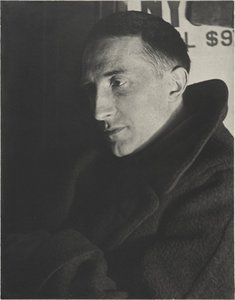
Marcel Duchamp
1887 - 1968 , Frankrike
Kort om kunstneren
- Artistic Movement Or Style:
- Kubisme
- Dadaisme
- Konseptuell kunst
- Artists Or Movements Influenced By This Artist:
- Kubisme
- Popkunst
- Minimalisme
- Date Of Birth: 28 juli 1887
- Date Of Death: 2 oktober 1968
- Full Name: Marcel Duchamp Henri-Robert-Marcel
- Nationality: Fransk-Amerikansk
- Notable Artworks:
- Fontane
- L.H.O.O.Q.
- Det Store Glas
- Boîte-en-valise
- Place Of Birth: Blainville, Frankrike