

 Se i rommet
 Del som digitalt kort
 Del
Del
 Detaljer
 Studentguide

 Last ned
 Liknende objekter
 Røntgen
 Lysbildefremvisning
 Besøksstatistikk
Resurketion
 Olje på lerret
- Veggkunst
- Surrealism
 1952
1952- Moderne
 168.0 x 108.0 cm
 Les mer
Kunstverket som vises på denne siden er beskyttet av opphavsretten, noe som betyr at vi ikke har juridisk tillatelse til å lage eller selge identiske reproduksjoner. Denne beskyttelsen håndheves i henhold til internasjonale avtaler som for eksempel Bernerkonvensjonen og av nasjonale lover, inkludert de som er fastsatt i Amerikansk opphavsrettslov – Tittel 17.
Denne metoden er i fullt samsvar med opphavsrettslige regler, da den ikke innebærer kopiering eller duplisering av det beskyttede kunstverket. I stedet er det snakk om en kreativ nytolkning – et nytt maleri som er inspirert av originalen, men ikke identisk med den.
Giclée / Kunsttrykk
Giclée- eller lerretsprint av museumskvalitet med rask produksjon og fleksible valgmuligheter for etterbehandling. ( Bestill håndmalt reproduksjon Gå til digitalt bilde)




P118B Nkr10

P118H Nkr10

P118W Nkr10

P438Z Nkr10

P508JH Nkr12

P508YH Nkr12

P805H Nkr10

P805Z Nkr10

P919BZ Nkr10

P919G Nkr10

P919XJ Nkr10

P959ZH Nkr10

P968JZ Nkr12

W106C Nkr8

W218G Nkr10

W218JH Nkr8

W218Y Nkr10

W307PJ Nkr10

W316G Nkr10

W316PJ Nkr8

W316Y Nkr10

W398PJ Nkr8

W4111J Nkr10

W500HY Nkr15

W500JH Nkr15

W692G Nkr12

W849H Nkr8

W940BG Nkr15

W953PJ Nkr8




Velg mellom våre forhåndsdefinerte størrelser som bevarer kunstverkets opprinnelige proporsjoner.

Skriv inn bredden og høyden du trenger, slik at den passer til din ramme eller vegg. Et trykk kan kun beskjæres, aldri gjøres større enn bildet, så et format med en annen form vil miste en del av motivet. Vi sender deg en digital mockup for godkjenning før vi trykker noe som helst. Bildet som vises på denne siden viser ikke den faktiske beskjæringen — det er kun mockuppen som gjør det.
Verdensomspennende levering () på 2 uker i stedet for standard 4/5 uker. (21 October)

Gratis ekspressfrakt over hele verden

Lerretsduk av høykvalitets lin

Full transportforsikring

Garanti for refusjon av toll og importavgifter

Garantert fargeekthet

100 dagers returrett ved fabrikasjonsfeil

100% pengene tilbake-garanti

Mengderabatt
 Glassalternativet er kun tilgjengelig i størrelser under 110 cm

Resurketion
Giclée / Kunsttrykk
Format på reproduksjon
-


Totalpris
Nkr 755
A Vision of Resurrection: Chagall’s Surrealist Masterpiece
Marc Chagall's 1952 painting, *Resurrection*, is a profoundly moving work that encapsulates the artist’s signature blend of dreamlike imagery, vibrant color, and deeply felt spiritual themes. Measuring 168 x 108 cm, this oil on canvas transcends simple depiction, offering instead an emotional and symbolic exploration of one of Christianity's most pivotal moments. It stands as a testament to Chagall’s ability to transform biblical narratives into intensely personal expressions of faith and sorrow—a feat that continues to resonate with audiences today.The Scene: Chaos and Hope Intertwined
The painting presents a dynamic and unsettling vision of the crucifixion and resurrection. Jesus Christ is depicted on the cross, not in isolation, but surrounded by a swirling mass of figures – some expressing anguish, others appearing as bewildered witnesses. Chagall deliberately eschews traditional realism; forms are distorted, perspectives fragmented, and bodies seem to float within the composition. Animals—horses and dogs prominently featured—add an element of earthly presence and emotional intensity to this otherwise ethereal scene. The backdrop is a fiery orange sky, suggestive of both divine judgment and transformative power. This deliberate rejection of conventional representation underscores Chagall’s commitment to conveying emotion rather than factual accuracy – a hallmark of his artistic approach throughout his prolific career.Symbolism and Spiritual Depth
Chagall imbues *Resurrection* with layers of symbolism. A central figure holding a lantern introduces a beacon of hope amidst the chaos, representing guidance or spiritual illumination. The fragmented figures can be interpreted as embodying the collective human experience of suffering and faith. The inclusion of animals is characteristic of Chagall’s work, often symbolizing innocence, vulnerability, and connection to the natural world. Resurrection isn't a literal retelling of the biblical story; it’s an exploration of its emotional resonance and spiritual significance. The lantern itself symbolizes divine grace—a guiding light amidst darkness—a motif frequently revisited in Chagall’s oeuvre.Artistic Style: Surrealism & Tachisme
Chagall’s style in *Resurrection* is firmly rooted in surrealism, though it also anticipates elements of tachisme – a spontaneous, gestural approach to painting that emerged in the early 1950s. His use of bold color, loose brushwork, and dreamlike imagery creates a sense of otherworldly beauty and emotional power. While influenced by Cubism’s geometric fragmentation, Chagall developed a uniquely personal visual language that prioritized feeling over strict representation. The visible brushstrokes and impasto-like textures contribute to the painting’s tactile quality and expressive energy. Tachisme—characterized by rapid execution and unfiltered emotion—allowed Chagall to capture the immediacy of his inner vision—a technique that distinguishes *Resurrection* from more polished academic styles.Historical Context: Post-War Reflection
Painted in 1952, *Resurrection* reflects the post-World War II climate of spiritual searching and existential questioning. Chagall, having experienced displacement and loss during the war, turned to religious themes as a source of solace and meaning. The painting can be seen as a response to the horrors of the conflict, offering a message of hope and renewal in the face of devastation. It’s also important to note the rise of tachisme at this time, with critics like Charles Estienne and Michel Tapié championing spontaneous abstraction – an aesthetic that resonates with Chagall's expressive style. This artistic decision underscores Chagall’s desire to communicate profound emotion—a testament to his enduring legacy as one of the most influential artists of the 20th century.Emotional Impact and Lasting Appeal
*Resurrection* is a deeply moving work that invites contemplation on themes of faith, suffering, and hope. Its emotional intensity and visual richness make it a compelling subject for art lovers and collectors alike. The painting’s enduring appeal lies in its ability to transcend religious boundaries and speak to the universal human experience. A reproduction of this masterpiece can bring a touch of spiritual depth and artistic beauty to any interior space—a reminder that true artistry resides not merely in accurate depiction but in conveying profound emotion.Spørsmål og svar
Hvor mettet er fargepaletten i "Resurketion"?
"Resurketion" av Marc Chagall er gjengitt med en Balansert myk metning.
Hvilket rom anbefales "Resurketion" av Marc Chagall for, med tanke på fargene?
Med sine Jordnær farger, anbefales "Resurketion" for et Stue og oppholdsrom.
Hvilke proporsjoner har "Resurketion" av Marc Chagall, og hva er målene?
"Resurketion" av Marc Chagall har proporsjonene til et Portrettformat-verk på 168 x 108 cm.
Kunstnerbiografi
A Life Painted in Dreams: The World of Marc Chagall
Marc Chagall, born Moishe Shagal in 1887 in the small Belarussian town of Liozna near Vitebsk, wasn’t merely a painter; he was a poet of color, a weaver of dreams, and a chronicler of memory. His life, spanning nearly a century, mirrored the tumultuous currents of the 20th century, yet his art remained steadfastly rooted in a deeply personal vision—one infused with the folklore of his Hasidic Jewish upbringing and an unwavering belief in the power of imagination. Vitebsk itself was more than just a birthplace; it became the emotional core of his artistic universe, a recurring motif populated by flying figures, whimsical animals, and the vibrant hues of remembered landscapes. The town’s unique blend of cultures—Russian Orthodox churches alongside bustling Jewish marketplaces—forged an aesthetic sensibility that would defy easy categorization throughout his long career. Though he sought formal training first with a local sign painter and later in St. Petersburg under Léon Bakst, and then in Paris at the Académie de la Grande Chaumière, Chagall never fully embraced any single artistic movement. He absorbed elements of Cubism, Symbolism, and Fauvism, but always filtered them through his own intensely personal lens, creating a style that was uniquely, unmistakably Chagall.Early Influences and Artistic Beginnings
Chagall’s formative years were marked by the traditions of Vitebsk’s Jewish community—a world steeped in ritual, storytelling, and vibrant visual culture. These influences would permeate his artistic vision throughout his life. His initial training was modest, focusing on practical skills as a sign painter, but he quickly developed an aptitude for drawing and painting, driven by an innate desire to capture the beauty of the natural world and the complexities of human emotion. St. Petersburg provided him with access to influential teachers like Léon Bakst, who encouraged him to experiment with theatrical design and introduced him to the principles of Cubism—a movement that would profoundly impact his artistic style. However, Chagall resisted rigid stylistic conventions, prioritizing instead a deeply expressive approach rooted in observation and imagination. His early canvases already hinted at the distinctive language he would develop – paintings like *I and the Village* (1911) are not simply depictions of place; they are explorations of identity, memory, and the relationship between the individual and community. The village isn’t rendered realistically but as a fragmented collection of recollections, imbued with symbolic meaning. This ability to transmute personal experience into universal themes became a hallmark of his art.The Symbolism of Flight and Memory
Chagall's artistic style quickly distinguished itself through its characteristic use of color and imagery—particularly the motif of flight. Figures soar across canvases in fantastical landscapes, defying gravity and logic, creating a dreamlike atmosphere that invites viewers into his inner world. This stylistic choice wasn’t accidental; it stemmed from a desire to move beyond mere imitation of reality and capture the essence of feeling, the weight of memory, and the power of folklore. Recurring symbols—such as apples, birds, and biblical figures—appear throughout his oeuvre, conveying profound emotional resonance and hinting at deeper spiritual concerns. His palette was bold and expressive, often employing vibrant, non-naturalistic colors to convey emotion rather than literal representation. This approach solidified his reputation as a visionary artist who dared to explore the subconscious mind and express ideas beyond conventional boundaries.From Vitebsk to Paris: Artistic Transformation
The Russian Revolution dramatically altered Chagall’s life trajectory, bringing him back to Vitebsk where he became involved in cultural initiatives, establishing an art school that briefly flourished before succumbing to the restrictions imposed by the new regime. This period was marked by both creative energy and political disillusionment, a tension that would continue to shape his artistic trajectory. He embraced Surrealism, influenced by André Breton and fellow artists, experimenting with dreamlike imagery and irrational juxtapositions—a stylistic shift that reflected the anxieties and uncertainties of the time. The outbreak of World War II forced him to flee occupied France for the United States, where he spent seven years in New York City. This period was marked by profound emotional upheaval and artistic experimentation. He found solace in his art, creating powerful works that reflected the traumas of war and displacement—particularly *White Crucifixion* (1938), a haunting depiction of suffering and persecution.Legacy and Recognition
After the war, Chagall returned to France, where he continued to paint and create until his death in 1985 at the age of 97. He received numerous prestigious commissions, including the ceiling of the Paris Opera (1964), a breathtaking explosion of color and form that celebrated musical masterpieces, and stunning stained glass windows for the Hadassah Hebrew University Medical Center synagogue in Jerusalem. These large-scale projects allowed him to translate his artistic vision into architectural spaces, creating immersive environments that continue to inspire awe and wonder. Chagall’s influence on subsequent generations of artists is undeniable. His lyrical quality, emotional depth, and imaginative power resonated with Surrealists and other movements that embraced fantasy and symbolism. He bridged the gap between European modernism and Jewish cultural identity, becoming known as “the quintessential Jewish artist of the twentieth century.” His ability to synthesize personal experience, folklore, and universal themes continues to resonate with audiences worldwide. Marc Chagall’s legacy extends beyond his paintings and stained glass; it resides in the enduring power of his vision—a vision that celebrates love, memory, and the boundless possibilities of the human imagination.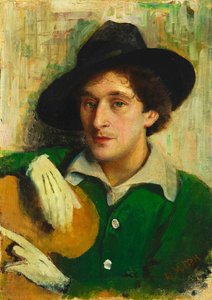
Marc Chagall
1887 - 1985 , Belarus
Kort om kunstneren
- Artistic Movement Or Style: Modernism, Kubism
- Artists Or Movements Influenced By This Artist:
- Surrealism
- Modern konst
- Artists Who Influenced This Artist:
- Bakst
- Delaunay
- Borovikovsky
- Date Of Birth: 7 juli 1887
- Date Of Death: 28 mars 1985
- Full Name: Marc Chagall
- Nationality: Russisk, senare fransk
- Notable Artworks:
- I och byen
- Vitbesk
- Vitkrifixion
- Place Of Birth: Liozna, Belarus
Relaterte artikler

Oil on Canvas: A Historical & Technical Exploration of a Timeless Artistic Medium
Explore the rich history & enduring techniques of oil painting on canvas. Discover the science behind its longevity, conservation practices, and contemporary relevance. Expert insights for art enthusiasts.

The Soul of Impressionism: Why Oil on Canvas Captures Eternal Light and Timeless Emotion
Discover the enchanting alchemy of Impressionism. Explore how the mastery of oil on canvas, through glazing and impasto, captures eternal light and emotion. Perfect for lovers of Monet and Van Gogh seeking the profound depth of hand-painted fine art.

The Enduring Legacy of Oil on Canvas: Technique, History & Aesthetic Impact
Explore the rich history & techniques of oil painting – from Renaissance masters to Impressionism. Discover pigments, layering methods, and why this timeless medium endures. Expert insights for artists & art enthusiasts.

Oljemaleriets varige arv: Teknikk, historie og samtidspraksis
Utforsk oljemaleriets fascinerende historie og teknikker! Lær om mestere, materialer og samtidspraksis. Få ekspertråd og inspirasjon for ditt neste kunstprosjekt.
De 10 mest ikoniske oljemalerier som forandret kunsthistorien – OriginalUniqueArt.com
Oppdag de 10 mest innflytelsesrike oljemaleriene gjennom tidene! Fra Mona Lisa til Van Goghs mesterverk – lær historien bak ikoniske kunstverk og finn inspirasjon for ditt hjem. Museumskvalitet reproduksjoner på OriginalUniqueArt.com.


