- Forsiden

- Reproduksjon av oljemaleri
- Marc Chagall
- Moses receiving the Tablets of Law (9)

 Bestill trykk Kjøp digitalt bilde
 Send
Send
 Del med andre
 Vis detaljer
 Legg til i favoritter

 Last ned bildet
 Liknende objekter
 Røntgenundersøkelse
 Lysbildefremvisning
Moses receiving the Tablets of Law (9)
 Akryl på lerret
- Veggkunst
- Naïve Art (Primitivism)
 1963
1963- Moderne kunst
 46.0 x 38.0 cm
 Vis hele teksten
Håndlaget oljereproduksjon
Håndmalt olje på lerret i din valgte størrelse og ramme, laget på bestilling av våre kunstnere.




P118B $10

P118H $10

P118W $10

P438Z $10

P508JH $12

P508YH $12

P805H $10

P805Z $10

P919BZ $10

P919G $10

P919XJ $10

P959ZH $10

P968JZ $12

W106C $8

W218G $10

W218JH $8

W218Y $10

W307PJ $10

W316G $10

W316PJ $8

W316Y $10

W398PJ $8

W4111J $10

W500HY $15

W500JH $15

W692G $12

W849H $8

W940BG $15

W953PJ $8




Velg mellom våre forhåndsdefinerte størrelser som bevarer kunstverkets opprinnelige proporsjoner.

Du kan angi egne mål for å tilpasse en spesifikk ramme eller plass. Dersom den valgte størrelsen ikke samsvarer med originalbildets proporsjoner, vil vi enten beskjære kunstverket eller utvide maleriet med ytterligere håndmalte elementer. En digital mockup vil bli sendt til din godkjenning før produksjonen starter.
Vennligst merk at forhåndsvisningen på skjermen ikke gjenspeiler den faktiske beskjæringen eller utvidelsen. Kun mockuppen vil vise den endelige komposisjonen nøyaktig.
Selv om tilpassede størrelser er tilgjengelige, anbefaler vi å velge et mål fra den forhåndsdefinerte listen for å bevare de originale proporsjonene.
Etter bestilling vil OriginalUniqueArt.com-teamet sende e-post til kunden for instruksjoner og sende et utkast (mockup) som forhåndsvisning.
Verdensomspennende levering () på 3–4 uker i stedet for standard 5 uker. (16 July). Ingen kompromisser med kvaliteten.

Gratis ekspressfrakt over hele verden

Lerretsduk av høykvalitets lin

Full forsikring under transport

Garanti for refusjon av toll og importavgifter

Garantert korrekt fargegjengivelse

60 dagers returrett (kun ved feil)

100% pengene tilbake-garanti

Rabatt ved flere kjøp
 Glassalternativet er kun tilgjengelig i størrelser under 110 cm

Moses receiving the Tablets of Law (9)
Teknikk for reproduksjon
Størrelse på reproduksjon
-


Endelig pris
-
Beskrivelse av kunstverket
Marc Chagall: A Life in Color and Imagination
Marc Chagall (1887-1985) var en russisk og fransk kunstner hvis liv og verk er et bemerkende vitnesbyrd om en unik kreativitet. Han var en tidlig modernist, sterkt knyttet til École de Paris, men også til en rekke andre kunstneriske stiler. Chagall skapte et utrolig variert antall arbeider, fra malerier og tegninger til bokillustrasjoner, glasskunst, scenografi, keramikk og trykk – alt preget av hans intense følelser og en dyp fascinasjon for menneskets eksistens. Hans tidlige liv i den lille belarusiske landsbyen Liozna, nær Vitebsk, var avgjørende for å forme hans kunstneriske identitet; her ble han introdusert for den hasidiske jødisk-tradisjonelle kulturen som skulle bli en konstant kilde til inspirasjon gjennom hele livet. Først reiste Chagall mellom St. Petersburg, Paris og Berlin, hvor han begynte å utvikle sin egen unike stil, basert på hans interesse for østeuropeisk og jødisk folketro. Under første verdenskrig fant Chagall tilflukt i sitt hjemlige Belarus, der han ble en fremtredende kunstner og en sentral skikkelse innen den modernistiske avantgardens bevegelser, og grunnla Vitebsk Kunsthøgskole. De påfølgende årene var preget av vanskelige forhold i Russland etter oktoberrevolusjonen – Chagall arbeidet under harde betingelser i Moskva før han igjen søkte tilflukt i Paris i 1923. Under andre verdenskrig flyktet han fra okkupert Frankrike til USA, hvor han bodde i New York City i syv år før han returnerte til Frankrike i 1948. Chagalls kunst er en unik blanding av det personlige og det politiske, av det religiøse og det profane, og hans arbeid har hatt en enorm innflytelse på kunstnere over hele verden.Naïve Kunst: En Verden Fylt med Drømmer
Naïve kunst, også kjent som primitivismen, er en bevegelse som oppstod i begynnelsen av det 20. århundre og kjennetegnes av sin enkelhet, mangel på formell utdannelse og et fokus på drømmende scener. Chagall var en sentral skikkelse innen denne bevegelsen, og hans kunst er preget av en uskyldig og ren estetikk som appellerer til følelsene. Han hentet inspirasjon fra sin jødiske arv og bibelske historier, og overførte disse fortellingene til et visuelt språk fylt med symbolikk og fantasi. Chagalls bruk av sterke farger, ofte i kombinasjon med enkle former og linjer, skaper en følelse av magi og mystikk som er typisk for denne kunstretningen."Moses Receiving the Tablets of Law": Et Øyeblikk av Åpenbaring
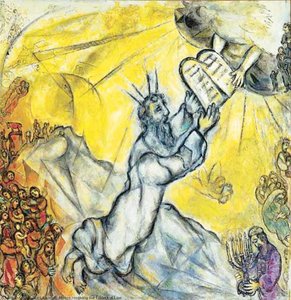
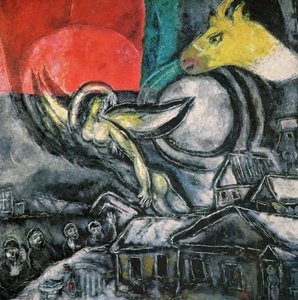
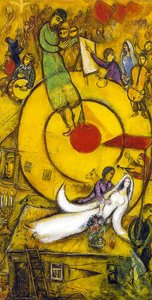
I dette spesifikke verket, "Moses Receiving the Tablets of Law (9)", ser vi et ikonisk øyeblikk fra bibelsk historie – Moses mottar de ti budene fra Gud på Sinai. Chagall fanger denne episoden med en intens følelse av åpenbaring og mystikk. Figuren av Moses, sentral i jødisk tro, står foran en mengde mennesker, utstrekker armene mot himmelen og mottar de hellige tabletter. De levende fargene – gult, blått og hvitt – skaper en følelse av å være i et guddommelig rom, mens de drømmende komposisjonene og de forvrengte figurene gir bildet en surrealistisk kvalitet.Symbolikk og Mening
Bildet er fullt av symbolsk betydning. Fuglene representerer frihet og den åndelige oppstigningen, mens folkemengden symboliserer menneskeheten som vitner om dette hellige øyeblikket. Tabletter, selvsagt, representerer loven og moralen, men også det guddommelige ordet. Chagalls bruk av naive teknikker – enkle penselstrøk, sterke farger og en mangel på perspektiv – bidrar til å skape en følelse av uskyld og renhet, som er typisk for denne kunstretningen. Det er et bilde som appellerer til vår dypeste følelser av tro, håp og menneskelighet.En Arv av Farge og Fantasi
Chagalls arbeid fortsetter å inspirere kunstnere i dag, og hans bidrag til naive kunstbevegelsen er uten tvil betydningsfulle. "Moses Receiving the Tablets of Law (9)" er et bevis på hans talent og kreativitet, og viser hvordan tradisjonelle temaer kan tolkes gjennom moderne kunstneriske stiler. Dette bildet er en kraftig påminnelse om den vedvarende innflytelsen av bibelske fortellinger på kunst og kultur, og dets evne til å berøre oss på et dypt følelsesmessig nivå.- The Naïve Art (Primitivism) Art Movement
- Painting by 'Marc Chagall' | Marc Chagall:Moses receiving the Tablets of Law (33 x 33 cm,Naive Art / Primitivism,Ink,)
- Painting by 'Marc Chagall' | Marc Chagall:Moses receiving the Tablets of Law (33 x 32 cm,Naive Art / Primitivism,Ink,)
For more information on naïve art and Marc Chagall's contributions to this movement, visit Wikipedia.org - Naïve Art. Photo Description: The painting is a colorful depiction of Moses receiving the tablets from God. The scene features several people in various positions, including one person holding a book above their head. There are also two birds visible in the painting, with one located near the top left corner and another towards the center-right area. The main focus is on Moses, who appears to be standing in front of a crowd of people. He is holding his hands up as if he's receiving the tablets from God. The image captures the essence of faith and spirituality through its vibrant colors and detailed composition. Size: 46 x 38 cm Date: 1963 movement: Naïve Art (Primitivism) topics: Moses, Tablets, God, Biblical, Faith, Religion, Symbolism, Jewish Folklore creative_period: Mature Period corpus_context: Inspired by Jewish heritage & biblical tales., Religious symbolism, divine communication., Central to his Biblical Message series., Blending folklore with spiritual contemplation.
Om kunstneren
A Life Painted in Dreams: The World of Marc Chagall
Marc Chagall, born Moishe Shagal in 1887 in the small Belarussian town of Liozna near Vitebsk, wasn’t merely a painter; he was a poet of color, a weaver of dreams, and a chronicler of memory. His life, spanning nearly a century, mirrored the tumultuous currents of the 20th century, yet his art remained steadfastly rooted in a deeply personal vision—one infused with the folklore of his Hasidic Jewish upbringing and an unwavering belief in the power of imagination. Vitebsk itself was more than just a birthplace; it became the emotional core of his artistic universe, a recurring motif populated by flying figures, whimsical animals, and the vibrant hues of remembered landscapes. The town’s unique blend of cultures—Russian Orthodox churches alongside bustling Jewish marketplaces—forged an aesthetic sensibility that would defy easy categorization throughout his long career. Though he sought formal training first with a local sign painter and later in St. Petersburg under Léon Bakst, and then in Paris at the Académie de la Grande Chaumière, Chagall never fully embraced any single artistic movement. He absorbed elements of Cubism, Symbolism, and Fauvism, but always filtered them through his own intensely personal lens, creating a style that was uniquely, unmistakably Chagall.Early Influences and Artistic Beginnings
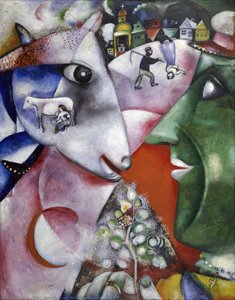
Chagall’s formative years were marked by the traditions of Vitebsk’s Jewish community—a world steeped in ritual, storytelling, and vibrant visual culture. These influences would permeate his artistic vision throughout his life. His initial training was modest, focusing on practical skills as a sign painter, but he quickly developed an aptitude for drawing and painting, driven by an innate desire to capture the beauty of the natural world and the complexities of human emotion. St. Petersburg provided him with access to influential teachers like Léon Bakst, who encouraged him to experiment with theatrical design and introduced him to the principles of Cubism—a movement that would profoundly impact his artistic style. However, Chagall resisted rigid stylistic conventions, prioritizing instead a deeply expressive approach rooted in observation and imagination. His early canvases already hinted at the distinctive language he would develop – paintings like *I and the Village* (1911) are not simply depictions of place; they are explorations of identity, memory, and the relationship between the individual and community. The village isn’t rendered realistically but as a fragmented collection of recollections, imbued with symbolic meaning. This ability to transmute personal experience into universal themes became a hallmark of his art.The Symbolism of Flight and Memory
Chagall's artistic style quickly distinguished itself through its characteristic use of color and imagery—particularly the motif of flight. Figures soar across canvases in fantastical landscapes, defying gravity and logic, creating a dreamlike atmosphere that invites viewers into his inner world. This stylistic choice wasn’t accidental; it stemmed from a desire to move beyond mere imitation of reality and capture the essence of feeling, the weight of memory, and the power of folklore. Recurring symbols—such as apples, birds, and biblical figures—appear throughout his oeuvre, conveying profound emotional resonance and hinting at deeper spiritual concerns. His palette was bold and expressive, often employing vibrant, non-naturalistic colors to convey emotion rather than literal representation. This approach solidified his reputation as a visionary artist who dared to explore the subconscious mind and express ideas beyond conventional boundaries.From Vitebsk to Paris: Artistic Transformation
The Russian Revolution dramatically altered Chagall’s life trajectory, bringing him back to Vitebsk where he became involved in cultural initiatives, establishing an art school that briefly flourished before succumbing to the restrictions imposed by the new regime. This period was marked by both creative energy and political disillusionment, a tension that would continue to shape his artistic trajectory. He embraced Surrealism, influenced by André Breton and fellow artists, experimenting with dreamlike imagery and irrational juxtapositions—a stylistic shift that reflected the anxieties and uncertainties of the time. The outbreak of World War II forced him to flee occupied France for the United States, where he spent seven years in New York City. This period was marked by profound emotional upheaval and artistic experimentation. He found solace in his art, creating powerful works that reflected the traumas of war and displacement—particularly *White Crucifixion* (1938), a haunting depiction of suffering and persecution.Legacy and Recognition
After the war, Chagall returned to France, where he continued to paint and create until his death in 1985 at the age of 97. He received numerous prestigious commissions, including the ceiling of the Paris Opera (1964), a breathtaking explosion of color and form that celebrated musical masterpieces, and stunning stained glass windows for the Hadassah Hebrew University Medical Center synagogue in Jerusalem. These large-scale projects allowed him to translate his artistic vision into architectural spaces, creating immersive environments that continue to inspire awe and wonder. Chagall’s influence on subsequent generations of artists is undeniable. His lyrical quality, emotional depth, and imaginative power resonated with Surrealists and other movements that embraced fantasy and symbolism. He bridged the gap between European modernism and Jewish cultural identity, becoming known as “the quintessential Jewish artist of the twentieth century.” His ability to synthesize personal experience, folklore, and universal themes continues to resonate with audiences worldwide. Marc Chagall’s legacy extends beyond his paintings and stained glass; it resides in the enduring power of his vision—a vision that celebrates love, memory, and the boundless possibilities of the human imagination.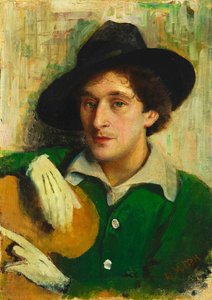
Marc Chagall
1887 - 1985 , Belarus
Kort om kunstneren
- Artistic Movement Or Style: Modernism, Kubism
- Artists Or Movements Influenced By This Artist:
- Surrealism
- Modern konst
- Artists Who Influenced This Artist:
- Bakst
- Delaunay
- Borovikovsky
- Date Of Birth: 7 juli 1887
- Date Of Death: 28 mars 1985
- Full Name: Marc Chagall
- Nationality: Russisk, senare fransk
- Notable Artworks:
- I och byen
- Vitbesk
- Vitkrifixion
- Place Of Birth: Liozna, Belarus
Relaterte artikler
Sacred Narratives on Canvas: Exploring Biblical Art Across Centuries
Explore the rich history of biblical art from Giotto to the Renaissance masters. Discover symbolism, techniques & enduring legacies with OriginalUniqueArt – your source for museum-quality reproductions and expert art insights.
Illuminating Faith: Biblical Scenes & Their Enduring Legacy in Art History
Explore the profound history of biblical art! Discover Renaissance masterpieces by Giotto & more. Uncover symbolism, artistic techniques, and lasting influence. Expert insights at OriginalUniqueArt.
Alfred Wallis: Rediscovering the Naïve Visionary of Cornish Life
Discover the captivating world of Alfred Wallis, the self-taught Cornish painter championed by modernists. Explore his unique naive style, maritime scenes & lasting legacy with OriginalUniqueArt.

Jean-Marc Nattier: Rococo Portraiture & Aristocratic Patronage
Explore the exquisite Rococo portraits of Jean-Marc Nattier, favored by French aristocracy. Discover his artistic techniques, patronage network, and lasting legacy – a guide for discerning collectors.
Primitivism in Art: Exploring the Roots of Modern Expression & its Enduring Legacy
Explore the fascinating history of Primitivism in art – its origins, key artists like Gauguin & Picasso, and lasting impact on modern expression. Uncover the complexities of this influential movement with OriginalUniqueArt.