

 Se i rommet
 Del som digitalt kort
 Del
Del
 Detaljer
 Studentguide

 Last ned
 Liknende objekter
 Røntgen
 Lysbildefremvisning
 Besøksstatistikk
Fiancee with bouquet


 Les mer
Kunstverket som vises på denne siden er beskyttet av opphavsretten, noe som betyr at vi ikke har juridisk tillatelse til å lage eller selge identiske reproduksjoner. Denne beskyttelsen håndheves i henhold til internasjonale avtaler som for eksempel Bernerkonvensjonen og av nasjonale lover, inkludert de som er fastsatt i Amerikansk opphavsrettslov – Tittel 17.
Denne metoden er i fullt samsvar med opphavsrettslige regler, da den ikke innebærer kopiering eller duplisering av det beskyttede kunstverket. I stedet er det snakk om en kreativ nytolkning – et nytt maleri som er inspirert av originalen, men ikke identisk med den.
Giclée / Kunsttrykk
Giclée- eller lerretsprint av museumskvalitet med rask produksjon og fleksible valgmuligheter for etterbehandling. ( Bestill håndmalt reproduksjon Gå til digitalt bilde)




P118B Nkr10

P118H Nkr10

P118W Nkr10

P438Z Nkr10

P508JH Nkr12

P508YH Nkr12

P805H Nkr10

P805Z Nkr10

P919BZ Nkr10

P919G Nkr10

P919XJ Nkr10

P959ZH Nkr10

P968JZ Nkr12

W106C Nkr8

W218G Nkr10

W218JH Nkr8

W218Y Nkr10

W307PJ Nkr10

W316G Nkr10

W316PJ Nkr8

W316Y Nkr10

W398PJ Nkr8

W4111J Nkr10

W500HY Nkr15

W500JH Nkr15

W692G Nkr12

W849H Nkr8

W940BG Nkr15

W953PJ Nkr8




Velg mellom våre forhåndsdefinerte størrelser som bevarer kunstverkets opprinnelige proporsjoner.

Du kan oppgi egne mål for å tilpasse en spesifikk ramme eller et bestemt område. Dersom den valgte størrelsen ikke samsvarer med det originale bildets proporsjoner, vil vi enten beskjære kunstverket eller utvide bildet med en speilet eller ensfarget kant. En digital mockup vil bli sendt til din godkjenning før produksjonen starter.
Vennligst merk at forhåndsvisningen på skjermen ikke gjenspeiler den faktiske beskjæringen eller utvidelsen. Kun mockuppen vil vise den endelige komposisjonen nøyaktig.
Selv om tilpassede størrelser er tilgjengelige, anbefaler vi å velge et mål fra den forhåndsdefinerte listen for å bevare de originale proporsjonene.
Verdensomspennende levering () på 2 uker i stedet for standard 4/5 uker. (12 October)

Gratis ekspressfrakt over hele verden

Lerretsduk av høykvalitets lin

Full transportforsikring

Garanti for refusjon av toll og importavgifter

Garantert fargeekthet

100 dagers returrett ved fabrikasjonsfeil

100% pengene tilbake-garanti

Mengderabatt
 Glassalternativet er kun tilgjengelig i størrelser under 110 cm

Fiancee with bouquet
Giclée / Kunsttrykk
Format på reproduksjon
-


Totalpris
Nkr 744
A Tapestry of Dreams: Exploring Marc Chagall’s ‘Fiancee with Bouquet’
Marc Chagall's 'Fiancee with Bouquet,' painted in 1977, stands as a quintessential embodiment of his signature Naïve Art style—a genre characterized by its childlike spontaneity and rejection of academic conventions. More than just a depiction of a woman holding flowers; it’s an invitation into Chagall’s deeply imaginative world, where reality blends seamlessly with myth and memory. The painting resides within Vitebsk, Belarus, reflecting the artist's lifelong fascination with his birthplace and its cultural heritage.Style and Technique: Embracing Primitivism
Chagall’s technique eschews meticulous realism, opting instead for bold color palettes and simplified forms—a deliberate choice that prioritizes emotional expression over precise representation. Thick brushstrokes dominate the canvas, conveying a palpable sense of movement and texture. The artist employs flattened perspectives, creating an illusionistic space that feels both familiar and otherworldly. This stylistic approach aligns perfectly with Naïve Art’s ethos: to capture the essence of experience rather than its literal details. The luminous blues and yellows characteristic of Vitebsk landscapes permeate the composition, mirroring Chagall's own recollections of his formative years.Historical Context: Vitebsk Under Siege
Painted during a period marked by significant political upheaval—specifically Vitebsk’s tumultuous defense against Nazi invasion in 1941—the artwork carries an undeniable resonance with its time. Chagall himself experienced firsthand the horrors of war, and this trauma profoundly influenced his artistic output. The inclusion of figures huddled together under umbrellas symbolizes resilience and solidarity amidst adversity – a poignant reflection of Vitebsk’s spirit during the siege. Furthermore, the painting's depiction of a serene woman surrounded by flowers serves as an antidote to the anxieties of the era, representing hope and beauty in the face of darkness.Symbolism: Folklore and Fantasy
‘Fiancee with Bouquet’ is replete with symbolic imagery drawn from Jewish folklore and Chagall’s personal mythology. The woman herself embodies femininity and grace—a recurring motif throughout his oeuvre. Her gaze directs upwards towards the heavens, signifying spiritual aspiration and transcendence. The bouquet of flowers symbolizes love, fertility, and remembrance – elements deeply ingrained in Vitebsk’s cultural traditions. Flying figures—a hallmark of Chagall's visual language—represent liberation from earthly constraints and embody the artist’s belief in a realm beyond material concerns.Emotional Impact: A Window into Chagall’s Soul
Ultimately, ‘Fiancee with Bouquet’ transcends mere visual representation; it communicates profound emotional depth. The painting evokes feelings of nostalgia, tenderness, and wonder—drawing viewers into Chagall's dreamlike vision. Its vibrant colors and expressive brushstrokes captivate the senses, transporting us back to Vitebsk and inviting contemplation on themes of love, loss, and faith. It’s a testament to Chagall’s ability to distill complex psychological states into accessible artistic forms – a masterpiece that continues to inspire audiences worldwide.Spørsmål og svar
Hvilke motiver fremkommer i "Fiancee with bouquet" av Marc Chagall?
Temaene i "Fiancee with bouquet" av Marc Chagall inkluderer woman, bouquet, landscape, twilight, figures, dreamlike, folklore. Sammen oppsummerer de verkets motiv.
Hva anbefales en reproduksjon av "Fiancee with bouquet" av Marc Chagall til?
Anbefalt bruk av et trykk av "Fiancee with bouquet" er Accent.
Hva slags verk er "Fiancee with bouquet"?
"Fiancee with bouquet" er et WallArt-verk.
Hvilken størrelse bør jeg velge for trykk av "Fiancee with bouquet" til rommet mitt?
I et Living Room anbefales det å trykke "Fiancee with bouquet" i størrelsen Large.
Hvordan møtes kunstretning og epoke i "Fiancee with bouquet" av Marc Chagall?
"Fiancee with bouquet" tilhører Naive Art Naïve Art-retningen, og skaperen arbeidet i Moderne tid-epoken.
Hvor gammel var Marc Chagall da "Fiancee with bouquet" ble skapt?
Da "Fiancee with bouquet" ble skapt i 1977, var Marc Chagall – født i 1887 – 90 år gammel.
Hvilken følelse formidler "Fiancee with bouquet" av Marc Chagall?
I "Fiancee with bouquet" ledsages en Romantic stemning av en Melancholic følelse.
Hvilket rom foreslås det at "Fiancee with bouquet" plasseres i, med tanke på fargepaletten?
Med sine Dark farger, anbefales "Fiancee with bouquet" for et Living Room.
Kunstnerbiografi
A Life Painted in Dreams: The World of Marc Chagall
Marc Chagall, born Moishe Shagal in 1887 in the small Belarussian town of Liozna near Vitebsk, wasn’t merely a painter; he was a poet of color, a weaver of dreams, and a chronicler of memory. His life, spanning nearly a century, mirrored the tumultuous currents of the 20th century, yet his art remained steadfastly rooted in a deeply personal vision—one infused with the folklore of his Hasidic Jewish upbringing and an unwavering belief in the power of imagination. Vitebsk itself was more than just a birthplace; it became the emotional core of his artistic universe, a recurring motif populated by flying figures, whimsical animals, and the vibrant hues of remembered landscapes. The town’s unique blend of cultures—Russian Orthodox churches alongside bustling Jewish marketplaces—forged an aesthetic sensibility that would defy easy categorization throughout his long career. Though he sought formal training first with a local sign painter and later in St. Petersburg under Léon Bakst, and then in Paris at the Académie de la Grande Chaumière, Chagall never fully embraced any single artistic movement. He absorbed elements of Cubism, Symbolism, and Fauvism, but always filtered them through his own intensely personal lens, creating a style that was uniquely, unmistakably Chagall.Early Influences and Artistic Beginnings
Chagall’s formative years were marked by the traditions of Vitebsk’s Jewish community—a world steeped in ritual, storytelling, and vibrant visual culture. These influences would permeate his artistic vision throughout his life. His initial training was modest, focusing on practical skills as a sign painter, but he quickly developed an aptitude for drawing and painting, driven by an innate desire to capture the beauty of the natural world and the complexities of human emotion. St. Petersburg provided him with access to influential teachers like Léon Bakst, who encouraged him to experiment with theatrical design and introduced him to the principles of Cubism—a movement that would profoundly impact his artistic style. However, Chagall resisted rigid stylistic conventions, prioritizing instead a deeply expressive approach rooted in observation and imagination. His early canvases already hinted at the distinctive language he would develop – paintings like *I and the Village* (1911) are not simply depictions of place; they are explorations of identity, memory, and the relationship between the individual and community. The village isn’t rendered realistically but as a fragmented collection of recollections, imbued with symbolic meaning. This ability to transmute personal experience into universal themes became a hallmark of his art.The Symbolism of Flight and Memory
Chagall's artistic style quickly distinguished itself through its characteristic use of color and imagery—particularly the motif of flight. Figures soar across canvases in fantastical landscapes, defying gravity and logic, creating a dreamlike atmosphere that invites viewers into his inner world. This stylistic choice wasn’t accidental; it stemmed from a desire to move beyond mere imitation of reality and capture the essence of feeling, the weight of memory, and the power of folklore. Recurring symbols—such as apples, birds, and biblical figures—appear throughout his oeuvre, conveying profound emotional resonance and hinting at deeper spiritual concerns. His palette was bold and expressive, often employing vibrant, non-naturalistic colors to convey emotion rather than literal representation. This approach solidified his reputation as a visionary artist who dared to explore the subconscious mind and express ideas beyond conventional boundaries.From Vitebsk to Paris: Artistic Transformation
The Russian Revolution dramatically altered Chagall’s life trajectory, bringing him back to Vitebsk where he became involved in cultural initiatives, establishing an art school that briefly flourished before succumbing to the restrictions imposed by the new regime. This period was marked by both creative energy and political disillusionment, a tension that would continue to shape his artistic trajectory. He embraced Surrealism, influenced by André Breton and fellow artists, experimenting with dreamlike imagery and irrational juxtapositions—a stylistic shift that reflected the anxieties and uncertainties of the time. The outbreak of World War II forced him to flee occupied France for the United States, where he spent seven years in New York City. This period was marked by profound emotional upheaval and artistic experimentation. He found solace in his art, creating powerful works that reflected the traumas of war and displacement—particularly *White Crucifixion* (1938), a haunting depiction of suffering and persecution.Legacy and Recognition
After the war, Chagall returned to France, where he continued to paint and create until his death in 1985 at the age of 97. He received numerous prestigious commissions, including the ceiling of the Paris Opera (1964), a breathtaking explosion of color and form that celebrated musical masterpieces, and stunning stained glass windows for the Hadassah Hebrew University Medical Center synagogue in Jerusalem. These large-scale projects allowed him to translate his artistic vision into architectural spaces, creating immersive environments that continue to inspire awe and wonder. Chagall’s influence on subsequent generations of artists is undeniable. His lyrical quality, emotional depth, and imaginative power resonated with Surrealists and other movements that embraced fantasy and symbolism. He bridged the gap between European modernism and Jewish cultural identity, becoming known as “the quintessential Jewish artist of the twentieth century.” His ability to synthesize personal experience, folklore, and universal themes continues to resonate with audiences worldwide. Marc Chagall’s legacy extends beyond his paintings and stained glass; it resides in the enduring power of his vision—a vision that celebrates love, memory, and the boundless possibilities of the human imagination.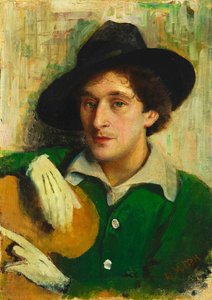
Marc Chagall
1887 - 1985 , Belarus
Kort om kunstneren
- Artistic Movement Or Style: Modernism, Kubism
- Artists Or Movements Influenced By This Artist:
- Surrealism
- Modern konst
- Artists Who Influenced This Artist:
- Bakst
- Delaunay
- Borovikovsky
- Date Of Birth: 7 juli 1887
- Date Of Death: 28 mars 1985
- Full Name: Marc Chagall
- Nationality: Russisk, senare fransk
- Notable Artworks:
- I och byen
- Vitbesk
- Vitkrifixion
- Place Of Birth: Liozna, Belarus
Relaterte artikler

John Constable: Topp 25 Maler – Engelsk Landskapskunst i Ditt Hjem
Opplev John Constables 25 mest ikoniske malerier! Fordyp deg i engelsk romantikk, landskapskunst og atmosfæriske scener. Finn museumskvalitets reproduksjoner & interiørinspirasjon på OriginalUniqueArt.com. Utforsk samlingen online!

Evocations of Place: A Historical Journey Through Landscape Art
Explore the rich history of landscape art with OriginalUniqueArt. Discover renowned artists, movements like Impressionism & Romanticism, and expert guidance for collecting timeless pieces. Find your perfect serene escape today!

Romantiske landskap: Topp 10 mesterverk for hjemmet – Kunst fra OriginalUniqueArt.com
Oppdag de 10 mest ikoniske romantiske landskapsmaleriene! Fra Caspar David Friedrich til Turner – utforsk kunsthistorien, stemningen og fargepalettene. Finn museumskvalitets reproduksjoner på OriginalUniqueArt.com.

Evocations of Place: A Historical Journey Through Landscape Art
Explore the rich history of landscape art with OriginalUniqueArt. Discover renowned artists, movements like Impressionism & tonalism, and expert guidance for collecting timeless pieces. Find your perfect serene escape today!

Evoking Nature's Sublime: A Comprehensive Exploration of 19th-Century Landscape Painting
Explore the captivating world of 19th-century landscape painting! Discover renowned artists like Friedrich & Monet, key movements, and find the perfect artwork to bring nature's serenity into your home. Expert insights at OriginalUniqueArt.


