Bytt til trykk
 Vis hele teksten







































 For kunstverk eller reproduksjoner som er større enn 105 cm (ca. 41 tommer) på noen side, vil rammen bli sendt som et sett som må monteres. Denne metoden sikrer trygg levering og forhindrer skader under transport.


A Study in Flux
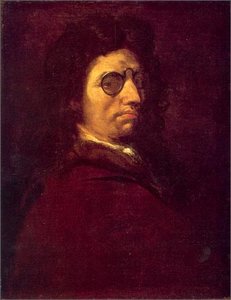
In this portrait, we find ourselves seated with a man lost in the quiet gravity of thought. The figure of Heraclitus is presented in profile, his presence defined by a dignified stillness that seems to anchor the composition. He is caught in a moment of deep intellectual labor, his gaze directed toward the tools of his inquiry—a globe and rolled maps spread across a table. A compass rose rests in his hand, a small but significant detail suggesting the navigation of both physical landscapes and abstract ideas. The light enters from the upper left, carving out the heavy folds of his dark clothing and the textured wrinkles of his aged face, leaving much of the background to recede into an indistinct, shadowy void.
The way the light catches the edge of his features creates a palpable sense of volume. There is a weight to the figure, a physical reality achieved through the careful layering of oil pigments. You can see it in the meticulous rendering of the cloak's heavy fabric and the subtle, weathered details of his skin. This technique brings a certain immediacy to the philosopher, making his contemplation feel less like an abstract concept and more like a lived experience.
The Language of Light and Shadow
There is a deliberate tension here between the luminous and the dark. While the artist’s early training under Ribera introduced a certain dramatic intensity through chiaroscuro, there is also a clear leaning toward the radiant colorism found in Venetian traditions. This balance allows the light to sculpt the subject, pulling him forward from the darkness. The deep shadows do not merely obscure; they provide the necessary contrast to highlight the textures of the maps and the smooth surface of the globe. ,
- ,
- ,
, ,The choice of subject carries its own weight. By depicting Heraclitus, the artist engages with the ancient notion that everything is in a state of constant change. The movement of light across the canvas mirrors this philosophical preoccupation with transformation and the unity of opposites. Even the inclusion of the compass rose acts as a quiet symbol for the search for knowledge amidst chaos. It is a somber, thoughtful work that invites you to linger on the details of his scholarly pursuit, finding a sense of peace in his focused, solitary study.
Spørsmål og svar
Oppbevares "Heraclitus" av Luca Giordano i kunstnerens hjemland?
Ja – kunstverket oppbevares i kunstnerens hjemland. "Heraclitus" befinner seg i Italia, mens Luca Giordano ble født i Italia.
Hvordan kan jeg få tak i en digital fil av "Heraclitus" av Luca Giordano?
Et digitalt bilde av "Heraclitus" av Luca Giordano kan kjøpes på siden for Digitalt kunstverk: nedlasting av et digitalt bilde i høy oppløsning.
Fremstår fargene i "Heraclitus" som sterke eller duse?
"Heraclitus" av Luca Giordano har en Monochromatic fargeintensitet.
 Forhåndsvisning
 Send
Send Del
Del
 Vis detaljer
 Utskriftsvennlig guide

 Last ned bilde
 Liknende objekter
 Røntgenundersøkelse
 Lysbildefremvisning
 Spørsmål og svar
 Statistikk