Bytt til trykk
 Vis hele teksten







































 For kunstverk eller reproduksjoner som er større enn 105 cm (ca. 41 tommer) på noen side, vil rammen bli sendt som et sett som må monteres. Denne metoden sikrer trygg levering og forhindrer skader under transport.


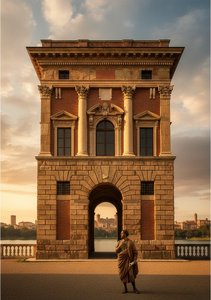
A Window into Renaissance Harmony: Façade (detail) by Leon Battista Alberti
- Subject Matter: This meticulously rendered detail captures the iconic façade of Palazzo Rucellai in Florence, Italy – a building that embodies the very principles of Renaissance architectural design. The painting isn't merely a depiction of stone and brick; it’s an exploration of order, proportion, and the harmonious relationship between human intellect and the natural world.
- Artist’s Vision: Painted by Leon Battista Alberti in 1446, this work represents more than just a commission. Alberti was a pivotal figure in the Renaissance – an architect, theorist, humanist scholar, and artist who sought to codify the rules of beauty and proportion. He believed that architecture should be rooted in mathematical ratios and geometric forms, reflecting divine order.
Technical Brilliance: A Study in Perspective and Light
- Renaissance Technique: Alberti’s masterful use of linear perspective is immediately apparent. The receding lines of the façade create a convincing illusion of depth, drawing the viewer into the heart of the building. Notice how he employs subtle shading – *chiaroscuro* – to model the stone blocks and highlight their textures, adding a remarkable sense of three-dimensionality to what is essentially a two-dimensional surface.
- Materiality: The choice of light-colored stone is crucial. It reflects the Florentine sunlight, enhancing the building’s luminosity and contributing to its overall elegance. Alberti's attention to detail extends beyond mere representation; he sought to capture the *essence* of the material itself.
Symbolism and Context: The Architecture of Humanism
- Architectural Principles: Palazzo Rucellai, designed by Alberti, was a groundbreaking structure that exemplified the humanist ideals of the Renaissance. Its symmetrical design, based on classical Roman precedents, reflected a belief in human reason and potential. The evenly spaced arches and windows were not just functional; they were symbolic representations of order and harmony.
- Historical Significance: Created during a period of immense intellectual and artistic ferment, this painting offers a valuable glimpse into the burgeoning Renaissance spirit. Alberti’s work influenced generations of architects and artists, shaping the course of Western art and architecture for centuries to come. It stands as a testament to the power of observation, mathematical precision, and human creativity.
Emotional Impact & Reproduction
- A Timeless Masterpiece: “Façade (detail)” evokes a sense of serenity, order, and intellectual contemplation. The painting’s harmonious composition invites the viewer to appreciate the beauty of architectural design and the enduring legacy of Renaissance thought.
- OriginalUniqueArt Reproduction: Our hand-painted reproductions capture every nuance of Alberti's original work, ensuring an authentic representation for your home or office. We utilize archival quality materials and skilled artisans to create a stunning piece that will be treasured for generations.
Spørsmål og svar
Hvilken stemning ville "Façade (detail)" tilføre et rom?
"Façade (detail)" av Leon Battista Alberti har en Elegant atmosfære og anbefales for et Living Room. Stemningen er det verket tilfører rommet rundt seg.
Hvilket rom passer best for "Façade (detail)", med tanke på fargepaletten?
Med sin Neutrals palett anbefales "Façade (detail)" av Leon Battista Alberti for et Living Room. Fargene er en av grunnene til denne anbefalingen.
Hva er den dominerende fargetonen i "Façade (detail)" av Leon Battista Alberti?
Den dominerende fargen i "Façade (detail)" av Leon Battista Alberti er Ochre to Sepia. Denne fargen utgjør den underliggende tonen i paletten.
 Forhåndsvisning
 Send
Send Del
Del
 Vis detaljer
 Utskriftsvennlig guide

 Last ned bilde
 Liknende objekter
 Røntgenundersøkelse
 Lysbildefremvisning
 Spørsmål og svar
 Statistikk