
 Forhåndsvisning
 Send
Send Del med andre
 Vis detaljer

 Last ned bildet
 Liknende objekter
 Røntgenundersøkelse
 Lysbildefremvisning
Allegory
 Oil On Canvas
- WallArt
- Dutch Golden Age
 1663
1663 116.0 x 97.0 cm
 Statens Museum for Kunst
 Vis hele teksten
Giclée / Kunsttrykk
Giclée- eller lerretsprint av museumskvalitet med rask produksjon og fleksible valgmuligheter for etterbehandling. ( Kjøp håndlaget maleri Kjøp bilde)




P118B $10

P118H $10

P118W $10

P438Z $10

P508JH $12

P508YH $12

P805H $10

P805Z $10

P919BZ $10

P919G $10

P919XJ $10

P959ZH $10

P968JZ $12

W106C $8

W218G $10

W218JH $8

W218Y $10

W307PJ $10

W316G $10

W316PJ $8

W316Y $10

W398PJ $8

W4111J $10

W500HY $15

W500JH $15

W692G $12

W849H $8

W940BG $15

W953PJ $8




Velg mellom våre forhåndsdefinerte størrelser som bevarer kunstverkets opprinnelige proporsjoner.

Du kan oppgi egne mål for å tilpasse en spesifikk ramme eller et bestemt område. Dersom den valgte størrelsen ikke samsvarer med det originale bildets proporsjoner, vil vi enten beskjære kunstverket eller utvide bildet med en speilet eller ensfarget kant. En digital mockup vil bli sendt til din godkjenning før produksjonen starter.
Vennligst merk at forhåndsvisningen på skjermen ikke gjenspeiler den faktiske beskjæringen eller utvidelsen. Kun mockuppen vil vise den endelige komposisjonen nøyaktig.
Selv om tilpassede størrelser er tilgjengelige, anbefaler vi å velge et mål fra den forhåndsdefinerte listen for å bevare de originale proporsjonene.
Verdensomspennende levering () på 2 uker i stedet for standard 4/5 uker. (13 August)

Gratis ekspressfrakt over hele verden

Lerretsduk av høykvalitets lin

Full forsikring under transport

Garanti for refusjon av toll og importavgifter

Garantert korrekt fargegjengivelse

60 dagers returrett (kun ved feil)

100% pengene tilbake-garanti

Rabatt ved flere kjøp
 Glassalternativet er kun tilgjengelig i størrelser under 110 cm

Allegory
Giclée / Kunsttrykk
Størrelse på reproduksjon
-


Endelig pris
$ 80
Beskrivelse av samleobjektet
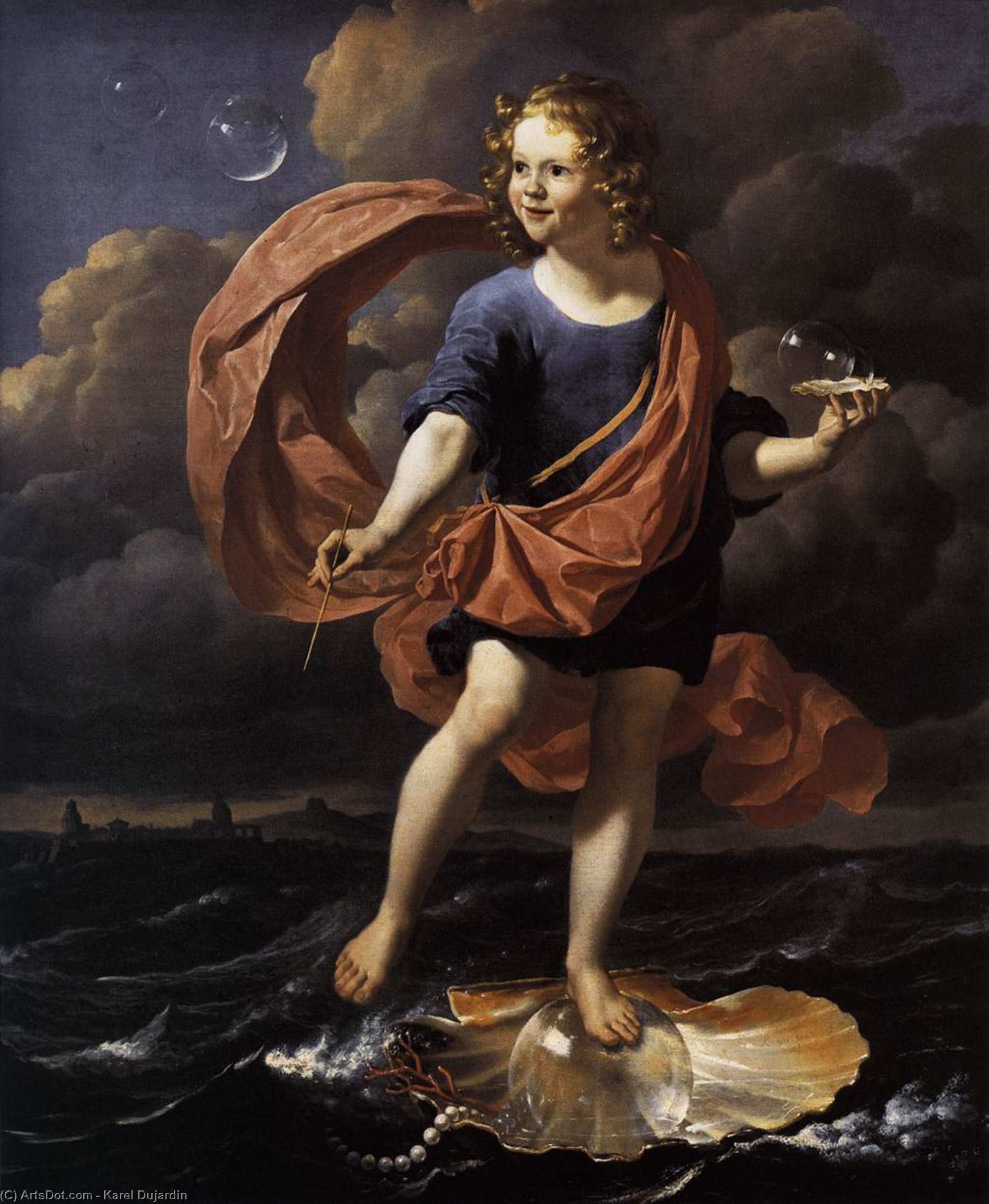
Karel Dujardin’s “Allegory”: A Fleeting Beauty Captured in Light
Karel Dujardin's "Allegory," painted in 1663, is more than just a picturesque scene; it’s a poignant meditation on the ephemeral nature of life and beauty. Born in Amsterdam during the height of the Dutch Golden Age, Dujardin was a master of capturing fleeting moments – particularly those involving light, animals, and idyllic landscapes. This particular work, housed within the National Gallery in London, exemplifies his signature style: a delicate balance between realism and idealized vision, imbued with a subtle melancholy that speaks to the transience of all things.
The painting depicts a young boy, dressed in a vibrant blue tunic and a flowing pink cloak, standing on the back of what appears to be a large sea creature – perhaps a whale or dolphin. He holds a small wand aloft, releasing a flurry of iridescent bubbles into the air. The backdrop is a hazy, cloudy sky, lending an atmospheric quality that enhances the sense of dreamlike serenity. Scattered throughout the scene are other figures, engaged in various activities—a woman tending to flowers, a man sailing a boat, and others enjoying the leisurely pace of life by the water’s edge. The inclusion of these secondary figures subtly underscores the central theme: a shared appreciation for beauty amidst the inevitable passage of time.
A Symbol of Transience: The Bubbles as Metaphor
At first glance, “Allegory” might seem simply a charming depiction of childhood play and a beautiful landscape. However, Dujardin deliberately employs symbolism to elevate the scene beyond mere representation. The bubbles themselves are the key to unlocking the painting’s deeper meaning. In 17th-century Dutch art, blowing bubbles was a well-established motif, representing the fleeting nature of life – much like the delicate spheres themselves. Each bubble rises briefly into the air before bursting, mirroring the transient beauty and joy that characterize human existence.
The boy’s posture—relaxed, almost carefree—suggests an acceptance of this ephemeral quality. He isn't striving to hold onto the bubbles; he simply enjoys their brief appearance. This mirrors a philosophical stance: embracing the present moment rather than clinging to illusions of permanence. The artist masterfully uses light and shadow to further emphasize this theme. The soft, diffused sunlight bathes the scene in a gentle glow, creating an atmosphere of tranquility while simultaneously reminding us that all beauty is ultimately subject to decay.
Dujardin’s Technique: Light, Color, and Detail
Dujardin's skill lies not only in his ability to capture a fleeting moment but also in his meticulous technique. He was known for his incredibly detailed renderings of animals and landscapes, often employing a technique called “grisaille,” where he would build up layers of thin paint to create subtle gradations of tone and texture. This is evident in the rendering of the sea creature’s skin, the delicate folds of the boy's clothing, and the shimmering surface of the bubbles themselves.
The color palette is restrained yet luminous—primarily blues, greens, and browns—creating a sense of harmony and balance. Dujardin expertly utilizes light to model forms and create depth, drawing the viewer’s eye into the scene. The subtle variations in tone suggest a mastery of chiaroscuro, a technique that employs strong contrasts between light and dark to heighten drama and create a sense of realism.
A Window into 17th-Century Dutch Life
"Allegory" offers a fascinating glimpse into 17th-century Dutch life. The scene is populated with figures engaged in typical activities—fishing, sailing, gardening—reflecting the prosperity and leisure enjoyed by many during this period. The inclusion of these everyday details grounds the allegorical theme in a tangible reality, making it all the more poignant. Dujardin’s work also reflects the influence of Italianate art, particularly the idealized landscapes favored by artists working in Rome at the time.
Today, “Allegory” remains a captivating masterpiece—a testament to Dujardin's artistic skill and his profound understanding of human nature. It serves as a beautiful reminder that even the most fleeting moments of beauty are worth cherishing, and that embracing the transience of life is an essential part of finding joy and fulfillment.
Om kunstneren
A Life Immersed in Light and Landscape
Karel Dujardin, a name resonating softly within the pantheon of Dutch Golden Age masters, was born in Amsterdam in 1626 – though some records suggest 1622. His life unfolded during a period of unprecedented artistic flourishing in the Netherlands, yet his path wasn’t one of immediate acclaim but rather a gradual unfolding of talent nurtured by careful study and extensive travel. Details surrounding his early years remain somewhat elusive, shrouded in the mists of time, however it is widely accepted that he received foundational training under Nicolaes Berchem, a painter celebrated for his idyllic landscapes populated with animals. This mentorship proved pivotal, instilling in Dujardin a deep appreciation for naturalism and a keen eye for capturing the subtle nuances of light and atmosphere. He diligently absorbed Berchem’s techniques—the masterful blending of colors, the precise rendering of textures—skills that would serve as bedrock for his own artistic endeavors.The Italianate Influence and Artistic Style
Dujardin’s journey took him beyond Amsterdam's studios and into the vibrant heart of Rome during the mid-1650s. He joined the *Bentvueghels*, a society comprised primarily of Dutch and Flemish painters who embraced a bohemian lifestyle, characterized by spirited debate and often adorned with fantastical nicknames. Here, he adopted “Barba di Becco” or "Goat-Beard"—a moniker playfully referencing his distinctive facial hair—reflecting the spirit of artistic experimentation prevalent in Rome at the time. This association profoundly impacted his artistic style. He wasn’t merely replicating Italian landscapes; instead, he synthesized them with the Dutch tradition of genre painting, creating a unique blend that captivated audiences on both sides of the Alps. His paintings are distinguished by meticulous detail and an extraordinary ability to depict scenes of everyday life—rural vistas brimming with animals, peasants engaged in their daily routines, and tranquil pastoral settings. He possessed an exceptional talent for capturing the play of light and shadow, imbuing his canvases with a palpable warmth and realism. Consider Woman Milking a Red Cow; its luminous depiction of rural activity exemplifies Dujardin’s dedication to portraying the natural world with breathtaking accuracy—a testament to Berchem's influence combined with Dujardin’s own artistic vision.Notable Works: Capturing Moments of Tranquility and Dignity
Dujardin’s oeuvre encompasses a remarkable range of subjects, yet he is particularly celebrated for his landscapes and genre scenes. Among his most enduring masterpieces are Farm Animals in the Shade of a Tree—a serene portrayal of livestock bathed in dappled sunlight—and Rest at an Italian Inn—a scene imbued with atmospheric depth and capturing the essence of travel and hospitality. These paintings demonstrate Dujardin’s mastery of composition, color palette, and tonal gradation—skills honed through years of observation and artistic practice. Furthermore, he achieved considerable renown for his portraits, notably The Regents of the Spinhuis and Nieuwe Werkhuis, Amsterdam (1669)—a monumental group portrait showcasing the dignity and gravitas of influential figures within Dutch society. The careful attention to facial expressions and posture underscores Dujardin’s ability to convey character and emotion with remarkable subtlety.A Legacy Rooted in Observation and Craftsmanship
Karel Dujardin's contribution to art history extends beyond his individual paintings; he embodies the core values of the Dutch Golden Age—a commitment to meticulous observation, unwavering craftsmanship, and a profound appreciation for the beauty inherent in ordinary life. He wasn’t driven by grand narratives or revolutionary ideas but rather sought to elevate genre painting through painstaking detail and luminous color. His work continues to inspire artists today, reminding us that true artistic achievement lies not merely in innovation but in perfecting established techniques—a legacy secured through a lifetime devoted to capturing the essence of his time. He stands as a beacon of Dutch artistic excellence, ensuring that Dujardin’s vision of pastoral beauty and dignified portraiture endures for generations to come.
Karel Dujardin
1626 - 1678 , Nederland
Kort om kunstneren
- Artistic Movement Or Style: Nederlandse Gouden Eeuw schilderkunst
- Artists Who Influenced This Artist:
- Nicolaes Berchem
- Rembrandt van Rijn
- Date Of Birth: September 27, 1626
- Full Name: Karel Dujardin
- Nationality: Nederlands
- Notable Artworks:
- Dame melkt een rode koe
- Veestanden onder een boom
- Rust aan een Italiaans ingericht huis
- Zelfportret (1662)
- De Regents van Spinhuis en Nieuwe Werkhuis
- Place Of Birth: Amsterdam, Nederland
Relaterte artikler

Golden Light & Dutch Skies: The Timeless Magic of Dutch Golden Age Landscapes
Discover the breathtaking beauty of Dutch Golden Age landscapes. Explore the mastery of light, chiaroscuro, and 17th-century realism through an expert art history lens, celebrating the enduring legacy of the Dutch Masters for discerning collectors and art lovers.

De 10 Mesterverkene som Definerte den Nederlandsk Gyldne Tidsalder – Kunst & Interiør
Oppdag de 10 ikoniske mesterverkene fra den nederlandske gullalderen! Lær om Rembrandt, Vermeer og andre store kunstnere. Finn inspirasjon til klassisk interiørdekorasjon og kjøp museumskvalitets reproduksjoner på OriginalUniqueArt.com.

Golden Light & Dutch Skies: Bringing the Magic of Dutch Golden Age Landscapes into Your Home
Transform your home with the breathtaking light of Dutch Golden Age landscapes. Discover how hand-painted oil reproductions of masterworks like Ruisdael and Vermeer bring timeless elegance, atmosphere, and soulful texture to modern interiors. Elevate your space with museum-quality art.
Nicolaes Berchem: Dutch Golden Age Pastoralism & the Evolution of Landscape Painting
Explore the captivating world of Nicolaes Berchem, a leading Dutch Golden Age painter. Discover his idyllic landscapes, masterful technique & lasting influence on art history. Learn more at OriginalUniqueArt.
Charles Leickert: Capturing the Dutch Golden Age Light – A Comprehensive Study of Technique, Context, and Legacy
Explore the captivating winter landscapes of Charles Leickert, a master of Dutch Golden Age light & atmosphere. Discover his techniques, symbolism, and lasting legacy – a comprehensive study for art enthusiasts and collectors.


