

 Forhåndsvisning
 Send
Send Del
Del
 Vis detaljer
 Utskriftsvennlig guide

 Last ned bilde
 Liknende objekter
 Røntgenundersøkelse
 Lysbildefremvisning
 Q&A
Q&A Statistikk
Still-Life
 Acrylic On Canvas
- WallArt
- Dutch Golden Age
 54.0 x 44.0 cm
 Wallraf-Richartz-Museum
 Vis hele teksten
Giclée / Kunsttrykk
Giclée- eller lerretsprint av museumskvalitet med rask produksjon og fleksible valgmuligheter for etterbehandling. ( Kjøp håndmalt maleri Bytt til digitalt bilde)




P118B Nkr10

P118H Nkr10

P118W Nkr10

P438Z Nkr10

P508JH Nkr12

P508YH Nkr12

P805H Nkr10

P805Z Nkr10

P919BZ Nkr10

P919G Nkr10

P919XJ Nkr10

P959ZH Nkr10

P968JZ Nkr12

W106C Nkr8

W218G Nkr10

W218JH Nkr8

W218Y Nkr10

W307PJ Nkr10

W316G Nkr10

W316PJ Nkr8

W316Y Nkr10

W398PJ Nkr8

W4111J Nkr10

W500HY Nkr15

W500JH Nkr15

W692G Nkr12

W849H Nkr8

W940BG Nkr15

W953PJ Nkr8




Velg mellom våre forhåndsdefinerte størrelser som bevarer kunstverkets opprinnelige proporsjoner.

Skriv inn ønsket bredde og høyde for å tilpasse trykket til din ramme eller vegg. Et trykk kan kun beskjæres, aldri skaleres opp utover motivets opprinnelige størrelse, noe som betyr at et format med andre proporsjoner vil føre til tap av deler av bildet. Vi sender deg en digital mockup for godkjenning før vi starter trykkeprosessen. Bildet som vises på denne siden viser ikke den faktiske beskjæringen — det er kun mockuppen som viser dette.
Verdensomspennende levering () på 2 uker i stedet for standard 4/5 uker. (29 October)

Gratis ekspressfrakt over hele verden

Lerretsduk av lin av høy kvalitet

Full transportforsikring

Garanti for refusjon av toll og importavgifter

Garantert fargegjengivelse

100 dagers returrett ved fabrikasjonsfeil

100% pengene tilbake-garanti

Rabatt ved flere kjøp
 Glassalternativet er kun tilgjengelig i størrelser under 110 cm

Still-Life
Giclée / Kunsttrykk
Størrelse på reproduksjon
-


Totalpris for valgte alternativer
Nkr 769
The Enigmatic Still Life of Juriaen van Streeck
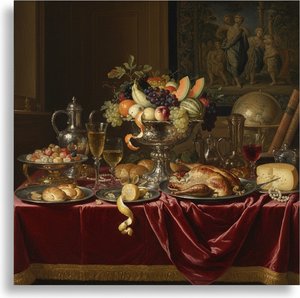
Juriaen van Streeck’s “Still-Life,” a remarkably preserved panel dating from the mid-17th century, offers a captivating glimpse into the world of Dutch Golden Age painting. More than simply a depiction of objects—a bowl of fruit, a porcelain ewer, and a scattering of silverware—it's an intricate meditation on light, texture, and the fleeting nature of beauty itself. The painting resides within the Bavarian State Painting Collections, a testament to its enduring quality and artistic merit.
Van Streeck’s style is deeply rooted in the traditions established by Willem Kalf, yet possesses a subtle individuality. He masterfully employs chiaroscuro—the dramatic contrast between light and shadow—to imbue each object with a palpable sense of volume and realism. The artist doesn't merely represent; he sculpts with light, creating an illusion of depth that draws the viewer into the scene. Notice how the folds of the velvet cloth seem to ripple in the reflected light, or how the sheen on the porcelain gleams with an almost ethereal quality.
A Symphony of Objects and Symbolism
The composition itself is a carefully orchestrated arrangement of seemingly disparate elements. The central focus rests upon a rich still life featuring a blue and white Wan-li bowl, overflowing with luscious peaches, a vibrant lemon, and an orange – each rendered with meticulous detail. A porcelain ewer and vase, alongside a gleaming silver knife, complete the tableau. But these are not merely decorative objects; they carry layers of symbolic meaning deeply embedded within the context of 17th-century Dutch society.
The inclusion of fruit, particularly peaches and oranges, was a deliberate reference to prosperity and abundance – hallmarks of the burgeoning merchant class that dominated the Netherlands at the time. The porcelain ewer, with its intricate floral patterns, speaks to the appreciation for luxury goods imported from the East. Even the loaf of bread, partially consumed, subtly alludes to the transient nature of earthly pleasures, a common theme in Dutch Golden Age art reflecting on mortality and the vanity of worldly possessions. The two butterflies fluttering amongst the objects further enhance this sense of ephemeral beauty.
The Painter’s Technique and Historical Context
Van Streeck's skill lies not just in his ability to render objects with photographic accuracy, but also in his understanding of how light interacts with different surfaces. He demonstrates a remarkable control over brushwork, creating subtle gradations of tone that mimic the way light would fall upon these materials. The painting’s palette is restrained yet sophisticated, dominated by rich browns, golds, and deep reds – colors that evoke the opulence of the Dutch merchant elite.
Created during a period of immense artistic innovation, “Still-Life” reflects the broader cultural trends of the time. The rise of the middle class fueled a demand for art depicting domestic life and luxurious objects, while artists like Van Streeck continued to explore themes of beauty, mortality, and the complexities of human experience. The painting’s provenance – its acquisition by the Princeton University Art Museum in 1954 – underscores its historical significance and enduring appeal.
A Timeless Appeal: Reproduction and Beyond
Reproductions of “Still-Life” offer a remarkable opportunity to bring this exquisite work into your home or office. The meticulous detail, the masterful use of light, and the profound symbolism combine to create a piece that is both visually stunning and intellectually stimulating. Consider pairing it with pieces that evoke similar themes – perhaps a richly textured rug, a vintage silver tray, or a collection of antique ceramics – to create an interior space that reflects your appreciation for beauty, history, and the enduring power of art.
Spørsmål og svar
Hvilken trykkstørrelse av "Still-Life" av Juriaen van Streeck passer til det anbefalte rommet?
Anbefalt trykkstørrelse for "Still-Life" av Juriaen van Streeck i et Living Room er Medium.
Hvilken fargetone dominerer i "Still-Life"?
Den dominerende fargen i "Still-Life" av Juriaen van Streeck er Warm Sunset Tones. Denne fargen utgjør den underliggende tonen i paletten.
Hva forestiller "Still-Life"?
Temaene i "Still-Life" av Juriaen van Streeck inkluderer still life, fruit, food, gold, velvet, music, symbolism, dutch painting. Sammen oppsummerer de verkets motiv.
Om kunstneren
A Life in Stillness: Unveiling the World of Juriaen van Streeck
Juriaen van Streeck, a name that whispers softly within the rich tapestry of Dutch Golden Age painting, invites us into a world meticulously rendered and profoundly contemplative. Born in Amsterdam in 1632, during an era of unprecedented artistic flourishing, he dedicated his life to the art of still life—a genre that, under his masterful hand, transcended mere representation to become a poignant meditation on existence itself. Details of his early years remain somewhat veiled in history, yet we know he emerged into a society deeply captivated by wealth, burgeoning trade, and an underlying awareness of mortality – themes that would indelibly shape the core of his artistic vision. In 1653, he found companionship and built a family with Grietje Claes, establishing a home within the vibrant Jordaan district before ultimately relocating to the prestigious Prinsengracht canal—a move that reflected both ambition and a desire for connection amidst the bustling heart of Amsterdam. Sadly, his life was marked by loss; three of his children succumbed to illness in infancy, casting a shadow over his family’s happiness despite their growing household – nine children in total. Later in life, seeking supplemental income, Van Streeck embraced the role of innkeeper on Kerkstraat, a pragmatic shift that offered a glimpse into the realities of 17th-century life and the diverse paths individuals took to sustain themselves.The Language of Objects: Style and Influences
Van Streeck’s artistic journey unfolded within the fertile ground of Dutch still life painting—a genre renowned for its exquisite detail, symbolic depth, and a remarkable ability to capture the essence of everyday objects. He quickly established himself as a master of this tradition, drawing inspiration from a lineage of accomplished artists while simultaneously forging his own distinctive style. A clear debt is visible in his work to Willem Kalf, another celebrated Dutch still life painter, particularly in Kalf’s masterful use of rich color palettes and dramatic compositions—a technique Van Streeck skillfully adopted and adapted to his own subject matter. However, Van Streeck was not merely a mimic; he possessed an innate ability to imbue his paintings with a unique sensibility, elevating the genre beyond simple representation. He excelled at capturing the textures of various materials – the cool sheen of polished silver, the velvety softness of ripe fruit, the delicate transparency of crystal glass – creating visual feasts for the eye that simultaneously prompted deeper philosophical reflection. His compositions often featured an array of carefully arranged objects: gleaming helmets and swords, leather-bound books and scrolls, delicate letters and seals, resonant musical instruments like lutes and harps, luscious fruits in their prime, and, crucially, *memento mori* – symbols of mortality such as skulls, decaying game, and wilting flowers. These elements were not merely decorative; they served as potent reminders of life’s fleeting nature and the ultimate futility of worldly possessions—a core tenet of the Vanitas tradition that was gaining prominence during his time.Vanitas and Beyond: Themes in Van Streeck’s Work
At the heart of Juriaen van Streeck's oeuvre lies a profound contemplation of mortality, transience, and the human condition. The inclusion of *memento mori* symbols wasn’t simply an aesthetic choice; it was a deliberate attempt to engage viewers in a dialogue about life, death, and the pursuit of meaning—a conversation that resonated deeply with the cultural anxieties of 17th-century Dutch society. A skull resting amongst opulent objects served as a stark reminder that all earthly possessions are ultimately ephemeral, while decaying fruit symbolized the inevitable decline of beauty and vitality. Beyond this overarching theme of mortality, his paintings also showcased an extraordinary attention to detail and realism—a hallmark of Dutch artistry during the Golden Age. He wasn’t merely interested in depicting objects; he sought to capture their essence, their weight, their texture, and their symbolic resonance. This meticulous approach reflects a broader cultural fascination with observation, scientific inquiry, and the pursuit of knowledge that characterized the era. His compositions often possess a luxurious quality, reminiscent of Kalf's work, but Van Streeck infused them with his own unique sensibility, creating arrangements that are both visually compelling and intellectually stimulating. Notable works such as “Snack,” “Still-Life With Peaches And A Lemon” and "A Still Life With Oysters, Peoches And Lemon On A Marble Table With A Fringed Carpet And Glasses" exemplify this delicate balance between aesthetic beauty and symbolic weight—a testament to his artistic skill and philosophical depth.Historical Significance and Legacy
Juriaen van Streeck occupies a significant, though perhaps understated, position within the Dutch Golden Age painting tradition. While not as universally celebrated as some of his contemporaries – Willem Kalf or Johannes Vermeer, for example – he was recognized during his lifetime by art historian Arnold Houbraken, who praised his versatility in still life subjects and acknowledged his skill in capturing the nuances of everyday objects. His influence can be discerned in the work of artists such as Barend van der Meer, demonstrating a ripple effect of artistic inspiration across generations. Van Streeck’s paintings offer invaluable insights into the cultural and philosophical concerns of 17th-century Dutch society – its preoccupation with wealth, its awareness of mortality, and its search for meaning in a rapidly changing world. He contributed to the evolution of still life painting as a genre capable of conveying both aesthetic pleasure and profound intellectual depth. Furthermore, his family continued the artistic tradition; his son, Hendrick van Streeck, also became a painter, specializing in church interiors – a poignant example of familial legacy within the art world. Today, works like “Schouburg Plate K” continue to captivate viewers with their intricate detail, symbolic richness, and enduring beauty—ensuring that Juriaen van Streeck’s artistic vision continues to resonate across centuries.Exploring Van Streeck’s World Today
- Museum Collections: While not extensively represented in the major international museum collections, examples of Van Streeck’s work can be found in institutions like the Museum Smidt van Gelder and the Museum Mayer van den Bergh in the Netherlands.
- Online Resources: Numerous online resources provide valuable information about Juriaen van Streeck, including biographical details, high-resolution images of his paintings, and scholarly analyses. Websites such as the Web Gallery of Art (WGA) and Wikipedia offer accessible starting points for research. Princeton University Art Museum also provides detailed analysis of a still life formerly attributed to him, highlighting ongoing scholarly debate surrounding his work.
- Reproductions: Platforms like OriginalUniqueArt.com provide high-quality, hand-painted reproductions of Van Streeck’s masterpieces, allowing art enthusiasts to bring the beauty and symbolism of his paintings into their own homes.

Juriaen van Streeck
1632 - 1687 , Nederland
Kort om kunstneren
- Artistic Movement Or Style: Still life, Barok
- Artists Or Movements Influenced By This Artist: ['Barend van der Meer']
- Artists Who Influenced This Artist: ['Willem Kalf']
- Date Of Birth: 1632 Amsterdam
- Date Of Death: 1687 Amsterdam
- Full Name: Juriaen van Streeck
- Nationality: Nederlands
- Notable Artworks:
- Schouburg Plate K
- Snack
- Still-Life
- Place Of Birth: Amsterdam, Nederland
Relaterte artikler

Golden Light & Dutch Skies: The Timeless Magic of Dutch Golden Age Landscapes
Discover the breathtaking beauty of Dutch Golden Age landscapes. Explore the mastery of light, chiaroscuro, and 17th-century realism through an expert art history lens, celebrating the enduring legacy of the Dutch Masters for discerning collectors and art lovers.

De 10 Mesterverkene som Definerte den Nederlandsk Gyldne Tidsalder – Kunst & Interiør
Oppdag de 10 ikoniske mesterverkene fra den nederlandske gullalderen! Lær om Rembrandt, Vermeer og andre store kunstnere. Finn inspirasjon til klassisk interiørdekorasjon og kjøp museumskvalitets reproduksjoner på OriginalUniqueArt.com.

Rembrandts Mesterverk: Topp 25 Kunstverk for Din Vegg | OriginalUniqueArt.no
Utforsk Rembrandts 25 mest ikoniske kunstverk! Oppdag historiene bak mestermalerier, portretter og bibelske scener fra den nederlandske barokken. Finn museumskvalitets reproduksjoner & interiørinspirasjon på OriginalUniqueArt.com.
Abraham Hendricksz van Beyeren: Pioneering Dutch Still Life & the Banquet Tradition
Explore the captivating world of Dutch Golden Age still life with Abraham van Beyeren. Discover his innovative techniques, symbolic banquet scenes & lasting influence on art history. Learn about collecting these masterpieces.

Golden Age Reflections: Dutch Baroque Painting & Cultural Innovation
Explore the Dutch Golden Age of painting! Discover key artists like Vermeer & ter Borch, their innovative techniques, and the rich cultural context behind these Baroque masterpieces. Learn about collecting & appreciating this iconic art period.