

 Se i rommet
 Del som digitalt kort
 Del
Del
 Detaljer
 Studentguide

 Last ned
 Liknende objekter
 Røntgen
 Lysbildefremvisning
 Besøksstatistikk
Astatic
 Woodcut
- WallArt
- Geometric Abstraction
 1944
1944- Modern
 33.0 x 22.0 cm
 Museum of Fine Arts
 Les mer
Giclée / Kunsttrykk
Giclée- eller lerretsprint av museumskvalitet med rask produksjon og fleksible valgmuligheter for etterbehandling. ( Bestill håndmalt reproduksjon Gå til digitalt bilde)




P118B $10

P118H $10

P118W $10

P438Z $10

P508JH $12

P508YH $12

P805H $10

P805Z $10

P919BZ $10

P919G $10

P919XJ $10

P959ZH $10

P968JZ $12

W106C $8

W218G $10

W218JH $8

W218Y $10

W307PJ $10

W316G $10

W316PJ $8

W316Y $10

W398PJ $8

W4111J $10

W500HY $15

W500JH $15

W692G $12

W849H $8

W940BG $15

W953PJ $8




Velg mellom våre forhåndsdefinerte størrelser som bevarer kunstverkets opprinnelige proporsjoner.

Du kan oppgi egne mål for å tilpasse en spesifikk ramme eller et bestemt område. Dersom den valgte størrelsen ikke samsvarer med det originale bildets proporsjoner, vil vi enten beskjære kunstverket eller utvide bildet med en speilet eller ensfarget kant. En digital mockup vil bli sendt til din godkjenning før produksjonen starter.
Vennligst merk at forhåndsvisningen på skjermen ikke gjenspeiler den faktiske beskjæringen eller utvidelsen. Kun mockuppen vil vise den endelige komposisjonen nøyaktig.
Selv om tilpassede størrelser er tilgjengelige, anbefaler vi å velge et mål fra den forhåndsdefinerte listen for å bevare de originale proporsjonene.
Verdensomspennende levering () på 2 uker i stedet for standard 4/5 uker. (27 September)

Gratis ekspressfrakt over hele verden

Lerretsduk av høykvalitets lin

Full transportforsikring

Garanti for refusjon av toll og importavgifter

Garantert fargeekthet

100 dagers returrett ved fabrikasjonsfeil

100% pengene tilbake-garanti

Mengderabatt
 Glassalternativet er kun tilgjengelig i størrelser under 110 cm

Astatic
Giclée / Kunsttrykk
Format på reproduksjon
-


Totalpris
$ 80
A Geometric Meditation in Shadow and Form
In the quiet, profound stillness of Josef Albers’s 1944 masterpiece, "Astatic," we encounter more than just a collection of shapes; we enter a realm of deep perceptual inquiry. This work serves as a mesmerizing window into the mind of one of the twentieth century's most influential architects of color and form. At its heart, the composition presents a striking equilateral triangle, bisected by a precise horizontal line, creating a structural anchor that commands the viewer's attention. Yet, this central stability is playfully challenged by a constellation of smaller triangles that radiate outward, establishing a rhythmic dance between repetition and variation. The piece does not merely sit upon the surface; it breathes through its careful arrangement, inviting the eye to wander through a labyrinth of geometric precision.
The technique employed in "Astatic" is a testament to Albers’s profound respect for the inherent qualities of his medium. Utilizing a woodcut from plywood, Albers bridged the gap between industrial craftsmanship and high art—a hallmark of the Bauhaus ethos he helped define. The physical texture of the wood provides a subtle, organic foundation that contrasts beautifully with the mathematical rigor of the design. While the photograph captures the work in a stark, timeless black and white, the original intent was a sophisticated exploration of tonal interaction. Albers meticulously utilized shades such as Prussian blue and Payne’s grey, demonstrating his revolutionary belief that color is never an isolated entity but a relational phenomenon that changes based on its neighbors.
The Legacy of Bauhaus and the Spirit of Innovation
To understand "Astatic," one must look back to the turbulent yet creatively fertile atmosphere of the Bauhaus movement. Albers’s formative years in Weimar, Germany, placed him at the epicenter of a radical rethinking of artistic education. Immersed alongside legends like Kandinsky and Moholy-Nagy, Albers developed a fascination with how materials—glass, metal, and wood—interact with light and space. This piece is a direct descendant of that experimental spirit, stripping away the unnecessary to focus on the fundamental building blocks of visual language. It embodies a transition from the decorative traditions of the past toward the clean, intellectual clarity of Minimalist aesthetics.
For the discerning collector or interior designer, "Astatic" offers an unparalleled opportunity to introduce a sense of structured serenity into a modern space. The artwork possesses a unique emotional duality: it is both intellectually stimulating and deeply calming. Its balanced composition provides a focal point that anchors a room, while its subtle interplay of shapes encourages a meditative state of mind. Whether displayed in a contemporary gallery setting or as a sophisticated accent in a curated residential interior, this reproduction brings with it the weight of art history and the enduring elegance of geometric abstraction. It is not merely a decoration, but an invitation to contemplate the very nature of how we see the world.
Kunstnerbiografi
A Life Forged in Material: The Early Years and Bauhaus Formation
Josef Albers’s artistic journey began not amidst the rarefied air of established academies, but within the pragmatic world of his father’s contracting business in Bottrop, Germany. Born in 1888, young Josef absorbed a deep respect for materials – carpentry, plumbing, house-painting – skills that would fundamentally shape his aesthetic sensibility. This wasn't merely vocational training; it was an immersion into the very essence of making, understanding how forms materialized and the inherent qualities within each medium. Before dedicating himself fully to art, Albers spent five years as a schoolteacher, honing patience and pedagogical skill—attributes that would later define his influential teaching career. Formal artistic training commenced at the Königliche Kunstschule in Berlin between 1913 and 1915, where he explored printmaking, painting, and, crucially, stained glass. His early commission, “Rosa Mystica Ora Pro Nobis” (1918), a stunning stained-glass window, foreshadowed his lifelong fascination with the interplay of light and color, hinting at the abstract explorations to come. This initial work wasn’t simply decorative; it was an investigation into how light *transformed* material, a theme that would resonate throughout his career.The Bauhaus Crucible: Color as Subject
A pivotal moment arrived in 1922 when Albers joined the faculty of the Bauhaus, a revolutionary school seeking to unify all artistic disciplines. Initially tasked with teaching the preliminary course – *Werklehre* (workshop practice) – he immersed himself in its core principles: functionalism, geometric abstraction, and material exploration. This period proved transformative. Albers began a systematic investigation into color perception, moving away from representational art towards an increasingly abstract vocabulary. He wasn’t interested merely in *what* colors were, but *how* they interacted, how they influenced each other, and how our eyes perceived them. The influence of fellow Bauhaus masters like Paul Klee and Wassily Kandinsky is discernible in his early work, yet Albers charted a unique course, prioritizing empirical observation over metaphysical interpretation. He wasn’t seeking spiritual truths through color; he was meticulously documenting its physical effects – a scientific rigor that became the hallmark of his artistic method. This focus on perception, on how we *see*, rather than what is *seen*, set him apart and laid the groundwork for his future explorations.Homage to the Square: A Laboratory of Perception
Following a period teaching at Black Mountain College – where he fostered a generation of American artists including Robert Rauschenberg and Cy Twombly – Albers embarked on what would become his most iconic series in 1949: “Homage to the Square.” This ongoing project consisted of paintings featuring nested squares within squares, each iteration exploring subtle variations in color relationships. It’s a deceptively simple premise, but one that belies an incredibly complex and rigorous investigation. The series wasn't intended as a celebration of geometry; rather, it was a laboratory for studying color perception. Albers meticulously documented his experiments, revealing how colors aren't static entities but dynamic forces governing each other through internal logic – often misleading to the eye. A seemingly brighter square might appear to recede while a darker one advances, defying intuitive understanding. This research culminated in his seminal book, “Interaction of Color” (1963), a foundational text still studied by artists and designers today. The book isn’t a treatise on color theory; it's a series of exercises designed to demonstrate how our perception of color is relative and contextual – a testament to Albers’ belief that seeing is not passive, but an active process of interpretation.Chromatic Interactions and Legacy
Albers’s work transcended mere aesthetics; he sought to understand the very mechanisms of visual experience. His later paintings, such as “Gray Instrumentation,” demonstrated his mastery of subtle tonal shifts and spatial relationships, often employing a limited palette to amplify the impact of color interactions. Throughout his career, Albers remained committed to experimentation and rigorous observation, constantly challenging conventional notions of art and perception. He wasn’t simply creating beautiful images; he was constructing systems for understanding how we see. His influence extends far beyond the realm of painting, shaping approaches in graphic design, architecture, and even psychology. Josef Albers died on March 25, 1976, in New Haven, Connecticut, leaving behind a legacy that continues to inspire and challenge artists, designers, and educators alike – a testament to the power of observation, experimentation, and the enduring mystery of color.Notable Works
- Gray Instrumentation I Prospectus (1975): A minimalist monochrome painting exemplifying geometric balance and subtle tonal variations.
- Study for Homage to the Square – Beaming (Date Unknown): A classic example of Albers’s exploration of color interaction within nested squares, evoking a sense of calm and spatial depth.
- Rosa Mystica Ora Pro Nobis (1918): His early stained-glass commission, foreshadowing his lifelong fascination with light and color.

Josef Albers
1888 - 1976 , Tyskland
Kort om kunstneren
- Artistic Movement Or Style: Geometrisk abstraksjon
- Artists Or Movements Influenced By This Artist:
- Minimalisme
- Fargefeltmaleri
- Artists Who Influenced This Artist:
- Paul Klee
- Wassily Kandinsky
- Date Of Birth: 19. mars 1888
- Date Of Death: 25. mars 1976
- Full Name: Josef Albers
- Nationality: Tysk-Amerikansk
- Notable Artworks:
- Homage til Kvadrat
- Grå Instrumentering I
- Rosa Mystica
- Place Of Birth: Bottrop, Tyskland
Relaterte artikler
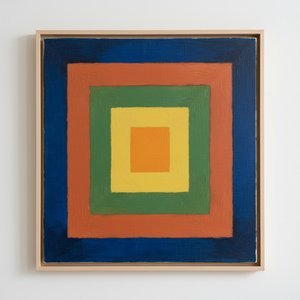
Josef Albers: A Homage to Color Interaction & the Foundations of Visual Perception
Explore Josef Albers's groundbreaking color theory & the 'Homage to the Square' series. Discover how his work revolutionized visual perception and influenced modern art movements like Minimalism & Op Art. Learn about his Bauhaus roots & lasting legacy.

Mastering the Woodcut: A Definitive Guide to the Art of Relief Printing and its Historical Legacy
Explore the profound history and technical mastery of woodcut relief printing. From ancient origins to German Expressionism, discover how artists use the subtractive process to create iconic works. A definitive guide for art students, collectors, and historians.
The Enduring Legacy of Printmaking: Techniques, Themes & Artistic Innovation Across Centuries
Explore the rich history of printmaking with OriginalUniqueArt. Discover techniques from intaglio to lithography, learn about collecting valuable prints & find museum-quality reproductions. Expert insights for art enthusiasts and collectors.

The Soul of the Grain: Discovering the Timeless Beauty and Artistic Legacy of Woodcut Art
Explore the profound beauty of woodcut art. From ancient traditions to modern mastery, discover the tactile soul of relief printing and its enduring legacy in fine art collections.

Geometrisk Abstraksjon: Topp 10 Mesterverk for Kunstelskere – OriginalUniqueArt.com
Utforsk de 10 mest innflytelsesrike verkene innen geometrisk abstraksjon! Oppdag historiene bak Mondrian, Kandinsky og Malevich. Finn inspirasjon til interiøret med OriginalUniqueArt.coms eksklusive reproduksjoner – museumskvalitet for ditt hjem. Utforsk samlingen online!