

 Se i rommet
 Del som digitalt kort
 Del
Del
 Detaljer
 Studentguide

 Last ned
 Liknende objekter
 Røntgen
 Lysbildefremvisning
 Besøksstatistikk
Chamouni, Rocks and Vegetation


 Les mer
Kjøp et høyoppløselig, forbedret digitalt bilde med langt høyere kvalitet enn forhåndsvisningen på nettet.
Hver fil er omhyggelig klargjort av våre egne spesialister ved hjelp av avanserte verktøy og profesjonell manuell retusjering. Vi sørger for at hvert bilde har eksepsjonell klarhet, presis fargegjengivelse og fine detaljer.
Den endelige filen leveres via e-post innen 72 timer, optimalisert for umiddelbar bruk i profesjonelle, redaksjonelle og trykte miljøer. Dette er den samme kvaliteten som benyttes av ledende designstudioer, utgivere og gallerier.
Digitalt bilde
Last ned en høyoppløselig fil til personlig bruk, utskrift og kreative prosjekter. ( Bytt til trykkversjon Bestill håndmalt reproduksjon)
Inkludert i alle bestillinger av digitale bilder
Profesjonell digital levering, garantert
Når du velger OriginalUniqueArt.com, får du ikke bare et bilde – du mottar et profesjonelt etterbehandlet digitalt kunstverk, skapt med presisjon og med en garantert tilfredshetsgaranti. Her er alt som automatisk følger med din bestilling:

Rask levering på e-post
Din høyoppløselige digitale bildefil sendes til din e-post innen 72 timer etter bestilling – klar til umiddelbar bruk.

KI-forbedret digital fil
Ditt kunstverk blir profesjonelt optimalisert ved hjelp av avanserte AI-verktøy og manuell redigering, noe som sikrer maksimal detaljrikdom, klarhet og fargegjengivelse.

Gratis livslang nybestilling
Har du ved et uhell slettet eller mistet filen din? Ingen bekymring – vi sender den på nytt når som helst, helt gratis.

Ingen importavgifter – noen gang
Nyt ditt kunstverk umiddelbart uten toll, avgifter eller leveringskostnader – digitale nedlastinger er alltid avgiftsfrie.

Garantert fargenøyaktighet
Vi sikrer at det digitale bildet gjenspeiler de originale fargene så nøyaktig som mulig ved hjelp av profesjonelle verktøy og fargehåndtering.

100 dagers tilfredshetsgaranti
Hvis du ikke er fornøyd med ditt digitale bilde, vil vi revidere det eller refundere 100% innen 100 dager – uten spørsmål.

100% Penggaranti
Ikke fornøyd? Få full refusjon innen 100 dager etter at du har mottatt din digitale fil – uten spørsmål.

Rabatt ved storkjøp
Kjøp 3 bilder, spar 10% - Kjøp 5, spar 15% - Kjøp 10+, spar 20%. Ideelt for kreative prosjekter, gallerier og byråer.
Ruskin’s Alpine Reverie: A Study in Texture and Moral Vision
John Ruskin's "Chamouni, Rocks and Vegetation," painted in 1854, stands as a testament to the Pre-Raphaelite movement’s fascination with capturing the sublime beauty of the natural world—a pursuit inextricably linked to ethical contemplation. More than just a landscape depiction, it embodies Ruskin’s profound belief that art should serve as a conduit for moral enlightenment, mirroring his broader philosophical stance on humanity's relationship with God and creation.- Subject Matter: The painting portrays the towering granite peaks of Mont Blanc (Chamouni), bathed in diffused sunlight—a quintessential Alpine vista meticulously rendered by Ruskin’s hand.
- Style & Technique: Ruskin championed a style characterized by painstaking detail and luminous color, prioritizing observation over idealized representation. He employed watercolor on paper, layering thin washes to build up texture and capturing the subtle nuances of light and shadow. The artist's deliberate brushstrokes convey a sense of immediacy and reverence for the grandeur of the mountain landscape.
- Historical Context: Created during Ruskin’s formative years as an art critic and intellectual, “Chamouni” reflects his burgeoning interest in geology and his conviction that understanding the physical world illuminates spiritual truths. It aligns perfectly with Millais's ambitious portrait of Ruskin at Glenfinlas, commissioned shortly after—a visual embodiment of Ruskin’s commitment to portraying nature with uncompromising honesty.
- Symbolism: The jagged rocks symbolize resilience and permanence against the relentless forces of time and decay – mirroring Ruskin’s broader moral concerns about confronting mortality and embracing virtue. The sparse vegetation represents the delicate balance between beauty and fragility, prompting viewers to consider humanity's responsibility for safeguarding the natural environment.
- Emotional Impact: Viewing “Chamouni” evokes a feeling of awe and contemplation—a desire to reconnect with the sublime grandeur of God’s creation. Ruskin aimed not merely to depict a mountain scene but to inspire a deeper appreciation for beauty, truth, and moral integrity—goals that continue to resonate powerfully with audiences today.
Detailed Examination: Texture and Color Palette
Ruskin's masterful watercolor technique is evident in the meticulous layering of washes that create an astonishingly realistic depiction of rock formations. The artist painstakingly captures the variations in tone and texture—from the rough granite surfaces to the smoother patches where lichen clings to the stone—demonstrating a dedication to observation unparalleled for his time. Furthermore, the color palette—dominated by muted blues, greens, and yellows—reflects the atmospheric conditions prevalent during Mont Blanc’s summers—a subtle yet crucial element in conveying Ruskin's vision of natural beauty.Connections to Millais’ Glenfinlas Portrait
The painting shares a striking stylistic kinship with Millais’ celebrated portrait of Ruskin at Glenfinlas, completed the following year. Both artists prioritized capturing the essence of their subject—Ruskin himself—within a landscape setting that served as a backdrop for intellectual and spiritual reflection. This deliberate juxtaposition underscores Ruskin's conviction that art should illuminate moral truths alongside aesthetic splendor—a principle that continues to inform artistic endeavors across disciplines.Legacy & Enduring Relevance
“Chamouni, Rocks and Vegetation” remains an influential work of art, anticipating the burgeoning interest in environmentalism and sustainability that would characterize the latter half of the 19th century. Ruskin’s insistence on portraying nature with uncompromising honesty—a stance rooted in his profound moral sensibility—continues to inspire artists and thinkers today—serving as a timeless reminder of the transformative power of beauty and contemplation.Spørsmål og svar
Hvordan laster jeg ned bildet av "Chamouni, Rocks and Vegetation" av John Ruskin?
Nedlasting er tilgjengelig for "Chamouni, Rocks and Vegetation": kunstverkets Last ned-side tilbyr nedlasting av et digitalt bilde i høy oppløsning.
Hvor lys er "Chamouni, Rocks and Vegetation" totalt sett?
Alt i alt er "Chamouni, Rocks and Vegetation" registrert som bright. Oppfattet lysstyrke beskriver hvor lyst eller mørkt verket fremstår.
Hva er anbefalt trykkstørrelse for "Chamouni, Rocks and Vegetation" av John Ruskin?
En reproduksjon i Large anbefales for "Chamouni, Rocks and Vegetation" av John Ruskin. Størrelsen kan justeres mens proporsjonene opprettholdes.
Kunstnerbiografi
A Polymath of Vision: The Life and Legacy of John Ruskin
John Ruskin, born in London on February 8, 1819, was far more than simply an art critic; he was a Victorian polymath whose influence permeated the realms of aesthetics, social reform, political economy, and environmentalism. His life was shaped by a fascinating duality – the pragmatic commercial world of his father, John James Ruskin, a successful sherry merchant, and the fervent evangelical piety of his mother, Margaret Cock. This contrasting upbringing instilled in him both a keen observational eye for detail and a deeply moral sensibility that would define his entire oeuvre. From an early age, Ruskin’s education was meticulously curated at home, steeped in biblical study and exposure to Romantic literature, particularly the works of Byron and Walter Scott. These formative influences laid the groundwork for a mind that would relentlessly seek connections between beauty, truth, and ethical living. His academic journey continued at Christ Church, Oxford, where he began to articulate his burgeoning ideas about art and its relationship to society.The Dawn of an Art Historian: Early Writings and Influences
Ruskin’s emergence as a significant voice in the art world began with *Modern Painters* (1843-1860), a monumental five-volume work initially conceived as a defense of J.M.W. Turner against what Ruskin perceived as unjust criticism. However, *Modern Painters* quickly evolved into something far more profound – a comprehensive treatise on the nature of art itself. He argued passionately for “truth to nature,” emphasizing that great art wasn’t merely about skillful representation but about an artist's sincere and empathetic engagement with the natural world. This concept was revolutionary at the time, challenging prevailing academic standards and paving the way for new artistic sensibilities. Ruskin didn’t just analyze technique; he delved into the spiritual and moral qualities of art, believing that true beauty reflected a virtuous soul. His meticulous descriptions of landscapes, rocks, and botanical details reveal not only his keen observational skills but also his profound reverence for nature as a manifestation of divine creation. This early work established Ruskin as a formidable critic and set the stage for his later explorations into architecture and social issues. He was deeply influenced by the Pre-Raphaelite Brotherhood, championing their commitment to detailed observation and rejection of academic conventions. They shared a belief that art should aspire to moral elevation and capture the essence of genuine experience—a conviction that would permeate Ruskin’s subsequent endeavors.Beyond Aesthetics: Social Commentary and The Guild of St. George
As Ruskin matured, his interests expanded beyond the purely aesthetic realm. Deeply troubled by the social injustices he witnessed during the Industrial Revolution, he began to apply his critical lens to the economic and political structures of Victorian England. *Unto This Last* (1860), a series of essays originally published in *The Cornhill Magazine*, marked a turning point in his career. In this work, Ruskin vehemently critiqued utilitarian economics and advocated for a more humane and equitable social order based on principles of fellowship and craftsmanship. He argued that the dignity of labor was essential to a flourishing society and that true wealth lay not in material possessions but in the quality of human relationships. This conviction led him to establish *Fors Clavigera* (1871-1884), a monthly series of letters addressed “To the Workmen and Labourers of Great Britain,” where he expounded his social and political ideas with characteristic fervor. From these writings emerged the Guild of St. George, founded in 1871, an organization dedicated to promoting craftsmanship, rural industries, and education among working-class communities. The Guild aimed to create a model society based on Ruskin’s ideals, fostering artistic skill, ethical labor practices, and a harmonious relationship with nature—a vision that anticipated many of the concerns confronting us today.Notable Works & Further Exploration
- Modern Painters (1843-1860): Ruskin’s foundational work, defending Turner and establishing his theories of art.
- The Stones of Venice (1851-1853): A detailed analysis of Venetian architecture, exploring its historical, social, and artistic significance.
- Unto This Last (1860): A powerful critique of Victorian economics and a call for social reform.
- Fors Clavigera (1871-1884): A series of letters addressing the working class, outlining Ruskin’s vision for a more equitable society.
- Dawn, Coniston: A breathtaking watercolor capturing the serene beauty of Coniston Water and demonstrating Ruskin's unparalleled ability to convey emotion through observation.
- Britannica: https://www.britannica.com/biography/John-Ruskin
- Wikipedia: https://en.wikipedia.org/wiki/John_Ruskin
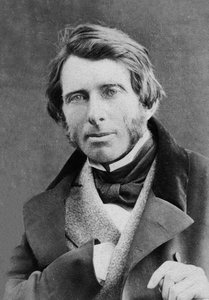
John Ruskin
1819 - 1900 , Storbritannia
Kort om kunstneren
- Artistic Movement Or Style: Victorian Art, Kunstkritikk
- Artists Or Movements Influenced By This Artist: ['Pre-Raphaelites']
- Artists Who Influenced This Artist: ['J.M.W. Turner']
- Date Of Birth: 8 februar 1819
- Date Of Death: 20 januar 1900
- Full Name: John Ruskin
- Nationality: Britisk
- Notable Artworks:
- Dawn, Coniston
- Fors Clavigera
- Place Of Birth: London, UK