
 Forhåndsvisning
 Send
Send Del
Del
 Vis detaljer
 Utskriftsvennlig guide

 Last ned bilde
 Liknende objekter
 Røntgenundersøkelse
 Lysbildefremvisning
 Spørsmål og svar
 Statistikk
Grove Scene


 Vis hele teksten
Giclée / Kunsttrykk
Giclée- eller lerretsprint av museumskvalitet med rask produksjon og fleksible valgmuligheter for etterbehandling. ( Kjøp håndmalt maleri Bytt til digitalt bilde)




P118B Nkr10

P118H Nkr10

P118W Nkr10

P438Z Nkr10

P508JH Nkr12

P508YH Nkr12

P805H Nkr10

P805Z Nkr10

P919BZ Nkr10

P919G Nkr10

P919XJ Nkr10

P959ZH Nkr10

P968JZ Nkr12

W106C Nkr8

W218G Nkr10

W218JH Nkr8

W218Y Nkr10

W307PJ Nkr10

W316G Nkr10

W316PJ Nkr8

W316Y Nkr10

W398PJ Nkr8

W4111J Nkr10

W500HY Nkr15

W500JH Nkr15

W692G Nkr12

W849H Nkr8

W940BG Nkr15

W953PJ Nkr8




Velg mellom våre forhåndsdefinerte størrelser som bevarer kunstverkets opprinnelige proporsjoner.

Skriv inn ønsket bredde og høyde for å tilpasse trykket til din ramme eller vegg. Et trykk kan kun beskjæres, aldri skaleres opp utover motivets opprinnelige størrelse, noe som betyr at et format med andre proporsjoner vil føre til tap av deler av bildet. Vi sender deg en digital mockup for godkjenning før vi starter trykkeprosessen. Bildet som vises på denne siden viser ikke den faktiske beskjæringen — det er kun mockuppen som viser dette.
Verdensomspennende levering () på 2 uker i stedet for standard 4/5 uker. (10 November)

Gratis ekspressfrakt over hele verden

Lerretsduk av lin av høy kvalitet

Full transportforsikring

Garanti for refusjon av toll og importavgifter

Garantert fargegjengivelse

100 dagers returrett ved fabrikasjonsfeil

100% pengene tilbake-garanti

Rabatt ved flere kjøp
 Glassalternativet er kun tilgjengelig i størrelser under 110 cm

Grove Scene
Giclée / Kunsttrykk
Størrelse på reproduksjon
-


Totalpris for valgte alternativer
Nkr 775
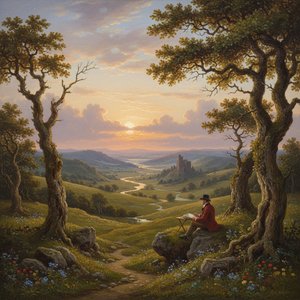
A Norfolk Woodland Clearing
A small clearing within a Norfolk forest provides the setting for this 1820 oil on canvas. Two figures stand amidst the trees, appearing as quiet observers of the landscape. Nearby, a horse grazes in the grass, contributing to the pastoral stillness of the scene. The composition uses these figures to anchor the expansive vista, establishing a connection between the human presence and the natural environment.
The work reflects the Romantic movement's emphasis on emotion and imagination. Rather than focusing on precise botanical detail, the artist prioritizes atmosphere. Dappled sunlight filters through the branches, creating a sense of depth and luminosity through the layering of yellows and greens. This technique produces a textural richness that suggests the movement of light through a dense canopy.
Technique and Influence
The brushwork is bold and loose, eschewing academic conventions in favor of conveying a specific mood. This approach is heavily influenced by the Dutch Masters, particularly the way light and shadow are used to define space. The palette is dominated by warm hues, which contribute to the emotional resonance of the woodland setting.
The painting aligns with the principles of the Norwich School, a movement dedicated to the direct observation of the English countryside. By capturing the specific character of the Norfolk landscape, the work moves beyond mere visual representation to reflect how the scene is felt. It remains a significant example of how regional identity was expressed through the study of light and natural forms.
Spørsmål og svar
Hvilken kunstner og hvilken stil står bak "Grove Scene"?
"Grove Scene" ble skapt av John Crome i Romanticism-stil. Kunstneren og stilen identifiserer verkets tradisjon.
Hvilken plass har "Grove Scene" av John Crome i kunsthistorien?
"Grove Scene" av John Crome tilhører Romanticism-retningen, innenfor 19th Century-perioden. Sammen gir de verket dets plass i kunsthistorien.
Kan jeg bestille en olje-reproduksjon av "Grove Scene"?
Du kan bestille en håndmalt reproduksjon av "Grove Scene" av John Crome direkte på siden for Håndmalt oljereproduksjon: en håndmalt oljereproduksjon på linlerret, laget etter bestilling.
Om kunstneren
John Crome (1768–1821) – Norfolk Museums Collections
John Crome, affectionately known as “Old Crome” to distinguish him from his artist son, stands as a pivotal figure in British art history—a founder and leading light of the celebrated Norwich School. Born in 1768 in the bustling market town of Norwich, Norfolk, Crome’s journey was one of remarkable self-education and dedication, rising from humble beginnings to become a respected landscape painter who captured the very essence of his beloved East Anglian countryside. His father, a weaver, instilled a strong work ethic, but it was an apprenticeship with house, coach, and sign painter Francis Whisler that first nurtured Crome’s artistic inclinations, providing him with foundational skills in design and color. This practical training proved invaluable as he began to explore his passion for depicting the natural world around him. A formative friendship with Robert Ladbrooke, a fellow aspiring artist, further fueled his development; together they sketched en plein air, honing their observational abilities and sharing a burgeoning enthusiasm for art.Early Influences and Artistic Training
Crome’s artistic trajectory was profoundly shaped by exposure to the artistic treasures housed in Thomas Harvey of Old Catton’s collection—a formative experience that introduced him to masterpieces by artists like Gainsborough and Hobbema. These works served as crucial models for composition, light, and atmosphere, demonstrating the importance of careful observation and stylistic emulation. Furthermore, guidance from established figures such as Sir William Beechey and John Opie cemented his connection to the wider artistic community, fostering a supportive environment conducive to artistic growth. Notably, Crome’s early training encompassed not only drawing but also printmaking—a skill honed during his apprenticeship with Whisler that would prove instrumental in developing his distinctive etching technique. This grounding in craftsmanship instilled a meticulous attention to detail and informed his approach to capturing the subtleties of Norfolk landscapes.The Norwich School: A Regional Vision
In 1803, Crome decisively propelled himself onto the national art stage by co-founding the Norwich Society of Artists with Robert Ladbrooke—a bold initiative that marked the formal genesis of the Norwich School. This groundbreaking movement championed direct engagement with nature and sought to portray the Norfolk landscape in a manner distinct from prevailing artistic conventions emanating from London, prioritizing authenticity and capturing the spirit of the region. Recognizing the need for a collective effort to elevate Norfolk’s artistic representation, Crome spearheaded this endeavor, uniting fellow artists who shared his unwavering commitment to portraying their surroundings truthfully. The Society quickly gained prominence, attracting talented painters eager to explore the beauty of Norfolk's countryside—a testament to Crome’s vision and leadership.Style and Technique: Light, Atmosphere, and Observation
Crome’s artistic style is characterized by a remarkable sensitivity to light and atmosphere—qualities he meticulously rendered in his paintings using a technique rooted in observation and meticulous detail. Unlike many of his contemporaries who favored idealized depictions, Crome prioritized capturing the nuances of natural illumination, conveying the mood and character of Norfolk landscapes with profound accuracy. His brushwork was loose yet controlled, allowing for expressive marks that nevertheless maintained compositional integrity. He skillfully employed watercolor and oil pigments to achieve a luminous effect—a hallmark of his distinctive style—demonstrating an exceptional understanding of color theory and artistic execution. Furthermore, Crome’s meticulous botanical studies informed his depictions of trees and plants, elevating his work beyond mere landscape representation into a celebration of the natural world.Legacy and Recognition
John Crome's contribution extended far beyond his artistic output. The Norwich School he helped establish fostered a distinctive regional artistic identity, nurturing generations of painters who followed in his footsteps—a legacy that continues to inspire artists today. His unwavering dedication to capturing Norfolk’s beauty solidified his place as one of Britain’s most important Romantic landscape painters. Despite initial skepticism from the London art establishment, Crome achieved national acclaim through thirteen exhibitions at the Royal Academy between 1806 and 1818—a testament to his artistic merit and enduring appeal. His etchings, though unpublished during his lifetime, revealed another facet of his talent—demonstrating a mastery of printmaking alongside his painting prowess. As historian Dr Giorgia Bottinelli eloquently stated, “Our three greatest masters - Crome, Constable and Turner - demonstrate that landscape painting ... is peculiarly the business of the English genius.” His life serves as an inspiring example of how artistic vision, combined with a deep connection to one’s surroundings, can create a body of work that resonates across generations. His paintings remain treasured for their quiet beauty, evocative atmosphere, and enduring reflection of Norfolk's timeless charm.
John Crome
1768 - 1821 , Storbritannia
Kort om kunstneren
- Artistic Movement Or Style: Norwich Skole
- Artists Or Movements Influenced By This Artist: ['Dutch Old Masters']
- Artists Who Influenced This Artist:
- Hobbema
- Wilson
- Date Of Birth: 1768
- Date Of Death: 1821
- Full Name: John Crome
- Nationality: Engelsk
- Notable Artworks:
- Lime Kiln
- Grove Scene
- Mousehold Heath
- Place Of Birth: Norwich, UK
Relaterte artikler
John Varley I: Intimate Observation & the British Romantic Landscape
Explore the serene landscapes of John Varley I, a key figure in British Romanticism. Discover his unique watercolour style, collaboration with William Blake & lasting artistic legacy. Learn about collecting Varley's work.

John Constable: Topp 25 Maler – Engelsk Landskapskunst i Ditt Hjem
Opplev John Constables 25 mest ikoniske malerier! Fordyp deg i engelsk romantikk, landskapskunst og atmosfæriske scener. Finn museumskvalitets reproduksjoner & interiørinspirasjon på OriginalUniqueArt.com. Utforsk samlingen online!

The Sublime and the Picturesque: Exploring Emotion & Nature in Romantic Landscape Painting
Explore the emotional power of Romantic landscape painting! Discover the sublime & picturesque traditions, key artists like Friedrich & Cole, and find your perfect artwork at OriginalUniqueArt.

Romantiske landskap: Topp 10 mesterverk for hjemmet – Kunst fra OriginalUniqueArt.com
Oppdag de 10 mest ikoniske romantiske landskapsmaleriene! Fra Caspar David Friedrich til Turner – utforsk kunsthistorien, stemningen og fargepalettene. Finn museumskvalitets reproduksjoner på OriginalUniqueArt.com.

John Singer Sargent's 25 Masterpieces: Portraits & Beyond | OriginalUniqueArt
Explore 25 iconic John Singer Sargent paintings – from dazzling portraits to Impressionist landscapes. Discover the stories behind Madame X, El Jaleo & more! Find museum-quality art reproductions and elevate your home decor with OriginalUniqueArt.com.
