Romantic Landscape Painting
SelfPortrait (John Constable)
John Constable (1776–1837) har laget SelfPortrait. Det tilhører Romantic Landscape Painting-bevegelsen. Den er laget i Graphite.
- Graphite

 Forhåndsvisning

 Håndmalt oljemaleri
 Send
 Del
 Utskriftsvennlig guide


 Last ned bilde
 Liknende objekter
 Røntgenundersøkelse
 Lysbildefremvisning
 Spørsmål og svar

 Statistikk
SelfPortrait: det viktigste
- Tittel
- SelfPortrait
- Kunstner
- John Constable (1776–1837)
- Kunstner født i
- East Bergholt, Storbritannia
- Medium
- Graphite
- Bevegelse
- Romantic Landscape Painting
- Periode
- 19th Century
- Motiv
- landscape, portraiture, rural scene, romanticism, british art, constable
Hva forestiller SelfPortrait?
Identification of the Self-Portrait by John Constable
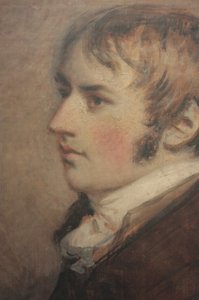
In 1806, John Constable turned his gaze inward to produce SelfPortrait. This work is a quiet study of the artist himself, captured in a moment of stillness. It functions as a visual meditation on solitude and the intent of the observer. The subject is the artist, rendered in a way that emphasizes the contours of his own face and neck.
The drawing presents a profile view of the young man. He wears a coat and cravat, his head and shoulders positioned to catch the light. This SelfPortrait by John Constable offers an intimate glimpse into a psyche shaped by observation. It is a record of a man looking toward his own inner world.
Composition and Visual Elements of the Portrait
The composition is a tight study of the head and shoulders, captured in a profile view. The subject's head is positioned off-center, a choice that breaks the symmetry of the frame and introduces a subtle tension to the arrangement. This placement directs the eye across the contours of the face and the line of the neck. The gaze is not fixed on the viewer but is directed slightly downwards and to the right, a gesture of quiet introspection.
Light enters from the left, striking the forehead and the bridge of the nose. This illumination leaves the right side of the face and the neck in shadow, carving out the physical volume of the form. The interplay of light and dark defines the structure of the features, creating a sense of three-dimensional presence within the narrow focus of the portrait. The arrangement remains intimate, keeping the viewer close to the subject's immediate presence.
Technique and Materials Used in the Work
Graphite meets the grain of the paper in a quiet, monochromatic dialogue. The artist works through a spectrum of gray, building form from the absence of color. Every stroke is a deliberate measurement of light and shadow. The palette remains strictly limited to these tonal shifts, relying on the subtle movement from pale highlights to deep, charcoal-like depths.
Precision defines the hand's movement. Meticulous detail emerges through the disciplined application of hatching and cross-hatching. These overlapping lines do more than mark the surface; they simulate the tactile reality of skin and the fine, individual strands of hair. The texture of the paper provides a foundation for this layered approach, allowing the graphite to settle into the fibers and create a sense of physical weight. The light enters from the left, casting shadows that give the profile a sculptural presence.
The drawing is a study in controlled observation. There is no excess in the line, only the necessity of the mark. The artist uses the density of the graphite to carve out the contours of the neck and the sharp edge of the collar. It is a quiet accumulation of marks that results in a steady, breathing likeness. The graphite settles into the paper, leaving only the essence of the form.
Related Works by John Constable
The artist’s hand often turned toward the faces of those closest to him. In 1816, he produced Maria Bicknell, a portrait of the woman who would become his wife. This work captures a sense of personal connection through the steady gaze of the sitter. His brush also found the quietude of the English countryside in other years. He painted The Hay Wain in 1821, a scene that reflects his deep attachment to the river and the shifting light of the Stour Valley.
Later, his focus shifted toward the architecture of the sacred and the movement of the sky. He produced Salisbury Cathedral from the Meadows in 1831, a composition where the building emerges from the landscape. Other works in the catalog include Landscape with a Double Rainbow, dated about 2026. Each piece remains a fragment of his lifelong observation of the natural world. The light continues to change.
SelfPortrait i høy oppløsning
John Constable, SelfPortrait. Felleseie
En digital ekspert kontrollerer fargene mot originalmaleriet og retusjerer filen, tro mot kunstnerens penselstrøk.
Kjøp bildet i høy oppløsningSpørsmål om SelfPortrait
Hvor harmoniske er fargene i "SelfPortrait" av John Constable?
Fargeharmonien i "SelfPortrait" er beskrevet som Strong Color Unity.
Hvordan kan "SelfPortrait" av John Constable brukes i interiøret?
"SelfPortrait" anbefales til Accent, og det anbefalte rommet er et Living Room.
Hva har "SelfPortrait" til felles med resten av John Constable sin produksjon?
"SelfPortrait" er et verk fra John Constable sin periode innen Romantic Landscape Painting, der de dokumenterte temaene inkluderer romantic landscape, english tradition, rural observation, constable’s vision, nature’s reflection.
Er bildet av "SelfPortrait" av John Constable i det frie domene?
Når det gjelder opphavsrett, er "SelfPortrait" fritt tilgjengelig – opphavsretten har utløpt.
Hvordan knytter "SelfPortrait" av John Constable Romantic Landscape Painting til kunstnerens hjemland?
Det Romantic Landscape Painting-pregede verket "SelfPortrait" ble skapt av en kunstner født i Storbritannia.
Kan "SelfPortrait" forhåndsvises i utvidet virkelighet (AR)?
"SelfPortrait" av John Constable kan forhåndsvises på din egen vegg via kunstverkets Se i AR-side ved bruk av utvidet virkelighet (AR) på en kompatibel enhet.
Hvilken følelse formidler "SelfPortrait" av John Constable?
Stemningen i "SelfPortrait" av John Constable kan beskrives som Romantic, og den emosjonelle tonen er Reflective.
Hvor plasserer "SelfPortrait" seg blant John Constable sine gjentakende motiver?
Blant John Constable sine dokumenterte temaer – romantic landscape, english tradition, rural observation, constable’s vision, nature’s reflection – retter "SelfPortrait" sitt eget fokus mot landscape, portraiture, rural scene, romanticism, british art, constable, atmospheric light.
Hva forestiller "SelfPortrait" av John Constable, og hvilken stemning formidler det?
"SelfPortrait" viser landscape, portraiture, rural scene, romanticism, british art, constable, atmospheric light, og den formidlede stemningen er Romantic.
Om kunstneren, John Constable
1776–1837, Storbritannia
John Constable
Tidlig liv, familie og utdanning John Constable ble født i 1776 i den idylliske landsbyen East Bergholt i Suffolk. Han var den andre sønnen til Golding og Ann (Watts) Constable. Faren var en velstående korn- og kullhandler som eide Flatford Mill. Denne tilknytningen til elven og den lokale handelen betydde at rytmen i vannet og varenes bevegelser var en integrert del av husholdningens daglige liv.
Også av John Constable
 Den brune vognen1821
 View of Salisbury Cathedral from the Bishop's Grounds1823
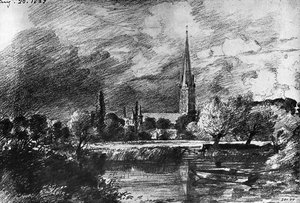 Salisbury Katedral
 Høyvognen (detalj)1821
Essays om SelfPortrait
 The Introspective Gaze: Tracing the Evolution and Psychological Depth of the Self-PortraitExplore the psychological evolution of self-portraiture from Dürer to modern masters. Trace the history of the human gaze with us.
 Egon Schieles 25 Mesterverk: En Reise i Ekspresjonisme og Sjelsliv – OriginalUniqueArt.noUtforsk Egon Schieles 25 mest ikoniske malerier! Oppdag ekspresjonismens sjel gjennom portretter, selvportrett og kraftfulle farger. Finn m…
 Mastering the English Landscape: The Top 25 Artworks by John ConstableImmerse yourself in the soul of the English countryside with our curated guide to John Constable's top 25 masterpieces. Explore the emotive…