Pop Art · 1999
MONKEY (Red-Orange) (Jeff Koons, 1999)
Jeff Koons (1955) har laget MONKEY (Red-Orange). Den er fra 1999. Det tilhører Pop Art-bevegelsen.
- 1999

 Forhåndsvisning

 Håndmalt oljemaleri
 Send
 Del
 Faktablad


 Last ned bilde
 Liknende objekter
 Røntgenundersøkelse
 Lysbildefremvisning
 Spørsmål og svar

 Statistikk
MONKEY (Red-Orange), kort fortalt
- Tittel
- MONKEY (Red-Orange)
- Kunstner
- Jeff Koons (1955)
- Kunstner født i
- York, USA
- Dato
- 1999
- Bevegelse
- Pop Art
- Motiv
- monkey, reflection, sculpture, pop art, vibrant, animal
Hva forestiller MONKEY (Red-Orange)?
MONKEY (Red-Orange) by Jeff Koons: A Vibrant Exploration of Pop Culture
- Artist: Jeff Koons
- Year: 1999
- Medium: Stainless Steel with Mirror Finish
- Dimensions: 175.30 x 150.30 x 3.00 cm (approximate)
Subject and Style: A Playful Reflection of Consumerism
“MONKEY (Red-Orange)” is a striking sculpture by Jeff Koons, instantly recognizable for its vibrant color and playful form. The artwork depicts a stylized monkey head, simplified to an almost cartoonish degree. This simplification aligns with Koons’ signature style – Neo-Pop Art – which draws heavily from popular culture imagery and mass production techniques. The choice of a monkey, often associated with playfulness, mimicry, and even consumerism in contemporary society, adds layers of meaning to the piece.
Technique and Materials: Mirror-Polished Precision
Koons is renowned for his meticulous fabrication process. “MONKEY (Red-Orange)” exemplifies this approach. The sculpture is crafted from stainless steel and finished with a highly polished mirror surface. This technique isn't merely aesthetic; it’s integral to the artwork’s concept. The reflective quality of the material transforms the sculpture into more than just an object; it becomes a dynamic element that interacts with its surroundings and, crucially, reflects the viewer themselves. The process involves a team of assistants working under Koons’ direction, ensuring a level of precision and uniformity rarely seen in traditional art forms.
Historical Context and Symbolism: Kitsch, Commerce, and Self-Reflection
Emerging from the 1980s Neo-Pop movement, Koons' work directly engages with the rise of consumer culture and the blurring lines between high art and popular entertainment. “MONKEY (Red-Orange)” can be interpreted as a commentary on our relationship with objects, particularly those associated with childhood innocence and playful enjoyment. The use of bright, artificial colors further reinforces this connection to mass-produced goods and commercial imagery. The reflective surface encourages self-reflection – literally and figuratively – prompting viewers to consider their own role in the cycle of consumption and representation.
Emotional Impact: Joyful Energy and Provocative Inquiry
Despite its potential for critical analysis, “MONKEY (Red-Orange)” evokes a sense of joyful energy. The vibrant red-orange hue is inherently stimulating, while the simplified form possesses an undeniable charm. However, this seemingly lighthearted aesthetic is deliberately provocative. Koons challenges viewers to question their assumptions about art and beauty, forcing them to confront the complexities of consumerism and self-perception within a visually arresting and engaging artwork.
Høyoppløselige bilder av MONKEY (Red-Orange)

Protected by copyright: these files are for personal reference, not a licence to republish.
Jeff Koons, MONKEY (Red-Orange) (1999).
Spørsmål om MONKEY (Red-Orange), besvart
I hvilket år ble "MONKEY (Red-Orange)" av Jeff Koons skapt?
"MONKEY (Red-Orange)" av Jeff Koons ble skapt i 1999.
Hva forestiller "MONKEY (Red-Orange)"?
"MONKEY (Red-Orange)" av Jeff Koons avbilder: monkey, reflection, sculpture, pop art, vibrant, animal, mirrored, playful.
Er "MONKEY (Red-Orange)" fri for opphavsrett?
Når det gjelder opphavsrett, er "MONKEY (Red-Orange)" fortsatt beskyttet av opphavsretten.
Hvem har skapt "MONKEY (Red-Orange)"?
"MONKEY (Red-Orange)" tilskrives Jeff Koons.
Hvilken stilart tilhører "MONKEY (Red-Orange)"?
"MONKEY (Red-Orange)" er et verk innenfor Pop Art. Retningen angir den kunstneriske tradisjonen verket er en del av.
Hvilken periode i Jeff Koons sin karriere tilhører "MONKEY (Red-Orange)"?
I Jeff Koons sin karriere tilhører "MONKEY (Red-Orange)" Mature Period. Denne perioden gjør det mulig å sammenligne verket med kunstnerens øvrige arbeider.
Hvor gammel var Jeff Koons da hen laget "MONKEY (Red-Orange)"?
Jeff Koons laget "MONKEY (Red-Orange)" i en alder av 44. Kunstneren ble født i 1955, og verket er datert 1999.
Hvor plasserer "MONKEY (Red-Orange)" seg i Jeff Koons sitt samlede kunstnerskap?
I Jeff Koons sitt kunstnerskap befinner "MONKEY (Red-Orange)" seg innenfor Pop Art-stilen, sammen med temaene pop art aesthetics, consumer culture inspiration, exploration of kitsch, represents koons' signature style, continues exploration of pop culture, part of 'easyfun' series, playfulness and innocence, consumerism critique.
Er "MONKEY (Red-Orange)" typisk for det Jeff Koons vanligvis skapte?
"MONKEY (Red-Orange)" skildrer monkey, reflection, sculpture, pop art, vibrant, animal, mirrored, playful, mens de dokumenterte temaene til Jeff Koons er pop art aesthetics, consumer culture inspiration, exploration of kitsch, represents koons' signature style, continues exploration of pop culture, part of 'easyfun' series, playfulness and innocence, consumerism critique. En sammenligning av disse viser hvordan verket relaterer seg til kunstnerens faste motiver.
Om kunstneren, Jeff Koons

1955, USA
Jeff Koons
A Reflection of Our Times: The World of Jeff Koons Jeff Koons, født i York i Pennsylvania i 1955, har ikke bare blitt en av de mest anerkjente og kommersielt suksessfulle kunstnerne på vår tid – han er også en skarp observatør av vår egen kultur. Hans kunstverk utfordrer samtidig konvensjonelle forestillinger om hva som kan regnes for kunst, og utforsker forholdet mellom forbrukerkultur, kitsch og den dype menneskelige lengselen etter mening og vakkerhet. Koons’ barndom, preget av en katolsk oppdragelse, la grunnlaget for hans unike estetikk – en blanding av uskyld, åndelighet og det ofte overdrevne og tiltalende i populærkulturen. Hans tidlige utdanning ved School of the Art Institute of Chicago og deretter Maryland Institute College of Art var avgjørende for å forme hans kunstneriske retning, men det var hans mentorforhold til Ed Paschke som virkelig satte fyr på hans lidenskap for Pop Art-teknikker og filosofier.
Også av Jeff Koons
 Tulips2004
 Wild Boy and Puppy1988
 Hanging Heart (Red/Gold)2006
 Serpents1988
Essays om MONKEY (Red-Orange)
 Timeless Modernity: The Top 25 Masterpiece Works by Jacques VilledieuExperience the magic of Jacques Villedieu's top 25 artworks. Explore a stunning fusion of modern life and classical mastery through premium…
 Postmodernity, Kitsch, and the New Logic of Neo-Pop ArtMaster the evolution of Neo-Pop from Jeff Koons to Murakami. Explore the intersection of kitsch and high art now.
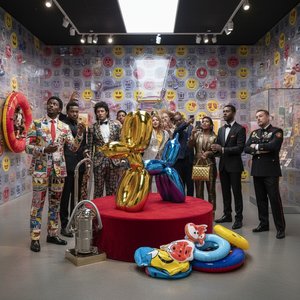 Jeff Koons: Irony, Kitsch & the Commodification of Contemporary ArtExplore the complex world of Jeff Koons with OriginalUniqueArt. Discover the irony, kitsch, and market forces behind his iconic sculptures.…