Bytt til trykk
 Vis hele teksten







































 For kunstverk eller reproduksjoner som er større enn 105 cm (ca. 41 tommer) på noen side, vil rammen bli sendt som et sett som må monteres. Denne metoden sikrer trygg levering og forhindrer skader under transport.


A Symphony of Color and Texture: The Eternal Bloom of Jan van Huysum
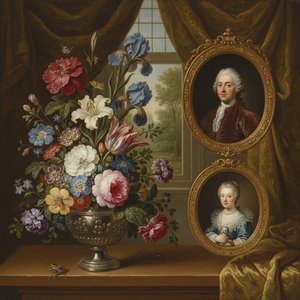
In the quiet grandeur of the Rijksmuseum Amsterdam, there exists a window into a world of perpetual spring, a masterpiece that transcends the boundaries of time and decay. Jan van Huysum’s “Flowers and Fruit,” completed in 1723, is far more than a mere arrangement of botanical specimens; it is a breathtaking triumph of the Dutch Baroque. To gaze upon this canvas is to enter a realm where the ephemeral beauty of nature is captured with such profound precision that one can almost sense the cool moisture on a petal or the sweet, heavy scent of ripening fruit. This work stands as a quintessential exemplar of an era defined by opulence, where the mastery of light and shadow served to celebrate both the abundance of the natural world and the unparalleled technical skill of the artist.
Born into a lineage of artistic excellence in Amsterdam, Jan van Huysum was destined to become the preeminent voice of floral still life. The son of Justus van Huysum the Elder, his very DNA was steeped in the traditions of the Dutch Golden Age. However, Jan did not merely replicate the works of his predecessors; he revolutionized the genre. While earlier masters often presented static, formal arrangements, Van Huysum introduced a sense of dynamic movement and organic spontaneity. In “Flowers and Fruit,” the composition breathes with life. Grapes appear to cluster with a heavy, succulent weight, while apples are scattered with a calculated casualness that suggests a moment frozen in time. This sense of illusionism—the art of deceiving the eye—is what elevates this piece from a simple study to a profound sensory experience.
The Alchemy of Light and Glaze
The technical brilliance required to achieve such luminosity is nothing short of miraculous. Van Huysum employed a painstaking method of layering thin, translucent glazes over multiple base coats, a technique that allowed light to penetrate the paint layers and reflect back from within, creating an inner glow. This meticulous process enabled him to render the diverse textures found in nature with startling accuracy: the velvety softness of a rose petal, the smooth, reflective sheen of a ripe peach, and the crystalline clarity of a single dewdrop clinging to a leaf. For the discerning collector or interior designer, these details offer a depth that is palpable; the painting does not merely sit upon a wall but interacts with the ambient light of a room, changing its character as the day progresses.
Beyond the technical execution lies a deeper layer of symbolic resonance. In the 18th century, such still lifes were often meditations on the concept of vanitas—the fleeting nature of life and the inevitability of change. Yet, Van Huysum’s approach leans more toward a celebration of abundance and the divine order of creation. The lushness of the fruit and the vibrant vitality of the blossoms serve as a testament to the richness of life. For those seeking to infuse a space with elegance and a sense of timeless prosperity, this artwork provides an anchor of sophistication. A high-quality reproduction of this masterpiece brings not just color, but a storied history of Dutch excellence and a profound appreciation for the delicate, fleeting moments that define our existence.
Spørsmål og svar
Når og med hvilke materialer ble "Flowers and Fruit" laget?
"Flowers and Fruit" ble laget i 1723 med Oil On Panel.
Hvilken stemning uttrykker "Flowers and Fruit" av Jan Van Huysum innenfor Dutch Golden Age?
"Flowers and Fruit" har en Calm emosjonell tone innenfor Dutch Golden Age-retningen.
Hva anbefales en reproduksjon av "Flowers and Fruit" av Jan Van Huysum til?
Anbefalt bruk for "Flowers and Fruit" av Jan Van Huysum er Accent. Den kan også brukes til andre formål.
 Forhåndsvisning
 Send
Send Del
Del
 Vis detaljer
 Utskriftsvennlig guide

 Last ned bilde
 Liknende objekter
 Røntgenundersøkelse
 Lysbildefremvisning
 Spørsmål og svar
 Statistikk