Text size

() ·

A painting made for you, by hand

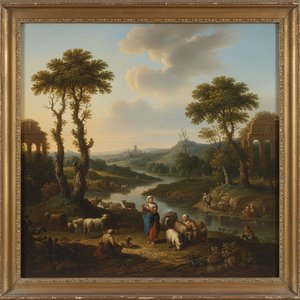
Italian Landscape

Håndlaget oljereproduksjon

Håndmalt olje på lerret i din valgte størrelse og ramme, laget på bestilling av våre kunstnere. ( Bytt til trykk Bytt til digitalt bilde)

Beskrivelse av objektet

Admire Jan Asselijn's "Italian Landscape" – a serene oil painting capturing a picturesque Italian vista with figures and ruins. A stunning piece of Dutch Golden Age art, perfect for collectors.

Om kunstneren

Jan Asselijn (1610-1652): Nederlands kunstmaler fra gullalderen kjent for italiensk landskapskunst og dyrelivsbilder som «Den truet skarv». Inspirert av Rembrandt og Pieter van Laer.

from ·

Chapter 1

How large should it be?

Slide to change the size; the picture on the left shows the frame at its real width. The proportions of the original are kept.

Standardformat
skreddersydd
CM
INCH

Velg mellom våre forhåndsdefinerte størrelser som bevarer kunstverkets opprinnelige proporsjoner.

bredde
høyde

Skriv inn ønsket bredde og høyde for å tilpasse bildet til din ramme eller vegg. Siden dette er håndmalt, kan kunstneren male litt mer rundt motivet eller beskjære det noe dersom du velger et annet format — valget er ditt. Vi sender deg en digital mockup til godkjenning før maleriet påbegynnes. Bildet som vises på denne siden representerer ikke det faktiske resultatet — kun mockuppen viser det endelige uttrykket.

Chapter 2

How should it arrive?

Choose the edges of the stretched canvas

Choose your frame

Corner sample of the WhiteWrap canvas edge finish, stretched on massivt tre bars
White Nkr1
Corner sample of the BlurSideWrap canvas edge finish, stretched on massivt tre bars
Blurside Nkr1
Corner sample of the ExtendedWrap canvas edge finish, stretched on massivt tre bars
Extended Nkr1
Corner sample of the P118B picture frame: støpt polystyren, 5 cm wide and 3 cm thick
P118B Nkr10
Corner sample of the P118H picture frame: støpt polystyren, 5 cm wide and 3 cm thick
P118H Nkr10
Corner sample of the P118W picture frame: støpt polystyren, 5 cm wide and 3 cm thick
P118W Nkr10
Corner sample of the P438Z picture frame: støpt polystyren, 5.5 cm wide and 3.5 cm thick
P438Z Nkr10
Corner sample of the P508JH picture frame: støpt polystyren, 7 cm wide and 3.5 cm thick
P508JH Nkr12
Corner sample of the P508YH picture frame: støpt polystyren, 7 cm wide and 3.5 cm thick
P508YH Nkr12
Corner sample of the P805H picture frame: støpt polystyren, 5 cm wide and 3.5 cm thick
P805H Nkr10
Corner sample of the P805Z picture frame: støpt polystyren, 5 cm wide and 3.5 cm thick
P805Z Nkr10
Corner sample of the P919BZ picture frame: støpt polystyren, 7 cm wide and 3.5 cm thick
P919BZ Nkr10
Corner sample of the P919G picture frame: støpt polystyren, 7 cm wide and 3.5 cm thick
P919G Nkr10
Corner sample of the P919XJ picture frame: støpt polystyren, 7 cm wide and 3.5 cm thick
P919XJ Nkr10
Corner sample of the P959ZH picture frame: støpt polystyren, 5 cm wide and 3 cm thick
P959ZH Nkr10
Corner sample of the P968JZ picture frame: støpt polystyren, 6 cm wide and 4 cm thick
P968JZ Nkr12
Corner sample of the W106C picture frame: massivt tre, 5 cm wide and 3 cm thick
W106C Nkr8
Corner sample of the W218G picture frame: massivt tre, 5 cm wide and 3 cm thick
W218G Nkr10
Corner sample of the W218JH picture frame: massivt tre, 5 cm wide and 3 cm thick
W218JH Nkr8
Corner sample of the W218Y picture frame: massivt tre, 5 cm wide and 3 cm thick
W218Y Nkr10
Corner sample of the W307PJ picture frame: massivt tre, 6 cm wide and 3 cm thick
W307PJ Nkr10
Corner sample of the W316G picture frame: massivt tre, 6 cm wide and 3 cm thick
W316G Nkr10
Corner sample of the W316PJ picture frame: massivt tre, 6 cm wide and 3 cm thick
W316PJ Nkr8
Corner sample of the W316Y picture frame: massivt tre, 6 cm wide and 3 cm thick
W316Y Nkr10
Corner sample of the W398PJ picture frame: massivt tre, 5 cm wide and 3 cm thick
W398PJ Nkr8
Corner sample of the W4111J picture frame: massivt tre, 6.5 cm wide and 3.5 cm thick
W4111J Nkr10
Corner sample of the W500HY picture frame: massivt tre, 7 cm wide and 5 cm thick
W500HY Nkr15
Corner sample of the W500JH picture frame: massivt tre, 7 cm wide and 5 cm thick
W500JH Nkr15
Corner sample of the W692G picture frame: massivt tre, 8 cm wide and 4 cm thick
W692G Nkr12
Corner sample of the W849H picture frame: massivt tre, 5 cm wide and 3 cm thick
W849H Nkr8
Corner sample of the W940BG picture frame: massivt tre, 7.5 cm wide and 4.5 cm thick
W940BG Nkr15
Corner sample of the W953PJ picture frame: massivt tre, 6 cm wide and 3.5 cm thick
W953PJ Nkr8
Corner sample of the H24-GOLD picture frame: utskåret tre med gesso, 10 cm wide and 6 cm thick
H24-GOLD Nkr30
Corner sample of the H24-SILVER picture frame: utskåret tre med gesso, 10 cm wide and 6 cm thick
H24-SILVER Nkr30
Corner sample of the H36-GOLD picture frame: utskåret tre med gesso, 15 cm wide and 6.5 cm thick
H36-GOLD Nkr45
Corner sample of the H36-SILVER picture frame: utskåret tre med gesso, 15 cm wide and 6.5 cm thick
H36-SILVER Nkr45

Moulding: . Overall size with the frame: .

Chapter 3

Who paints it, and should anything change?

Examples of what can be changed: Replace face with customer photo; Add pet (e.g., replace cat with dog); Include hidden message in background; Change background landscape or elements.
After order, OriginalUniqueArt.com team will email client for instructions and provide a mockup preview

Verdensomspennende levering () på 3–4 uker i stedet for standard 5 uker. (2 November). Ingen kompromisser med kvaliteten.

Chapter 4

The finishing touches

A nameplate, as in a museum?

Detaljer om gravert bronseplate

This elegant plaque features the artist's name and the title of the artwork, finely engraved for a timeless presentation.

It is made from bronze with a refined, elegant finish. The text is precisely laser-engraved for a sharp and permanent result. Measuring 9x2 cm, the plaque is compact yet easy to read. It's built to be durable and scratch-resistant, offering a professional, museum-quality look. Mounting is simple thanks to the included adhesive backing.

Detaljer om gjennomsiktig akrylplate

The plaque includes essential engraved details such as the artist's name, the title of the artwork, the date it was created, the type of media used-like oil on canvas or watercolor-a brief description of the piece, and a QR code that links to the complete artwork information.

It is crafted from clear acrylic, offering a sleek, modern appearance. The text is UV-engraved in black to ensure strong visual contrast. With a size of 10x15 cm, it ensures optimal readability. It comes equipped with two metal hooks for secure wall mounting. The plaque is designed to be weather-resistant, making it suitable for various environments, and it includes interactive features that work seamlessly with smartphone scanning.

Detaljer om plakett i svart akryl

This elegant plaque includes engraved information such as the artist's name, the title of the artwork, the date it was created, the type of media used (like oil on canvas or watercolor), a short description of the artwork, and a QR code for quick access to more information.

The plaque itself is made from refined black acrylic with a premium finish. The text is laser-engraved in white for high contrast and readability. Its size is 10x15 cm, designed to be easy to read. It comes with two metal hooks for professional mounting. The design is sleek and fits any interior style. It is also weather-resistant and durable, with built-in digital integration for mobile compatibility.

A protective varnish?

When do you need it?

Chapter 5

Your painting, as you ordered it

Italian Landscape

Trykkmetode

Størrelse på reproduksjon

-

Utvalgte mesterkunstnere

Mer detaljrikdom, finesse og ekstra produksjonstid

-

Innramming av reproduksjon

-

-

For kunstverk eller reproduksjoner som er større enn 105 cm (ca. 41 tommer) på noen side, vil rammen bli sendt som et sett som må monteres. Denne metoden sikrer trygg levering og forhindrer skader under transport.

Krever profesjonell montering – dette er ikke et DIY-produkt.
Settet må monteres og lerretet strammes av en erfaren profesjonell rammelegger, ved bruk av trelim (følger ikke med), en lerretstang og klemmer for å holde rammelisten vinkelrett mens limet tørker. Feilaktig montering eller ujevn stramming av lerretet kan påføre kunstverket permanente skader og er ikke dekket av vår garanti.

  • Alle massive trelister er inkludert, presist tilpasset i størrelse.

  • Monteres med de medfølgende skruene, samt trelim til hjørnene, som ikke er inkludert og må anskaffes av din rammehandler.

  • Profesjonelt verktøy er nødvendig og er ikke inkludert: en lerretstang (strammer) og klemmer for å holde rammene vinkelrette mens limet tørker.

Viktig:
Hjørnene krever trelim, listene må holdes på plass med tvinger til limet er helt tørt, og stramming av lerretet på den ferdige rammen krever en lerretstang. Ingen av disse produktene er inkludert i settet. Vennligst sørg for tilgang til en erfaren profesjonell rammehandler før du bestiller denne størrelsen.

Navneskilt

-

-

Beskyttende ferniss

Blank lakk (forsterker farger, beskytter mot lys og fuktighet)

-

Tilpass mitt kunstverk

Eksempler på hva som kan endres: Erstatt ansikt med bilde av kunden; Legg til kjæledyr (f.eks. bytt ut katt med hund); Inkluder en skjult melding i bakgrunnen; Endre bakgrunnslandskap eller elementer.

-

Ekspresslevering

Verdensomspennende levering () på 3–4 uker i stedet for standard 5 uker. (2 November). Ingen kompromisser med kvaliteten.

-

Ekspresslevering

Verdensomspennende levering til innen 5 uker. (9 November).

Inkludert frakt

Totalpris for valgte alternativer

Nkr 2887

Totalpris Nkr 2887

Glassalternativet er kun tilgjengelig i størrelser under 110 cm

Included with every order

  • Gratis ekspressfrakt over hele verden
  • Lerretsduk av lin av høy kvalitet
  • Full transportforsikring
  • Garanti for refusjon av toll og importavgifter
  • Garantert fargegjengivelse
  • 100 dagers returrett ved fabrikasjonsfeil
  • 100% pengene tilbake-garanti
  • Rabatt ved flere kjøp

A Glimpse of Italian Pastoral: Jan Asselijn’s “Italian Landscape”

Jan Asselijn's "Italian Landscape," painted circa 1625-1652, isn’t merely a depiction of a picturesque vista; it’s an invitation to step into a carefully constructed world of serene beauty and subtle drama. This oil on canvas transports the viewer to a hypothetical Italian landscape – a deliberate choice by Asselijn that speaks volumes about the evolving artistic sensibilities of the Dutch Golden Age. The painting, now housed in collections like Bonhams, exemplifies the influence of both the Venetian masters and the burgeoning tradition of “pure” landscape painting emerging from Italy itself.

Asselijn’s style is distinctly characterized by a meticulous attention to detail and a masterful command of atmospheric perspective. He leans heavily into the techniques pioneered by Bamboccio – a contemporary painter known for his evocative, almost dreamlike landscapes – creating an image that feels both familiar and subtly unsettling. The composition unfolds with deliberate grace: a modest, classically-inspired building anchors the left foreground, its geometric solidity providing a grounding element against the undulating hills and hazy distance. The artist skillfully employs a muted palette of browns, ochres, and blues, avoiding bright colors to emphasize the painting’s contemplative mood. This restrained approach allows the subtle shifts in tone – from the dark shadows cast by distant trees to the luminous highlights reflecting off water – to create a remarkably convincing sense of depth and atmosphere.

The Influence of Venetian Masters and Italianate Tradition

Asselijn's work is deeply rooted in the artistic currents flowing through Italy at the time. He was profoundly influenced by the Venetian landscape painters, particularly those who favored a looser, more atmospheric style than their predecessors. However, unlike many of his contemporaries who simply copied Italian scenes directly, Asselijn imbued them with a distinctly Dutch sensibility – a focus on light, texture, and a carefully considered composition. This blending of influences is evident in the painting’s balanced structure, its subtle use of color, and its overall sense of quiet contemplation.

Furthermore, “Italian Landscape” reflects the broader trend toward what became known as "Italianate landscape" within Dutch art circles. This style sought to emulate the idealized landscapes depicted by artists like Claude Lorrain, who had established a dominant visual language for representing Italian scenery in Northern Europe. Asselijn’s painting isn't a literal transcription of an Italian vista; rather, it’s a carefully constructed fantasy – a “imaginary Italian Landscape” as described in some historical sources – designed to evoke the spirit and beauty of Italy while adhering to Dutch artistic conventions.

Symbolism and Emotional Resonance

Beyond its technical merits, "Italian Landscape" is rich in symbolic meaning. The solitary building, often interpreted as a villa or farmhouse, suggests themes of rural life, tranquility, and perhaps even isolation. The distant mountains, shrouded in mist, evoke a sense of mystery and the sublime – a recognition of nature’s power and grandeur. The figures scattered across the foreground, riding horses and walking along the riverbank, add a touch of human presence to the scene, reminding us of our connection to the natural world.

The painting's overall effect is one of profound serenity and contemplative beauty. It invites the viewer to slow down, to appreciate the subtle details of the landscape, and to lose themselves in its timeless atmosphere. It’s a testament to Asselijn’s skill as an artist – his ability to capture not just the appearance of a scene but also its emotional essence.

A Reproduction for Today's Spaces

Reproductions of “Italian Landscape” offer a beautiful addition to any interior space. The painting’s calming colors and evocative imagery create a sense of tranquility and sophistication, making it ideal for living rooms, bedrooms, or studies. The detailed depiction of the landscape invites contemplation and provides a visual connection to the natural world – a welcome respite from the stresses of modern life. Consider framing this piece in a classic wooden frame to further enhance its timeless appeal.

Spørsmål og svar

Hvor stor er kontrasten i "Italian Landscape" av Jan Asselijn?

"Italian Landscape" av Jan Asselijn viser en Balanced kontrast mellom de lyse og mørke partiene.

Hvilke andre navn er Jan Asselijn kjent under?

Jan Asselijn er også kjent under navnene Jan Asselyn.

Kan jeg undersøke "Italian Landscape" mer detaljert?

Røntgenvisningen av "Italian Landscape" av Jan Asselijn finnes på verkets Røntgenstråling-side: en interaktiv undersøkelse av bildet gjennom elleve optiske lag.

More about this painting

Forhåndsvisning Se i AR Bytt til trykk Bytt til digitalt bilde Send
Vis detaljer Utskriftsvennlig guide Legg til i favoritter Last ned bilde Liknende objekter Røntgenundersøkelse Lysbildefremvisning Q&A Statistikk

In numbers

  • 29frames to choose from
  • standard sizes, in its own proportions
  • 5weeks to paint and deliver it
Jan Asselijn

Jan Asselijn

1610 - 1652, Frankrike

Quick facts about Jan Asselijn

  • Artistic Movement Or Style: Italianate landskap
  • Artists Or Movements Influenced By This Artist: ['Pieter van Laer']
  • Artists Who Influenced This Artist:
    • Jan Martszen den yngre
    • Esaias van de Velde
    • Rembrandt
  • Date Of Birth: Dieppe, rundt 1610
  • Date Of Death: 1652
  • Full Name: Jean Asselin
  • Nationality: Nederlands
  • Notable Artworks:
    • Den truet svane
    • Hangout i Italia
    • Høyrde ved Colosseum
  • Place Of Birth: Dieppe, Frankrike

Om kunstneren

A Life Forged in Landscape: The World of Jan Asselijn

Born Jean Asselin around 1610 in Dieppe, France, Jan Asselijn’s life unfolded against the backdrop of turbulent religious times and a burgeoning artistic revolution. His family, Huguenots fleeing persecution, relocated to Amsterdam in 1621 – a city pulsating with commercial energy and brimming with creative talent during the Dutch Golden Age. This move proved transformative, immersing young Jean into an environment where landscape painting was undergoing a dramatic shift away from traditional representations toward scenes imbued with palpable atmosphere and profound emotion. Initially apprenticed under Jan Martszen the Younger, he honed his skills in battle paintings before discovering his true passion: capturing the splendor of both natural vistas and animal life. The Dutch light – expansive skies and vibrant hues – would become an indelible mark on Asselijn’s artistic vision, though a journey to Italy solidified his aesthetic sensibilities and propelled him toward groundbreaking innovation.

The Italianate Embrace & The Bentvueghels

Like many ambitious Northern European painters of the era, Asselijn sought inspiration in Italy, arriving sometime after 1635. He wholeheartedly embraced the *Italianate* style – a genre characterized by sun-drenched landscapes, classical ruins, and pastoral scenes brimming with romanticism. He joined the ranks of the *Bentvueghels*, a peculiar society of Dutch and Flemish artists residing in Rome. These “Birds of a Feather” defied convention, adopting outlandish nicknames and prioritizing direct observation—rejecting studio work altogether. Within this spirited community, Asselijn earned the moniker "Krabbetje" (little crab) due to a congenital deformity affecting his hand – yet he flourished creatively. He absorbed influences from artists like Pieter van Laer (Bamboccio), whose depictions of Roman peasant life and landscapes resonated deeply with Asselijn’s evolving style. This formative period instilled in him the ability to convey emotion, light, and narrative within his canvases—a skill that would define his oeuvre.

Mastering Light & Symbolism: Key Works

Upon returning to Amsterdam, Asselijn possessed a refined technique and a distinctive artistic voice. His paintings are distinguished by exceptional clarity of execution and masterful manipulation of light – qualities that swiftly garnered admiration from contemporaries like Rembrandt, who even created etchings portraying Asselijn at work—a gesture perhaps sensitive to the artist’s physical disability. While he produced historical and battle scenes, it was his landscapes and animal studies that truly cemented his reputation. The Threatened Swan, completed around 1640, stands as his most celebrated masterpiece. More than merely a depiction of avian defense, this painting became a potent emblem of Dutch national resilience against external pressures—a visual articulation of anxieties prevalent during the time and interpreted allegorically as representing Johan de Witt, a prominent Dutch statesman. Intriguingly, later owners added symbolic inscriptions to the canvas – “Holland” on one of the eggs and “Enemy of the state” beside the menacing dog—further amplifying its political significance. Other notable works include Cavalry Attack at Sunset, showcasing his initial training in battle painting with dramatic flair, and depictions of rural life like Drovers with Cattle under an Arch of the Colosseum in Rome, which harmoniously blend Italianate landscapes with animal observations—demonstrating Asselijn’s capacity to capture both visual beauty and narrative depth. The Breach of the Saint Anthony’s Dike near Amsterdam exemplifies his ability to portray a moment of national crisis—reflecting the ever-present danger posed by water and necessitating ingenious solutions for Dutch land reclamation.

Influence & Legacy: A Lasting Impression

Jan Asselijn's influence extended beyond his prolific output. He was revered by artists like Rembrandt, who produced etchings documenting Asselijn’s artistic process—a gesture perhaps considerate of the artist’s physical impairment. Furthermore, he served as a mentor to Frederik de Moucheron, another accomplished Dutch landscape painter who championed the Italianate style and disseminated its principles widely. Asselijn's innovative approach to light and atmosphere profoundly impacted subsequent generations of painters—laying the groundwork for greater naturalism and emotional resonance in landscape art. His works are now housed in prestigious institutions such as the Rijksmuseum in Amsterdam, ensuring his enduring legacy as a pivotal figure within the Dutch Golden Age—a testament to his artistic brilliance and lasting contribution to European art history.

Kort om verket

  • Dimensions: 22 x 26in (55.9 x 66.0cm)
  • Year: 1652
  • Artistic style: Atmospheric, serene
  • Movement: Italianate landscape
  • Medium: Oil on canvas
  • Title: Italian Landscape

Kunnequiz om kunst

Det er kun ett riktig svar på hvert spørsmål.

Spørsmål 1:
What is the primary subject depicted in Jan Asselijn’s ‘Italian Landscape’?
Spørsmål 2:
Which artistic movement is most closely associated with Jan Asselijn’s style, as evidenced by his ‘Italian Landscape’?
Spørsmål 3:
The painting utilizes a predominantly monochromatic color scheme. What effect does this primarily achieve?
Spørsmål 4:
Jan Asselijn’s background included a period spent in Italy. What impact did this experience have on his artistic development?
Spørsmål 5:
The painting ‘Italian Landscape’ is considered part of a broader artistic tradition. What is this tradition primarily known for?
Utforsk kunstverk organisert etter temaer, stiler og kjennetegn.