

 Se i rommet
 Del som digitalt kort
 Del
Del
 Detaljer
 Studentguide

 Last ned
 Liknende objekter
 Røntgen
 Lysbildefremvisning
 Besøksstatistikk
Virtue


 Les mer
Håndlaget oljereproduksjon
Håndmalt olje på lerret i din valgte størrelse og ramme, laget på bestilling av våre kunstnere. ( Bytt til trykkversjon Gå til digitalt bilde)




P118B Nkr10

P118H Nkr10

P118W Nkr10

P438Z Nkr10

P508JH Nkr12

P508YH Nkr12

P805H Nkr10

P805Z Nkr10

P919BZ Nkr10

P919G Nkr10

P919XJ Nkr10

P959ZH Nkr10

P968JZ Nkr12

W106C Nkr8

W218G Nkr10

W218JH Nkr8

W218Y Nkr10

W307PJ Nkr10

W316G Nkr10

W316PJ Nkr8

W316Y Nkr10

W398PJ Nkr8

W4111J Nkr10

W500HY Nkr15

W500JH Nkr15

W692G Nkr12

W849H Nkr8

W940BG Nkr15

W953PJ Nkr8




Velg mellom våre forhåndsdefinerte størrelser som bevarer kunstverkets opprinnelige proporsjoner.

Du kan angi egne mål for å tilpasse en spesifikk ramme eller plass. Dersom den valgte størrelsen ikke samsvarer med originalbildets proporsjoner, vil vi enten beskjære kunstverket eller utvide maleriet med ytterligere håndmalte elementer. En digital mockup vil bli sendt til din godkjenning før produksjonen starter.
Vennligst merk at forhåndsvisningen på skjermen ikke gjenspeiler den faktiske beskjæringen eller utvidelsen. Kun mockuppen vil vise den endelige komposisjonen nøyaktig.
Selv om tilpassede størrelser er tilgjengelige, anbefaler vi å velge et mål fra den forhåndsdefinerte listen for å bevare de originale proporsjonene.
Etter bestilling vil OriginalUniqueArt.com-teamet sende e-post til kunden for instruksjoner og sende et utkast (mockup) som forhåndsvisning.
Verdensomspennende levering () på 3–4 uker i stedet for standard 5 uker. (7 October). Ingen kompromisser med kvaliteten.

Gratis ekspressfrakt over hele verden

Lerretsduk av høykvalitets lin

Full transportforsikring

Garanti for refusjon av toll og importavgifter

Garantert fargeekthet

100 dagers returrett ved fabrikasjonsfeil

100% pengene tilbake-garanti

Mengderabatt
 Glassalternativet er kun tilgjengelig i størrelser under 110 cm

Virtue
Reproduksjonsmetode
Format på reproduksjon
-


Totalpris
Nkr 2774
Virtue: A Testament to Renaissance Idealism
Jacopo della Quercia’s “Virtue,” sculpted around 1414, stands as an emblem of the burgeoning humanist spirit that characterized early Renaissance Florence—a moment where classical ideals wrestled with Christian theology to forge a new aesthetic vision. This marble sculpture, housed in Siena Cathedral's Fonte Gaia fountain complex, isn’t merely a depiction of a woman; it’s a carefully crafted embodiment of Temperance, one of the Cardinal Virtues revered throughout Christendom and championed by philosophers like Pico della Mirandola as essential for achieving human flourishing. The sculpture itself is remarkably restrained in its composition. A seated female figure dominates the frame, positioned within an architectural niche that lends depth to the scene. Her gaze directs upwards, conveying a sense of serene contemplation—a deliberate choice reflecting the Renaissance fascination with inner reflection and moral virtue. The drapery clings to her form, rendered with flowing lines that contrast subtly with the angularity of her face and hands, demonstrating Quercia’s mastery of sculptural technique. Circular shapes are present in the folds of fabric, mirroring the harmonious balance sought by artists of the period. The artist skillfully employed subtractive sculpting—removing material from a block of Carrara marble—to reveal the idealized form he envisioned. The surface texture captures the subtle imperfections inherent in natural stone, yet maintains an overall smoothness that underscores the sculpture’s polished appearance. Light emanates from above and slightly to the left, casting shadows that accentuate the three-dimensionality of the figure and niche walls, creating a convincing illusion of space. This masterful use of lighting aligns perfectly with Renaissance artistic conventions, prioritizing realism while elevating the subject matter to spiritual significance. Beyond its technical prowess, “Virtue” resonates deeply with symbolic meaning. The book held by the woman symbolizes knowledge—a cornerstone of humanist thought—and represents divine guidance, mirroring the theological framework underpinning the sculpture’s creation. Her posture exudes dignity and wisdom, reflecting the Renaissance aspiration for moral excellence and intellectual enlightenment. Viewing this artwork evokes feelings of reverence and contemplation—a reminder that beauty can serve as a conduit to profound ethical considerations. The Fonte Gaia fountain complex itself is a testament to Siena's artistic ambition during the Quattrocento. Commissioned by Pope Pius II, it represents an extraordinary undertaking in civic art, aiming to elevate Siena’s prestige and commemorate its patron saint, Saint Catherine of Siena. Jacopo della Quercia’s contribution—along with other prominent sculptors—was intended to inspire piety and reinforce moral values within the city's populace. “Virtue,” therefore, isn’t just a standalone masterpiece; it’s an integral part of a larger artistic project designed to shape the cultural landscape of Renaissance Italy.- Artist: Jacopo della Quercia
- Born Year: 1374
- Death Year: 1438
- Birth City: Monteroni di Lecce
- Birth Country: Italy
- Material: Marble
- Technique: Subtractive Sculpting
- Style: Early Renaissance Sculpture
Spørsmål og svar
Hvilken størrelse og orientering anbefales for et trykk av "Virtue" av Jacopo Della Quercia?
Large størrelse, Portrait orientering: dette er den anbefalte trykkinnstillingen for "Virtue" av Jacopo Della Quercia.
Er "Virtue" tilgjengelig som et kunsttrykk?
For å bestille et trykk av "Virtue" av Jacopo Della Quercia, kan du enkelt gjøre det på denne siden: et kunsttrykk på bomullslerret eller arkivbestandig lerretspapir.
Hva er produksjonsåret til "Virtue" av Jacopo Della Quercia?
"Virtue" dateres til 1414. Datoen plasserer verket innenfor Jacopo Della Quercia sin karriere og sin epoke.
Hvor gammel var Jacopo Della Quercia da hen laget "Virtue"?
Da "Virtue" ble skapt i 1414, var Jacopo Della Quercia – født i 1374 – 40 år gammel.
Hvem er kunstneren bak "Virtue"?
Kunstneren bak "Virtue" er Jacopo Della Quercia. Verket er katalogisert under Jacopo Della Quercia sitt navn.
Ble "Virtue" værende i kunstnerens hjemland?
Ja – kunstverket oppbevares i kunstnerens hjemland. Kunstneren ble født i Italia; det originale verket befinner seg i Italia.
Hvilken stemning ville "Virtue" tilføre et rom?
"Virtue" av Jacopo Della Quercia har en Serene atmosfære og anbefales for et Living Room. Stemningen er det verket tilfører rommet rundt seg.
Kunstnerbiografi
Jacopo della Quercia: Bridging the Gothic and Embracing Renaissance Vision
Jacopo della Quercia, a name synonymous with artistic transition in 15th-century Italy, stands as a pivotal figure bridging the lingering shadows of the Gothic era with the burgeoning brilliance of the Italian Renaissance. Born in Monteroni di Lecce around 1374 and tragically dying in Bologna in 1438, his life was a tapestry woven with commissions, rivalries, and a profound engagement with both classical antiquity and the evolving sensibilities of his time. He wasn’t merely a sculptor; he was an architect of style, a translator between traditions, and ultimately, a harbinger of the revolutionary artistic shifts that would define the Renaissance.
His early training, meticulously honed under his father, Piero d'Angelo – a skilled woodcarver and goldsmith – laid the foundation for his burgeoning talent. This formative period instilled in him not just technical proficiency but also an appreciation for craftsmanship and the enduring power of traditional techniques. Crucially, however, young Jacopo’s artistic journey was profoundly shaped by his exposure to the monumental works of Nicola Pisano and Arnolfo di Cambio adorning the pulpit of Siena Cathedral. These encounters ignited a fascination with narrative sculpture, dynamic composition, and the expressive potential of human form – elements that would become hallmarks of his distinctive style.
The Early Years: Lucca and the Seeds of Innovation
Jacopo’s career truly blossomed in Lucca, a city strategically positioned at the crossroads of artistic influence. His relocation to Lucca with his father in 1386, driven by political instability, proved to be a catalyst for significant artistic development. It was here that he began to establish himself as a sculptor of considerable promise, undertaking projects such as the poignant “Man of Sorrows” for the altar of the Sacrament and a relief depicting St. Aniello on a tomb. These early works already demonstrated a nascent ability to imbue stone with emotional depth – a characteristic that would become increasingly pronounced in his later career.
A pivotal moment arrived in 1401 when Jacopo entered the prestigious competition to design the bronze doors for Florence’s Baptistery, a contest ultimately won by Ghiberti. Though he didn't secure the commission itself, this experience exposed him to the highest standards of Florentine artistry and fueled his ambition. The whereabouts of the designs themselves remain a tantalizing mystery, adding an element of intrigue to his already fascinating story.
Ferrara and the Influence of Roman Antiquity
Jacopo’s journey continued eastward to Ferrara in 1403, where he was commissioned to sculpt the marble Virgin and Child for the city’s cathedral. This work marked a significant shift towards greater naturalism and classical influence – a reflection of his growing engagement with the artistic legacy of ancient Rome. He also undertook the creation of a statuette of St. Maurice during this period, now housed in the Museo del Duomo, showcasing his ability to seamlessly blend Gothic sensibilities with emerging Renaissance ideals.
The city of Ferrara provided him with access to an extraordinary collection of Roman sculptures and sarcophagi, sparking a deep appreciation for the elegance, proportion, and narrative power of classical antiquity. These encounters profoundly shaped his artistic vision, leading him to incorporate elements of classical drapery, anatomy, and composition into his own work – subtly yet decisively transforming the Gothic style he had inherited.
Fonte Gaia: A Masterpiece of Civic Pride and Artistic Innovation
Perhaps Jacopo della Quercia’s most enduring legacy is undoubtedly Fonte Gaia, a monumental fountain commissioned in 1406 by Paolo Guinigi, the ruler of Lucca. This ambitious project represented not only a significant civic investment but also a bold artistic statement – a deliberate rejection of the pagan Venus statue that had previously adorned the square and been blamed for outbreaks of plague. The fountain itself is a marvel of engineering and artistry, constructed from gleaming white marble and adorned with numerous statues and spouts, creating a vibrant spectacle of water and light.
Fonte Gaia stands as a testament to Jacopo’s ability to synthesize diverse influences – Gothic elegance, classical proportion, and the burgeoning spirit of the Renaissance. The inclusion of nude putti flanking the fountain's base—a daring departure from traditional sculptural conventions—clearly signaled his embrace of classical ideals while retaining a distinctly humanistic sensibility. The project, however, was a protracted undertaking, spanning over a decade and reflecting the challenges inherent in managing multiple commissions simultaneously.
Later Works and a Legacy of Transition
Throughout the remainder of his career, Jacopo della Quercia continued to work on a diverse range of projects, including the Trenta Chapel in San Frediano, Lucca, and tomb slabs for Lorenzo Trenta and his wife. His involvement in the design of a hexagonal basin with bronze panels for Siena’s Baptistery, alongside his rival Ghiberti, resulted in the completion of only one relief – “The Annunciation to Zacharias” – due to his simultaneous commitments to other projects. This episode highlights his cautious approach to working with bronze and his preference for the more manageable medium of marble.
Jacopo della Quercia’s life was tragically cut short in 1438, but his artistic legacy endures as a bridge between the Gothic and Renaissance worlds. He wasn't simply a skilled craftsman; he was an innovator, a visionary, and a key figure in shaping the trajectory of Italian art. His work foreshadowed the revolutionary developments championed by Michelangelo, solidifying his place as one of the most important sculptors of the Early Renaissance.

Jacopo Della Quercia
1374 - 1438 , Italia
Kort om kunstneren
- Artistic Movement Or Style: Tidlig renessanse
- Artists Or Movements Influenced By This Artist: ['Michelangelo']
- Artists Who Influenced This Artist:
- Nicola Pisano
- Arnolfo di Cambio
- Date Of Birth: c. 1374
- Date Of Death: 1438
- Full Name: Jacopo di Pietro d'Agnolo Di Guarnieri
- Nationality: Italiensk
- Notable Artworks:
- Fonte Gaia
- Tomb Ilaria
- Zacharias
- Place Of Birth: Monteroni di Lecce, Italia
Relaterte artikler

The Enduring Allure of Marble in Art History: From Classical Sculpture to Modern Abstraction
Explore the captivating history of marble sculpture from ancient Greece to modern art. Discover renowned artists like Canova & Michelangelo, carving techniques, and investment insights at OriginalUniqueArt.

Bronzens Mesterverk: 10 Skulpturer Som Forandret Kunsthistorien | OriginalUniqueArt
Oppdag 10 legendariske bronse skulpturer som revolusjonerte kunsthistorien! Fra Michelangelo til Rodin – lær om teknikker, historier og tidløs skjønnhet. Finn museumskvalitets reproduksjoner & interiørinspirasjon på OriginalUniqueArt.com.

Timeless Elegance: A Complete Guide to the Sublime Beauty and Artistry of Marble Sculpture
Discover the sublime beauty of marble art through an expert exploration of Renaissance and Neoclassical masterpieces. From the delicate textures of Carpeaux to the grandeur of Sansovino, immerse yourself in a guide to timeless elegance and sculptural perfection.

Bronseklassikere: 10 skulpturer som revolusjonerte kunsten | OriginalUniqueArt
Utforsk 10 legendariske bronseskulpturer som formet kunsthistorien! Fra Rodin til Michelangelo – oppdag historiene, teknikkene og skjønnheten bak tidløse mesterverk. Finn din perfekte veggkunst eller interiørdekor på OriginalUniqueArt.com.
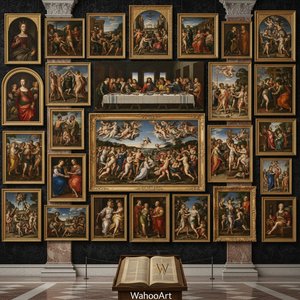
Jacopo Tintorettos 25 Mesterverk: Drama, Lys og Renessanse Kunst | OriginalUniqueArt.no
Oppdag Jacopo Tintorettos 25 mest ikoniske malerier! Fordyp deg i renessansens drama, lys og farger. Eksklusive kunsttrykk & lerretstrykk på OriginalUniqueArt.no – finn din favoritt nå!

