Se i rommet
 Del som digitalt kort
 Del
Del
 Detaljer
 Studentguide

 Last ned
 Liknende objekter
 Røntgen
 Lysbildefremvisning
 Besøksstatistikk
Odessa


 Les mer
Giclée / Kunsttrykk
Giclée- eller lerretsprint av museumskvalitet med rask produksjon og fleksible valgmuligheter for etterbehandling. ( Bestill håndmalt reproduksjon Gå til digitalt bilde)




P118B Nkr10

P118H Nkr10

P118W Nkr10

P438Z Nkr10

P508JH Nkr12

P508YH Nkr12

P805H Nkr10

P805Z Nkr10

P919BZ Nkr10

P919G Nkr10

P919XJ Nkr10

P959ZH Nkr10

P968JZ Nkr12

W106C Nkr8

W218G Nkr10

W218JH Nkr8

W218Y Nkr10

W307PJ Nkr10

W316G Nkr10

W316PJ Nkr8

W316Y Nkr10

W398PJ Nkr8

W4111J Nkr10

W500HY Nkr15

W500JH Nkr15

W692G Nkr12

W849H Nkr8

W940BG Nkr15

W953PJ Nkr8




Velg mellom våre forhåndsdefinerte størrelser som bevarer kunstverkets opprinnelige proporsjoner.

Skriv inn bredden og høyden du trenger, slik at den passer til din ramme eller vegg. Et trykk kan kun beskjæres, aldri gjøres større enn bildet, så et format med en annen form vil miste en del av motivet. Vi sender deg en digital mockup for godkjenning før vi trykker noe som helst. Bildet som vises på denne siden viser ikke den faktiske beskjæringen — det er kun mockuppen som gjør det.
Verdensomspennende levering () på 2 uker i stedet for standard 4/5 uker. (26 October)

Gratis ekspressfrakt over hele verden

Lerretsduk av høykvalitets lin

Full transportforsikring

Garanti for refusjon av toll og importavgifter

Garantert fargeekthet

100 dagers returrett ved fabrikasjonsfeil

100% pengene tilbake-garanti

Mengderabatt
 Glassalternativet er kun tilgjengelig i størrelser under 110 cm

Odessa
Giclée / Kunsttrykk
Format på reproduksjon
-


Totalpris
Nkr 760
A Symphony of Sea and Light: Ivan Aivazovsky’s “Odessa”
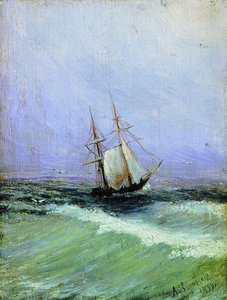
Ivan Aivazovsky's "Odessa," painted in 1840, isn’t merely a depiction of a coastal city; it’s an immersive experience. The canvas breathes with the salty air of the Black Sea, capturing not just the physical landscape but also the very spirit of maritime life and the sublime beauty that captivated Aivazovsky throughout his extraordinary career. This work, currently residing in the Pushkin State Museum in Moscow, stands as a testament to the artist’s unparalleled ability to translate the dynamism of water onto canvas – a skill honed by a lifetime spent intimately connected with the sea.
The scene unfolds with remarkable clarity and depth. A cluster of boats, rendered with meticulous detail, dances across the water's surface, ranging from smaller skiffs near the shore to larger vessels receding into the distance. The buildings lining Odessa’s harbor are subtly integrated into the composition, providing a grounding element while simultaneously contributing to the overall sense of bustling activity. Notice how Aivazovsky masterfully employs atmospheric perspective – the colors and details become softer and less distinct with increasing distance – creating an illusion of vastness and drawing the viewer's eye into the heart of the seascape.
Romanticism’s Embrace: Emotion and the Sublime
“Odessa” is firmly rooted in the Romantic movement, a period characterized by its emphasis on emotion, imagination, and the power of nature. Aivazovsky wasn’t simply recording what he saw; he was conveying *how* he felt when confronted with the sea's grandeur. The painting’s luminosity—achieved through his signature layering technique—evokes a sense of tranquility and almost ethereal beauty. The light, particularly as it reflects off the water, is not merely descriptive but actively contributes to the emotional impact of the scene. It suggests an underlying energy, a constant movement beneath the surface that mirrors the turbulent spirit of the Romantic ideal.
Aivazovsky’s use of color is equally crucial. He employs a rich palette of blues and greens, punctuated by flashes of white foam and the warm hues of the distant shoreline. These colors aren't blended smoothly; instead, they are applied in distinct brushstrokes, creating a textured surface that adds to the painting’s dynamism and sense of immediacy. This technique, combined with his masterful handling of light and shadow, imbues the scene with a palpable sense of life.
The Artist’s Process: Layering and Light
Aivazovsky's technique was revolutionary for its time. He built up layers upon layers of thin washes of paint, allowing each subsequent layer to subtly alter the colors and values beneath it. This method, known as *alla prima*, created a remarkable sense of depth and luminosity – a hallmark of his style. He often worked directly onto the wet surface of the canvas, blending the colors with his brush rather than relying on traditional glazing techniques. This approach resulted in a vibrant, almost luminous quality that is particularly evident in “Odessa,” where the reflections on the water shimmer with an otherworldly brilliance.
Furthermore, Aivazovsky’s meticulous study of light and its effects on water were unparalleled. He spent countless hours observing the sea, meticulously documenting how sunlight interacted with the waves, creating a dazzling array of colors and patterns. This deep understanding is evident in every brushstroke, transforming “Odessa” into more than just a seascape; it's a celebration of the sea’s transformative power.
A Legacy of Maritime Mastery
“Odessa” stands as one of Aivazovsky’s most celebrated works, alongside pieces like "View of Odessa by Moonlight" and “Tempest by Cape Aiya.” These paintings collectively demonstrate his extraordinary ability to capture the drama and beauty of the sea under a multitude of conditions. Reproductions of this masterpiece offer an exceptional opportunity to bring the evocative power of Aivazovsky’s vision into any space, whether as a striking centerpiece or a subtle accent. OriginalUniqueArt offers meticulously crafted reproductions that faithfully recreate the artist's original techniques and colors, ensuring that you experience the full emotional impact of “Odessa” for years to come.
Spørsmål og svar
Hvilket nasjonalt opphav ligger bak Romanticism-retningen i "Odessa"?
"Odessa" knytter Romanticism-bevegelsen til Russland gjennom skaperens fødested.
Hvor sterk er kontrasten i "Odessa" av Ivan Aivazovsky?
Kontrastnivået i "Odessa" av Ivan Aivazovsky er Gentle.
Er det mulig å laste ned "Odessa"?
Bildet av "Odessa" av Ivan Aivazovsky kan lastes ned fra verkets Last ned-side: nedlasting av et digitalt bilde i høy oppløsning.
Kunstnerbiografi
A Life Embraced by the Waves
Ivan Konstantinovich Aivazovsky, born Hovhannes Aivazian in 1817, was more than a painter of seascapes; he was a conduit to the ocean’s soul. His very existence seemed inextricably linked to the Black Sea—a vast, unpredictable expanse that would forever dominate his artistic vision and fuel an extraordinary career spanning nearly six decades. Born in the Crimean port city of Feodosia, Aivazovsky didn't merely observe the sea; he felt it – its raw energy, sublime beauty, and inherent danger becoming the very essence of his art. From a young age, this connection was nurtured, initially by local architect Jacob Koch who recognized the boy’s talent, then blossoming within the rigorous academic environment of the Imperial Academy of Arts in Saint Petersburg. Yet, formal training alone couldn't account for the depth of Aivazovsky’s understanding; it was the constant presence of salt-laced air and the cries of gulls that truly shaped his artistic sensibility. His Armenian heritage also played a significant role, as he was baptized at the St. Sargis Armenian Church in Feodosia and maintained strong cultural ties throughout his life, occasionally incorporating Armenian themes into his expansive body of work.The Early Years and Artistic Foundations
Aivazovsky’s early years were steeped in the maritime traditions of Feodosia, a bustling port city with deep roots in trade and seafaring. His family, originally from Western Armenia, had migrated to Crimea centuries earlier, establishing themselves as merchants and artisans. This exposure to the sea – its rhythms, its dangers, and its beauty – undoubtedly shaped his artistic sensibilities from an early age. Recognizing his exceptional talent, Jacob Koch, a local architect, encouraged Aivazovsky’s artistic pursuits, providing him with initial instruction. Later, he received formal training at the Imperial Academy of Arts in Saint Petersburg, where he honed his skills under the guidance of established masters. However, despite this rigorous academic education, Aivazovsky's true artistic voice emerged from his direct engagement with the natural world – specifically, the Black Sea. He spent countless hours observing ships, studying weather patterns, and capturing the ever-changing moods of the ocean on canvas. This intimate connection to the sea became the cornerstone of his unique style.The Rise as a Naval Painter
A pivotal moment in Aivazovsky’s career arrived with his appointment as the main painter of the Russian Navy in 1843. This wasn't merely a prestigious title; it was an unparalleled opportunity—access to ships, sailors, naval battles, and firsthand observation that profoundly influenced his work. He became intimately acquainted with maritime life, documenting ship movements, capturing the drama of naval engagements, and portraying the lives of those who served on the Russian fleet. This role provided him with a constant stream of subject matter and allowed him to develop a highly realistic and technically proficient style. His paintings of naval battles – such as *The Battle of Navarino* (1846) – became iconic representations of these historical events, capturing both the chaos and the heroism of war at sea. The patronage of the Russian Imperial family further elevated his status and provided him with resources to continue his artistic endeavors.A European Journey and Artistic Refinement
In the early 1840s, Aivazovsky embarked on a journey through Europe, seeking inspiration and broadening his artistic horizons. Italy proved particularly formative, immersing him in new landscapes and light, refining his skills, and developing a distinctive style characterized by dramatic compositions and masterful use of color. He spent time studying the works of masters like Turner and Friedrich, absorbing their techniques for capturing atmospheric effects and conveying emotion through landscape painting. His travels also exposed him to different artistic traditions, enriching his own creative vision. He returned to Russia with a renewed sense of purpose and a deeper understanding of the principles of art.Style and Legacy: The Romantic Sea
Aivazovsky’s paintings are instantly recognizable for their romantic sensibility and technical brilliance. He wasn't simply recording what was seen, but rather conveying what was felt – the power, the mystery, and the sublime beauty of the sea. His use of color—particularly his mastery of light and shadow—created a sense of drama and movement that captivated viewers. Works like *The Ninth Wave* (1850) exemplify this ability to evoke both terror and awe, capturing the raw energy of a storm at sea. He often worked en plein air, directly from nature, capturing fleeting light effects. His prolific output – around 6,000 paintings—is remarkable and demonstrates his unwavering dedication to his craft. Aivazovsky’s legacy extends far beyond his artistic achievements; he is remembered as a symbol of Russian maritime pride and a pioneer in the development of marine art. His paintings continue to inspire awe and wonder, reminding us of the enduring power of nature and the human spirit.- Key Techniques: Aivazovsky’s distinctive style was characterized by his use of loose brushstrokes, layering of paint, and masterful manipulation of light and shadow.
- Subject Matter: He primarily focused on seascapes, naval battles, and scenes of maritime life.
- Influence: Aivazovsky profoundly influenced subsequent generations of Russian landscape painters.

Ivan Aivazovsky
1817 - 1900 , Russland
Kort om kunstneren
- Artistic Movement Or Style: Romantikk, sjøkunst
- Artists Or Movements Influenced By This Artist: Russisk landskapsmaleri
- Artists Who Influenced This Artist: Ingen kjent
- Date Of Birth: 1817
- Date Of Death: 1900
- Full Name: Ivan Konstantinovich Aivazovsky
- Nationality: Russisk-armensk
- Notable Artworks:
- Niende bølge
- Skip i stormfullt hav
- Place Of Birth: Feodosia, Russland
Relaterte artikler
Ivan Aivazovsky: Mastering Light & Emotion in 19th-Century Marine Painting
Explore the captivating world of Ivan Aivazovsky, a master of 19th-century marine painting. Discover his techniques, iconic artworks & lasting legacy in this expert guide.

The Enduring Legacy of Oil on Canvas: Technique, History & Aesthetic Impact
Explore the rich history & techniques of oil painting – from Renaissance masters to Impressionism. Discover pigments, layering methods, and why this timeless medium endures. Expert insights for artists & art enthusiasts.
The Allure of the Horizon: A Comprehensive Exploration of Seascape Art Through History & Emotion
Explore the captivating world of seascape art! Discover its history, key artists & movements – from Dutch Masters to Impressionism. Expert insights for collectors and enthusiasts at OriginalUniqueArt.

Svart Kunst: Topp 10 Maler som Definerer Skyggenes Skjønnhet | OriginalUniqueArt.no
Utforsk 10 ikoniske malerier dominert av svart – fra Rembrandts skygger til Munchs ekspresjonisme. Oppdag historiene bak mesterverkene og finn kunsttrykk for ditt hjem på OriginalUniqueArt.no. Utforsk hele samlingen online!

Oil on Canvas: A Historical & Technical Exploration of a Timeless Artistic Medium
Explore the rich history & enduring techniques of oil painting on canvas. Discover the science behind its longevity, conservation practices, and contemporary relevance. Expert insights for art enthusiasts.