

 Forhåndsvisning
 Send
Send Del
Del
 Vis detaljer
 Utskriftsvennlig guide

 Last ned bilde
 Liknende objekter
 Røntgenundersøkelse
 Lysbildefremvisning
 Q&A
Q&A Statistikk
Metaesquema n.225


 Vis hele teksten
Kunstverket som vises på denne siden er beskyttet av opphavsretten, noe som betyr at vi ikke har juridisk tillatelse til å lage eller selge identiske reproduksjoner. Denne beskyttelsen håndheves i henhold til internasjonale avtaler som for eksempel Bernerkonvensjonen og av nasjonale lover, inkludert de som er fastsatt i Amerikansk lov om opphavsrett – Tittel 17.
Denne metoden er i fullt samsvar med opphavsrettslige regler, da den ikke innebærer kopiering eller duplisering av det beskyttede kunstverket. I stedet er det snakk om en kreativ nytolkning – et nytt maleri som er inspirert av originalen, men ikke identisk med den.
Giclée / Kunsttrykk
Giclée- eller lerretsprint av museumskvalitet med rask produksjon og fleksible valgmuligheter for etterbehandling. ( Kjøp håndmalt maleri Bytt til digitalt bilde)




P118B Nkr10

P118H Nkr10

P118W Nkr10

P438Z Nkr10

P508JH Nkr12

P508YH Nkr12

P805H Nkr10

P805Z Nkr10

P919BZ Nkr10

P919G Nkr10

P919XJ Nkr10

P959ZH Nkr10

P968JZ Nkr12

W106C Nkr8

W218G Nkr10

W218JH Nkr8

W218Y Nkr10

W307PJ Nkr10

W316G Nkr10

W316PJ Nkr8

W316Y Nkr10

W398PJ Nkr8

W4111J Nkr10

W500HY Nkr15

W500JH Nkr15

W692G Nkr12

W849H Nkr8

W940BG Nkr15

W953PJ Nkr8




Velg mellom våre forhåndsdefinerte størrelser som bevarer kunstverkets opprinnelige proporsjoner.

Skriv inn ønsket bredde og høyde for å tilpasse trykket til din ramme eller vegg. Et trykk kan kun beskjæres, aldri skaleres opp utover motivets opprinnelige størrelse, noe som betyr at et format med andre proporsjoner vil føre til tap av deler av bildet. Vi sender deg en digital mockup for godkjenning før vi starter trykkeprosessen. Bildet som vises på denne siden viser ikke den faktiske beskjæringen — det er kun mockuppen som viser dette.
Verdensomspennende levering () på 2 uker i stedet for standard 4/5 uker. (30 October)

Gratis ekspressfrakt over hele verden

Lerretsduk av lin av høy kvalitet

Full transportforsikring

Garanti for refusjon av toll og importavgifter

Garantert fargegjengivelse

100 dagers returrett ved fabrikasjonsfeil

100% pengene tilbake-garanti

Rabatt ved flere kjøp
 Glassalternativet er kun tilgjengelig i størrelser under 110 cm

Metaesquema n.225
Giclée / Kunsttrykk
Størrelse på reproduksjon
-


Totalpris for valgte alternativer
Nkr 769
A Symphony of Lines: Deconstructing Reality with Helio Oiticica’s Metaesquema n.225
Helio Oiticica, a pivotal figure in Brazilian art and a pioneer of environmental art, invites us into a world where the boundaries between painting, space, and perception dissolve within Metaesquema n.225 (1957). This captivating work, housed at the Centro Cultural Banco do Brasil Rio de Janeiro, isn’t merely a painting; it's an orchestrated exploration of interconnectedness, a visual meditation on the very act of seeing. Oiticica, deeply influenced by both European modernism and the vibrant traditions of his native Brazil – particularly the rhythmic movements of the batuque dances – sought to move beyond traditional artistic constraints, creating art that actively engages with the viewer’s experience.
Image: Metaesquema n.225 by Helio Oiticica (WikiArt)
Neo-Concrete and the Embrace of Phenomenology
Oiticica’s work is firmly rooted in the Neo-Concrete movement, a Brazilian artistic response to the rigid formalism of Concrete Art. Unlike its predecessor, which prioritized objective geometric forms, Neo-Concrete sought to capture the subjective experience of reality – the way we perceive and interact with our surroundings. Metaesquema n.225 exemplifies this philosophy perfectly. The intricate network of lines isn’t intended to represent a fixed image but rather to evoke a state of being, a dynamic interplay between order and chaos, structure and fluidity. Oiticica believed that art should be more than just representation; it should actively shape the viewer's perception.
The Language of Ink: Technique and Process
Executed in ink on cardstock, Metaesquema n.225 reveals a remarkable control over line and form. The artist’s hand guides the ink with deliberate precision, creating a dense tapestry of interconnected lines that seem to pulse with energy. Notice how the varying thicknesses and densities of the lines contribute to the overall sense of depth and complexity. Oiticica's meticulous approach suggests a deep understanding of color theory and spatial relationships – principles he explored extensively in his later “Invencao” monochromes, where he sought to embody light itself. The choice of cardstock provides a subtle textural contrast to the smooth flow of the ink, further enhancing the work’s tactile quality.
Symbolism and Emotional Resonance
While seemingly abstract, Metaesquema n.225 is rich in symbolic meaning. The interconnected lines can be interpreted as representing the complex web of relationships that connect us to one another and to the world around us. The overall composition evokes a sense of dynamism and movement – a feeling of being caught within a swirling vortex of ideas and emotions. Oiticica’s work invites contemplation, prompting viewers to consider their own place within this intricate network. It's not simply a visual puzzle but an invitation to engage in a deeply personal dialogue with the artwork.
A Legacy of Environmental Art
Metaesquema n.225 stands as a crucial precursor to Oiticica’s later, more immersive environmental works, such as his “Penetrables” and “Parangolés.” These pieces – often involving large-scale installations that viewers could physically enter or interact with – pushed the boundaries of artistic practice even further, blurring the lines between art and life. Oiticica's exploration of color, space, and human interaction continues to resonate today, solidifying his position as a visionary artist who fundamentally reshaped the landscape of contemporary art.
Spørsmål og svar
Er fargene i "Metaesquema n.225" av Hélio Oiticica livlige eller dempede?
Fargene i "Metaesquema n.225" av Hélio Oiticica har en Balanced Soft metning med en Vivid intensitet.
Hvilken fase av Hélio Oiticica sin karriere tilhører "Metaesquema n.225" (1957)?
"Metaesquema n.225", skapt i 1957, tilhører Neo-Concrete Period i Hélio Oiticica sin karriere.
Hva anbefales en reproduksjon av "Metaesquema n.225" av Hélio Oiticica til?
Anbefalt bruk av et trykk av "Metaesquema n.225" er Statement.
Om kunstneren
The Architect of Experience: The Life and Vision of Hélio Oiticica
To encounter the work of Hélio Oiticica is not merely to view an object, but to enter a living, breathing world. Born in 1937 in the vibrant, culturally dense landscape of Rio de Janeiro, Oiticica emerged from an intellectual lineage that prepared him to dismantle the very boundaries of the canvas. The son of a photographer and entomologist, and the grandson of a prominent anarchist leader, he grew up immersed in a spirit of inquiry and social transformation. His early artistic training under Ivan Serpa at the Museum of Modern Art in Rio provided him with a foundation in geometric abstraction, yet Oiticica’s destiny was never to remain within the confines of two-dimensional tradition. He sought instead a way to bridge the gap between the sterile perfection of European Constructivism and the raw, rhythmic pulse of Brazilian life.
As a central figure in the Neo-Concrete movement, Oiticica participated in a radical rebellion against the rigid, mathematical constraints of previous avant-garde movements. Alongside peers like Lygia Clark, he helped forge an aesthetic that prioritized poetry, subjectivity, and the physical presence of the viewer. He moved away from the idea of art as a window to be looked through, proposing instead that art should be an environment to be inhabited. This shift was deeply informed by his fascination with the batuques—the ritualistic Afro-Brazilian dances of Bahia—and the sensory richness of the streets of Rio. For Oiticica, color was not just a pigment on a surface; it was a spatial force, a weight, and a texture that could envelop the human body.
From Metaesquemas to the Immersive Tropicália
The evolution of Oiticica’s technique is a journey from the controlled to the chaotic, from the grid to the groove. His early Metaesquemas (1957–1958) showcased a mastery of color and form, utilizing gouaches where hues were broken into irregular shapes within a structured grid. However, this formalist precision soon gave way to much more daring explorations. He began to develop his Penetráveis (Penetrables), large-scale installations that invited the audience to physically walk through, touch, and inhabit the artwork. These structures transformed the viewer from a passive observer into an active participant, a concept he termed "supersensoriality."
Perhaps his most enduring legacy is the concept of Tropicália, a term he coined in 1967 to describe an artwork that captured the kaleidoscopic, often contradictory essence of Brazilian identity. This movement was not just an aesthetic style but a cultural manifesto, blending high modernism with the popular, the kitsch, and the visceral. His Parangolés—vibrant, wearable sculptures made from fabric, plastic, and found materials—demanded that the wearer dance to activate the art. In these works, the distinction between the creator and the consumer dissolved; the art only truly existed in the moment of movement, rhythm, and human interaction.
A Legacy of Freedom and Participation
Oiticica’s career was marked by a relentless pursuit of freedom, both artistic and political. During his period of exile in New York following Brazil’s military dictatorship, he continued to push the limits of medium and message. His Cosmococa series, created in collaboration with Neville D’Almeida, utilized slide projections, music, and interactive objects to create a sensory collage that challenged the boundaries of memory and perception. Even as his work became more complex and multimedia-driven, the fundamental constant remained: an unwavering commitment to the physical nature of color and its ability to trigger profound emotional responses.
Though his life was tragically cut short in 1980, Oiticica’s impact on contemporary art remains immeasurable. He paved the way for installation art, performance art, and relational aesthetics, teaching generations of artists that the most powerful medium is the human experience itself. His work stands as a testament to the idea that art should not be a static monument to the past, but a dynamic, participatory force capable of reshaping our perception of space, society, and ourselves.

Hélio Oiticica
1937 - 1980 , Brazil
Kort om kunstneren
- Full Name: Hélio Oiticica
- Nationality: Brazilian
- Date Of Birth: 1937
- Date Of Death: 1980
- Place Of Birth: Rio de Janeiro, Brazil
- Notable Artworks:
- Metaesquema n.225
- Tropicália
- Artistic Movement Or Style: Neo-Concrete
- Artists Who Influenced This Artist: ['Adriano leite ribeiro']
- Artists Or Movements Influenced By This Artist: ['Lygia Pape']
Relaterte artikler

Topp 10 mesterverk fra abstrakt ekspresjonisme – Kunst for ditt hjem | OriginalUniqueArt.no
Oppdag de 10 mest ikoniske verkene fra abstrakt ekspresjonisme! Lær historien bak Jackson Pollock, Mark Rothko og andre mestere. Finn kunsttrykk av høy kvalitet for ditt hjem på OriginalUniqueArt.com – museumskvalitet & inspirasjon.

Geometrisk Abstraksjon: Topp 10 Mesterverk for Kunstelskere – OriginalUniqueArt.com
Utforsk de 10 mest innflytelsesrike verkene innen geometrisk abstraksjon! Oppdag historiene bak Mondrian, Kandinsky og Malevich. Finn inspirasjon til interiøret med OriginalUniqueArt.coms eksklusive reproduksjoner – museumskvalitet for ditt hjem. Utforsk samlingen online!

Neo-Abstract Art: The High-Impact Evolution of Modern Visual Energy and Geometric Sophistication
Discover the power of Neo-Abstract art. Explore how bold geometric forms and high-impact visual energy are redefining modern design. Learn to curate sophisticated, high-energy spaces with the latest trends in contemporary abstraction and structural color.
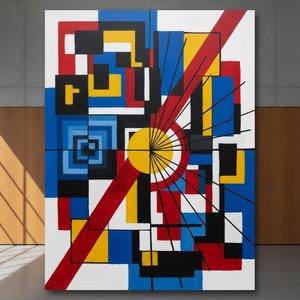
Neo-Abstract Art: Redefining Modern Expression Through Bold Compositions and Geometric Sophistication
Explore the profound evolution of Neo-Abstract art. Discover how bold geometric forms, vibrant chromatic depth, and tactile textures redefine modern expression for the discerning collector seeking sophisticated, high-impact masterpieces for contemporary interiors.

Beyond the Lines: Mastering the High-Impact World of Contemporary Abstraction
Master the high-impact world of contemporary abstraction. Discover how bold colors, textures, and modern movements like Abstract Expressionism can transform your space with premium, high-energy art curated for the design-conscious professional.