Meny
Text size

() ·

A painting made for you, by hand

Self-Portrait

Håndlaget oljereproduksjon

Håndmalt olje på lerret i din valgte størrelse og ramme, laget på bestilling av våre kunstnere. ( Bytt til trykk Bytt til digitalt bilde)

Beskrivelse av objektet

Om kunstneren

Gustave Courbets «Hvetesilter» er et ikonisk realistisk maleri som skildrer hverdagsarbeid og samfunnets realiteter. Opplev detaljrikdommen og den dype menneskelige fortellingen i dette mesterverket fra 1854.

from ·

Chapter 1

How large should it be?

Slide to change the size; the picture on the left shows the frame at its real width. The proportions of the original are kept.

Standardformat
skreddersydd
CM
INCH

Velg mellom våre forhåndsdefinerte størrelser som bevarer kunstverkets opprinnelige proporsjoner.

bredde
høyde

Skriv inn ønsket bredde og høyde for å tilpasse bildet til din ramme eller vegg. Siden dette er håndmalt, kan kunstneren male litt mer rundt motivet eller beskjære det noe dersom du velger et annet format — valget er ditt. Vi sender deg en digital mockup til godkjenning før maleriet påbegynnes. Bildet som vises på denne siden representerer ikke det faktiske resultatet — kun mockuppen viser det endelige uttrykket.

Chapter 2

How should it arrive?

Choose the edges of the stretched canvas

Choose your frame

Corner sample of the WhiteWrap canvas edge finish, stretched on massivt tre bars
White Nkr1
Corner sample of the BlurSideWrap canvas edge finish, stretched on massivt tre bars
Blurside Nkr1
Corner sample of the ExtendedWrap canvas edge finish, stretched on massivt tre bars
Extended Nkr1
Corner sample of the P118B picture frame: støpt polystyren, 5 cm wide and 3 cm thick
P118B Nkr10
Corner sample of the P118H picture frame: støpt polystyren, 5 cm wide and 3 cm thick
P118H Nkr10
Corner sample of the P118W picture frame: støpt polystyren, 5 cm wide and 3 cm thick
P118W Nkr10
Corner sample of the P438Z picture frame: støpt polystyren, 5.5 cm wide and 3.5 cm thick
P438Z Nkr10
Corner sample of the P508JH picture frame: støpt polystyren, 7 cm wide and 3.5 cm thick
P508JH Nkr12
Corner sample of the P508YH picture frame: støpt polystyren, 7 cm wide and 3.5 cm thick
P508YH Nkr12
Corner sample of the P805H picture frame: støpt polystyren, 5 cm wide and 3.5 cm thick
P805H Nkr10
Corner sample of the P805Z picture frame: støpt polystyren, 5 cm wide and 3.5 cm thick
P805Z Nkr10
Corner sample of the P919BZ picture frame: støpt polystyren, 7 cm wide and 3.5 cm thick
P919BZ Nkr10
Corner sample of the P919G picture frame: støpt polystyren, 7 cm wide and 3.5 cm thick
P919G Nkr10
Corner sample of the P919XJ picture frame: støpt polystyren, 7 cm wide and 3.5 cm thick
P919XJ Nkr10
Corner sample of the P959ZH picture frame: støpt polystyren, 5 cm wide and 3 cm thick
P959ZH Nkr10
Corner sample of the P968JZ picture frame: støpt polystyren, 6 cm wide and 4 cm thick
P968JZ Nkr12
Corner sample of the W106C picture frame: massivt tre, 5 cm wide and 3 cm thick
W106C Nkr8
Corner sample of the W218G picture frame: massivt tre, 5 cm wide and 3 cm thick
W218G Nkr10
Corner sample of the W218JH picture frame: massivt tre, 5 cm wide and 3 cm thick
W218JH Nkr8
Corner sample of the W218Y picture frame: massivt tre, 5 cm wide and 3 cm thick
W218Y Nkr10
Corner sample of the W307PJ picture frame: massivt tre, 6 cm wide and 3 cm thick
W307PJ Nkr10
Corner sample of the W316G picture frame: massivt tre, 6 cm wide and 3 cm thick
W316G Nkr10
Corner sample of the W316PJ picture frame: massivt tre, 6 cm wide and 3 cm thick
W316PJ Nkr8
Corner sample of the W316Y picture frame: massivt tre, 6 cm wide and 3 cm thick
W316Y Nkr10
Corner sample of the W398PJ picture frame: massivt tre, 5 cm wide and 3 cm thick
W398PJ Nkr8
Corner sample of the W4111J picture frame: massivt tre, 6.5 cm wide and 3.5 cm thick
W4111J Nkr10
Corner sample of the W500HY picture frame: massivt tre, 7 cm wide and 5 cm thick
W500HY Nkr15
Corner sample of the W500JH picture frame: massivt tre, 7 cm wide and 5 cm thick
W500JH Nkr15
Corner sample of the W692G picture frame: massivt tre, 8 cm wide and 4 cm thick
W692G Nkr12
Corner sample of the W849H picture frame: massivt tre, 5 cm wide and 3 cm thick
W849H Nkr8
Corner sample of the W940BG picture frame: massivt tre, 7.5 cm wide and 4.5 cm thick
W940BG Nkr15
Corner sample of the W953PJ picture frame: massivt tre, 6 cm wide and 3.5 cm thick
W953PJ Nkr8
Corner sample of the H24-GOLD picture frame: utskåret tre med gesso, 10 cm wide and 6 cm thick
H24-GOLD Nkr30
Corner sample of the H24-SILVER picture frame: utskåret tre med gesso, 10 cm wide and 6 cm thick
H24-SILVER Nkr30
Corner sample of the H36-GOLD picture frame: utskåret tre med gesso, 15 cm wide and 6.5 cm thick
H36-GOLD Nkr45
Corner sample of the H36-SILVER picture frame: utskåret tre med gesso, 15 cm wide and 6.5 cm thick
H36-SILVER Nkr45

Moulding: . Overall size with the frame: .

Chapter 3

Who paints it, and should anything change?

Examples of what can be changed: Replace face with customer photo; Add pet (e.g., replace cat with dog); Include hidden message in background; Change background landscape or elements.
After order, OriginalUniqueArt.com team will email client for instructions and provide a mockup preview

Verdensomspennende levering () på 3–4 uker i stedet for standard 5 uker. (29 October). Ingen kompromisser med kvaliteten.

Chapter 4

The finishing touches

A nameplate, as in a museum?

Detaljer om gravert bronseplate

This elegant plaque features the artist's name and the title of the artwork, finely engraved for a timeless presentation.

It is made from bronze with a refined, elegant finish. The text is precisely laser-engraved for a sharp and permanent result. Measuring 9x2 cm, the plaque is compact yet easy to read. It's built to be durable and scratch-resistant, offering a professional, museum-quality look. Mounting is simple thanks to the included adhesive backing.

Detaljer om gjennomsiktig akrylplate

The plaque includes essential engraved details such as the artist's name, the title of the artwork, the date it was created, the type of media used-like oil on canvas or watercolor-a brief description of the piece, and a QR code that links to the complete artwork information.

It is crafted from clear acrylic, offering a sleek, modern appearance. The text is UV-engraved in black to ensure strong visual contrast. With a size of 10x15 cm, it ensures optimal readability. It comes equipped with two metal hooks for secure wall mounting. The plaque is designed to be weather-resistant, making it suitable for various environments, and it includes interactive features that work seamlessly with smartphone scanning.

Detaljer om plakett i svart akryl

This elegant plaque includes engraved information such as the artist's name, the title of the artwork, the date it was created, the type of media used (like oil on canvas or watercolor), a short description of the artwork, and a QR code for quick access to more information.

The plaque itself is made from refined black acrylic with a premium finish. The text is laser-engraved in white for high contrast and readability. Its size is 10x15 cm, designed to be easy to read. It comes with two metal hooks for professional mounting. The design is sleek and fits any interior style. It is also weather-resistant and durable, with built-in digital integration for mobile compatibility.

A protective varnish?

When do you need it?

Chapter 5

Your painting, as you ordered it

Self-Portrait

Trykkmetode

Størrelse på reproduksjon

-

Utvalgte mesterkunstnere

Mer detaljrikdom, finesse og ekstra produksjonstid

-

Innramming av reproduksjon

-

-

For kunstverk eller reproduksjoner som er større enn 105 cm (ca. 41 tommer) på noen side, vil rammen bli sendt som et sett som må monteres. Denne metoden sikrer trygg levering og forhindrer skader under transport.

Krever profesjonell montering – dette er ikke et DIY-produkt.
Settet må monteres og lerretet strammes av en erfaren profesjonell rammelegger, ved bruk av trelim (følger ikke med), en lerretstang og klemmer for å holde rammelisten vinkelrett mens limet tørker. Feilaktig montering eller ujevn stramming av lerretet kan påføre kunstverket permanente skader og er ikke dekket av vår garanti.

  • Alle massive trelister er inkludert, presist tilpasset i størrelse.

  • Monteres med de medfølgende skruene, samt trelim til hjørnene, som ikke er inkludert og må anskaffes av din rammehandler.

  • Profesjonelt verktøy er nødvendig og er ikke inkludert: en lerretstang (strammer) og klemmer for å holde rammene vinkelrette mens limet tørker.

Viktig:
Hjørnene krever trelim, listene må holdes på plass med tvinger til limet er helt tørt, og stramming av lerretet på den ferdige rammen krever en lerretstang. Ingen av disse produktene er inkludert i settet. Vennligst sørg for tilgang til en erfaren profesjonell rammehandler før du bestiller denne størrelsen.

Navneskilt

-

-

Beskyttende ferniss

Blank lakk (forsterker farger, beskytter mot lys og fuktighet)

-

Tilpass mitt kunstverk

Eksempler på hva som kan endres: Erstatt ansikt med bilde av kunden; Legg til kjæledyr (f.eks. bytt ut katt med hund); Inkluder en skjult melding i bakgrunnen; Endre bakgrunnslandskap eller elementer.

-

Ekspresslevering

Verdensomspennende levering () på 3–4 uker i stedet for standard 5 uker. (29 October). Ingen kompromisser med kvaliteten.

-

Ekspresslevering

Verdensomspennende levering til innen 5 uker. (5 November).

Inkludert frakt

Totalpris for valgte alternativer

Nkr 2883

Totalpris Nkr 2883

Glassalternativet er kun tilgjengelig i størrelser under 110 cm

Included with every order

  • Gratis ekspressfrakt over hele verden
  • Lerretsduk av lin av høy kvalitet
  • Full transportforsikring
  • Garanti for refusjon av toll og importavgifter
  • Garantert fargegjengivelse
  • 100 dagers returrett ved fabrikasjonsfeil
  • 100% pengene tilbake-garanti
  • Rabatt ved flere kjøp

A Portrait of Radical Realism: Gustave Courbet’s Self-Portrait

The painting titled “Self-Portrait” by Gustave Courbet stands as a cornerstone of realist art, embodying the artist's unwavering dedication to portraying life without embellishment or romantic idealism. Completed sometime around 1869, this intimate depiction offers more than just a likeness; it presents a profound statement about artistic integrity and societal observation—a legacy that continues to resonate with audiences today.
  • Subject Matter & Composition: Courbet’s gaze meets the viewer head-on, establishing an immediate connection of confrontation and honesty. The artist positions his chin delicately in his hand, a gesture imbued with both vulnerability and deliberate control—a subtle defiance against the conventions of portraiture that prioritized idealized beauty.
  • Style & Technique: Courbet’s style is unmistakably rooted in Impressionism's rejection of academic formalism. However, unlike many Impressionists who sought to capture fleeting moments of light and atmosphere, Courbet meticulously rendered his subject with painstaking detail. The brushstrokes are visible, textured surfaces—a deliberate choice designed to convey the materiality of existence.

Historical Context: Challenging Artistic Tradition

Courbet’s artistic rebellion stemmed from a deep dissatisfaction with the École des Beaux-Arts and its insistence on mythological subjects and polished finishes. He famously declared, “I do not depict what I see; I paint what I think,” encapsulating his belief that art should serve as a vehicle for social commentary. The Self-Portrait arrived during a period of significant artistic upheaval—the Impressionist movement was gaining momentum, challenging the dominance of Salon painting and redefining notions of beauty.
  • Symbolism & Interpretation: Beyond its straightforward representation, the portrait carries symbolic weight. The plain background—a stark contrast to the opulent interiors favored by academic painters—underscores Courbet’s rejection of bourgeois values and his focus on the everyday realities of life. Furthermore, the artist's gaze is considered a deliberate challenge to the viewer’s expectations, prompting contemplation about identity and artistic purpose.
  • Materiality & Texture: Courbet employed encaustic—a technique combining beeswax and resin—to achieve remarkable textural depth and luminosity. This method allowed him to capture subtle nuances of light and shadow, creating a surface that feels remarkably alive. The resulting image is not merely visually appealing; it’s an embodiment of the artist's commitment to portraying the world as he experienced it.

Emotional Impact & Legacy

“Self-Portrait” transcends mere visual representation, conveying a palpable sense of introspection and conviction. Courbet’s unflinching gaze communicates both confidence and melancholy—a reflection of the artist's own struggles against societal pressures and artistic conventions. It remains an enduring emblem of realism’s power to confront viewers with uncomfortable truths and inspire them to reconsider their perceptions of beauty and truth. Today, reproductions of this seminal artwork continue to captivate collectors and interior designers alike, offering a glimpse into the spirit of a revolutionary artist and his unwavering belief in the transformative potential of art.

Spørsmål og svar

Hvordan kan jeg se "Self-Portrait" av Gustave Courbet som en lysbildefremvisning?

"Self-Portrait" av Gustave Courbet kan vises som en lysbildefremvisning på verkets Bildekarusell-side.

Hvor populær er "Self-Portrait" innenfor Contemporary Realism?

Innenfor Contemporary Realism-retningen har "Self-Portrait" et Recognized popularitetsnivå.

Hvilken stemning uttrykker "Self-Portrait" av Gustave Courbet innenfor Contemporary Realism?

Den Reflective stemningen i "Self-Portrait" ledsager dens Contemporary Realism-stil.

More about this painting

Forhåndsvisning Se i AR Bytt til trykk Bytt til digitalt bilde Send
Vis detaljer Utskriftsvennlig guide Legg til i favoritter Last ned bilde Liknende objekter Røntgenundersøkelse Lysbildefremvisning Q&A Statistikk

In numbers

  • 29frames to choose from
  • standard sizes, in its own proportions
  • 5weeks to paint and deliver it
Gustave Courbet

Gustave Courbet

1819 - 1877, Frankrike

Quick facts about Gustave Courbet

  • Artistic Movement Or Style: Realisme
  • Artists Or Movements Influenced By This Artist:
    • Impressionisme
    • Postimpressionisme
  • Artists Who Influenced This Artist:
    • Eugène Delacroix
    • Théodore Géricault
    • Caravaggio
  • Date Of Birth: 10 Juni 1819
  • Date Of Death: 31 Desember 1877
  • Full Name: Gustave Courbet
  • Nationality: Fransk
  • Notable Artworks:
    • Steinknackare
    • Begravning i Ornans
    • Målarens Studio
  • Place Of Birth: Orléans, Frankrike

Om kunstneren

A Rebel’s Brush: The Life and Legacy of Gustave Courbet

Jean Désiré Gustave Courbet, born in Ornans, France, on June 10, 1819, stands as a monumental figure in the history of art – a defiant iconoclast who irrevocably altered the trajectory of painting during the mid-nineteenth century. More than simply capturing visual impressions; his artistic journey embodies a profound rejection of convention and an unwavering dedication to portraying reality with uncompromising honesty. His upbringing within a moderately prosperous bourgeois family fostered an early appreciation for artistic pursuits, nurtured by his mother’s encouragement – a formative influence that propelled him toward a revolutionary vision of artistic expression. Formal training commenced at the École des Beaux-Arts in Paris in 1839, yet Courbet swiftly recognized the limitations imposed by the prevailing academic doctrines and Romantic idealism. While acknowledging connections to artists like Eugène Delacroix and Théodore Géricault – figures who wrestled with grand narratives and emotional intensity – Courbet deliberately distanced himself from these approaches, prioritizing observation over imagination and truth above all else. He sought not to embellish or glorify but to confront viewers with the unvarnished face of existence.

The Birth of Realism: Challenging Artistic Conventions

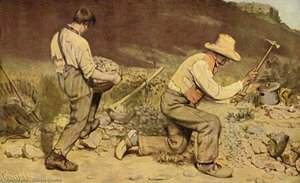
Courbet’s artistic breakthrough arrived through a radical departure from established aesthetic standards. Unlike Romantic painters who favored mythological tales and heroic portrayals, he turned his gaze toward the everyday lives of ordinary individuals – laborers, peasants, and rural communities – subjects largely ignored by the art world of his time. This commitment to depicting reality without embellishment—a stance that would become synonymous with Realism—immediately provoked censure from critics accustomed to idealized representations steeped in beauty and grandeur. Early canvases explored landscapes and portraits, yet he soon gravitated toward scenes of working-class life, rendered on a scale traditionally reserved for monumental historical paintings. This deliberate decision wasn’t merely stylistic; it was an assertion of dignity and importance – recognizing the inherent value within these marginalized segments of society. The masterpiece *The Stone Breakers* (1849), tragically destroyed during World War II, exemplifies this ethos—a stark depiction of two laborers engaged in arduous toil, their faces obscured by exhaustion and grime. This painting challenged the very notion of what constituted “worthy” subject matter for artistic endeavor.

Major Works and Artistic Philosophy

Courbet’s artistic philosophy extended beyond mere subject matter; it encompassed a revolutionary technique – *impasto*. He applied paint thickly onto the canvas, creating textured surfaces that captured the physicality of the medium itself. This method mirrored his belief in portraying reality as accurately as possible, rejecting illusionistic techniques favored by earlier artists. Notable works like *A Burial at Ornans* (1850-51) and *The Painter’s Studio* (1855) solidified his reputation as a provocateur who championed artistic freedom and confronted societal prejudices. The latter painting served as an allegorical manifesto, reflecting Courbet's conviction that art should engage with pressing social issues—a stance that resonated powerfully with contemporaries and cemented his legacy as a champion of intellectual independence. His participation in the Salon des Refusés in 1863 – an exhibition showcasing rejected artworks deemed unsuitable by the official Salon – underscored his defiance against artistic orthodoxy and reaffirmed his commitment to challenging conventional norms. Landscapes like *View in the Forest of Fontainebleau* (1855) were imbued with a similar spirit of realism, capturing the natural beauty without romantic embellishment.

Legacy and Historical Significance

Gustave Courbet’s influence on subsequent art movements is undeniable. While he acknowledged influences from artists such as Caravaggio for their dramatic use of light and shadow—a stylistic homage to artistic predecessors—his impact transcended mere imitation. He fundamentally reshaped the landscape of painting by liberating Impressionists and Post-Impressionists from the constraints of academic tradition, encouraging them to explore new avenues of perception and representation. His unwavering advocacy for artistic liberty served as an inspiration to generations of artists who sought to express their convictions through creative endeavors. Courbet died in Paris on April 29, 1877, leaving behind a corpus of work that continues to captivate audiences worldwide—a testament to the enduring power of art to provoke thought and inspire transformative change. He remains an unparalleled figure in artistic history, forever remembered as the herald of Realism and a courageous voice for artistic integrity.

Kort om verket

  • Subject or theme: Self-representation
  • Movement: Realism
  • Artist: Gustave Courbet
  • Notable elements or techniques: Detailed facial portraiture
  • Title: Self-Portrait

Kunnequiz om kunst

Det er kun ett riktig svar på hvert spørsmål.

Spørsmål 1:
What artistic movement is Gustave Courbet primarily associated with?
Spørsmål 2:
The painting’s composition emphasizes a close-up view of the artist's face. Why might this stylistic choice be significant?
Spørsmål 3:
What is a notable characteristic of Courbet’s artistic approach?
Spørsmål 4:
Considering the artist’s biography, what role did his family's encouragement play in fostering his artistic ambitions?
Spørsmål 5:
The painting depicts a man with prominent facial hair. What does this detail contribute to the overall impression of the portrait?