- Forsiden

- Reproduksjon av oljemaleri
- Gerard van Honthorst
- The steadfast philosopher
 Preview
 Bestill trykk Kjøp digitalt bilde
 Send
Send
 Del med andre
 Vis detaljer
 Legg til i favoritter

 Last ned bildet
 Liknende objekter
 Røntgenundersøkelse
 Lysbildefremvisning
The steadfast philosopher


 Vis hele teksten
Håndlaget oljereproduksjon
Håndmalt olje på lerret i din valgte størrelse og ramme, laget på bestilling av våre kunstnere.




P118B $10

P118H $10

P118W $10

P438Z $10

P508JH $12

P508YH $12

P805H $10

P805Z $10

P919BZ $10

P919G $10

P919XJ $10

P959ZH $10

P968JZ $12

W106C $8

W218G $10

W218JH $8

W218Y $10

W307PJ $10

W316G $10

W316PJ $8

W316Y $10

W398PJ $8

W4111J $10

W500HY $15

W500JH $15

W692G $12

W849H $8

W940BG $15

W953PJ $8




Velg mellom våre forhåndsdefinerte størrelser som bevarer kunstverkets opprinnelige proporsjoner.

Du kan angi egne mål for å tilpasse en spesifikk ramme eller plass. Dersom den valgte størrelsen ikke samsvarer med originalbildets proporsjoner, vil vi enten beskjære kunstverket eller utvide maleriet med ytterligere håndmalte elementer. En digital mockup vil bli sendt til din godkjenning før produksjonen starter.
Vennligst merk at forhåndsvisningen på skjermen ikke gjenspeiler den faktiske beskjæringen eller utvidelsen. Kun mockuppen vil vise den endelige komposisjonen nøyaktig.
Selv om tilpassede størrelser er tilgjengelige, anbefaler vi å velge et mål fra den forhåndsdefinerte listen for å bevare de originale proporsjonene.
Etter bestilling vil OriginalUniqueArt.com-teamet sende e-post til kunden for instruksjoner og sende et utkast (mockup) som forhåndsvisning.
Verdensomspennende levering () på 3–4 uker i stedet for standard 5 uker. (23 July). Ingen kompromisser med kvaliteten.

Gratis ekspressfrakt over hele verden

Lerretsduk av høykvalitets lin

Full forsikring under transport

Garanti for refusjon av toll og importavgifter

Garantert korrekt fargegjengivelse

60 dagers returrett (kun ved feil)

100% pengene tilbake-garanti

Rabatt ved flere kjøp
 Glassalternativet er kun tilgjengelig i størrelser under 110 cm

The steadfast philosopher
Teknikk for reproduksjon
Størrelse på reproduksjon
-


Endelig pris
-
Beskrivelse av kunstverket
The Steadfast Philosopher: A Window into Honthorst's Baroque Intimacy
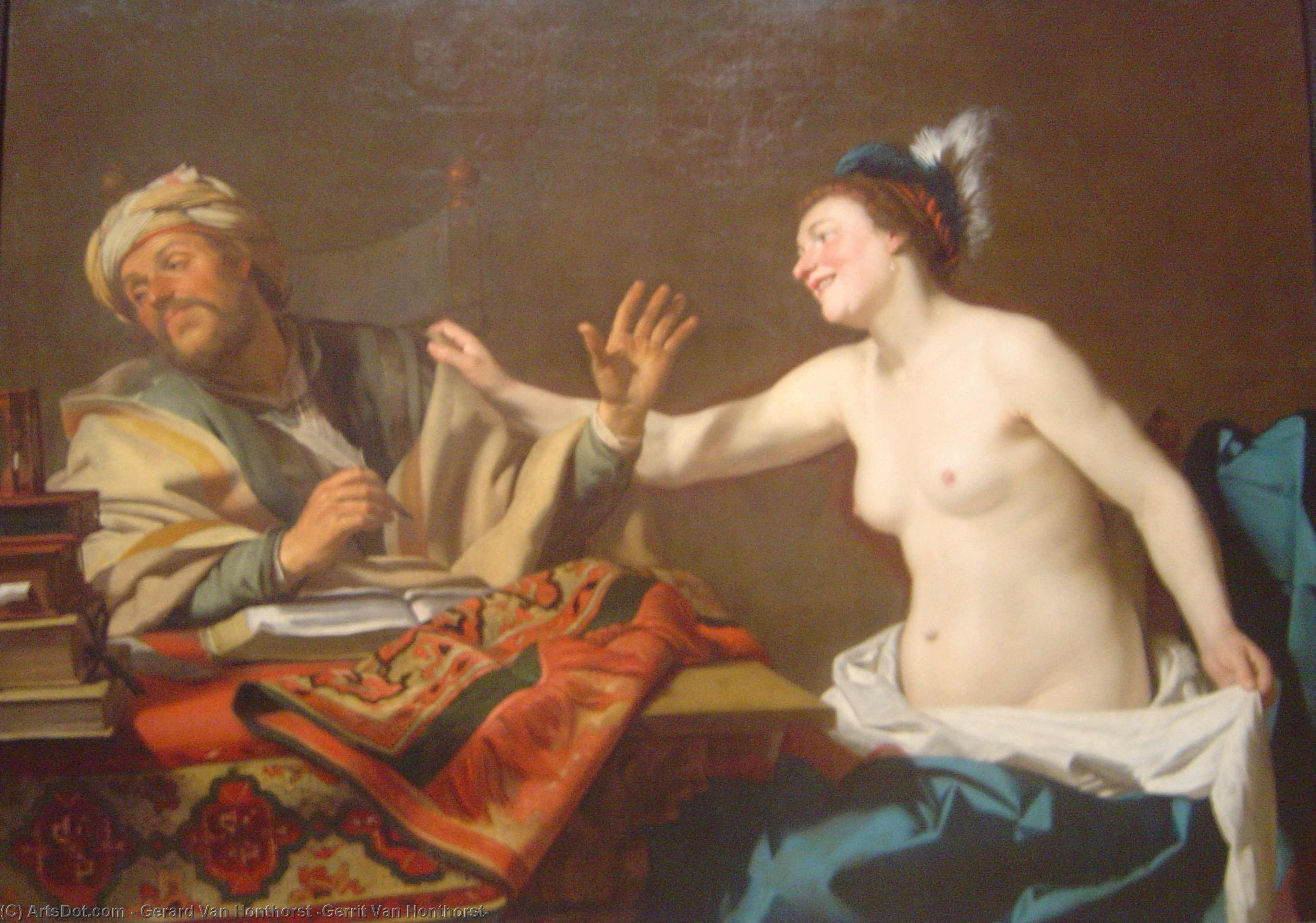
Gerard van Honthorst’s “The Steadfast Philosopher” is not merely a portrait; it’s an immersion into the heart of 17th-century Dutch life, rendered with a dramatic intensity that speaks to the era’s fascination with light and shadow – a hallmark of what became known as ‘Gherardo delle Notti,’ or Gerard of the Nights. This captivating scene depicts a private moment of intellectual exchange between a man and woman, their figures bathed in a carefully orchestrated chiaroscuro that draws the viewer into their intimate world. The painting’s power lies not just in its subject matter – a conversation potentially blossoming into something more – but in Honthorst's masterful manipulation of light to evoke a palpable sense of desire and contemplation.
Honthorst, deeply influenced by Caravaggio’s revolutionary use of tenebrism, employed this technique with precision. Notice how the strong directional light illuminates the man’s turbaned head and beard, drawing immediate attention to his intellectual presence, while simultaneously casting the woman in a softer, more ambiguous glow. This deliberate contrast heightens the scene's dramatic tension and underscores the painting’s sensual undertones. The inclusion of scattered books – open to specific pages – subtly reinforces the theme of knowledge and discourse, suggesting that this is not simply a depiction of physical attraction but also an exchange of ideas.
A Masterclass in Baroque Composition
The composition itself is meticulously constructed, reflecting the prevailing principles of Baroque art. The figures are arranged within a shallow space, creating a sense of immediacy and drawing the viewer into the scene. The table acts as a visual anchor, grounding the composition while simultaneously suggesting a space for interaction and reflection. Honthorst’s use of perspective – subtly employed to create depth – further enhances the illusion of realism, making the figures appear almost tangible. The woman's pose, with her hand resting lightly on the table, invites the viewer into this intimate tableau, fostering a sense of voyeuristic curiosity and admiration for the scene’s quiet drama.
Symbolism and Context: Utrecht Caravaggisti
“The Steadfast Philosopher” is a prime example of Honthorst's work within the Utrecht Caravaggisti school. This group, centered in Utrecht, was profoundly influenced by Caravaggio’s dramatic style, particularly his use of dark backgrounds and intense lighting. Their paintings often depicted scenes of everyday life – brothel scenes, philosophical discussions, and intimate gatherings – imbued with a heightened sense of emotion and realism. The inclusion of the blue cloth covering the woman's breasts is significant; while potentially provocative in its time, it also aligns with Baroque artistic conventions that frequently explored themes of beauty, sensuality, and the human form. The books themselves symbolize knowledge, wisdom, and perhaps even the pursuit of enlightenment – elements central to the philosophical nature of the scene.
Emotional Impact & Reproduction Value
Ultimately, “The Steadfast Philosopher” transcends a simple portrait; it’s an evocative exploration of human connection, intellectual curiosity, and the allure of the unknown. Honthorst's ability to capture such nuanced emotion through light and composition is what makes this painting so enduringly captivating. A hand-painted reproduction of this artwork offers a unique opportunity to bring this Baroque masterpiece into your home or office – a stunning addition that will undoubtedly spark conversation and inspire contemplation, mirroring the original’s profound emotional impact.
Om kunstneren
A Master of Light and Shadow: The Life and Art of Gerard van Honthorst
Gerard van Honthorst emerged from Utrecht in 1592, a pivotal figure poised to illuminate the Dutch Golden Age with his dramatic artistry. Initially guided by his father, a decorative painter, young Gerard’s talent blossomed under the tutelage of Abraham Bloemaert, establishing a solid foundation in draftsmanship and composition. However, it was a transformative journey to Rome that irrevocably altered the course of his artistic development. There, amidst the fervent energy of the Italian Baroque, he encountered the groundbreaking work of Caravaggio – an encounter that would define his signature style and earn him the evocative nickname “Gherardo delle Notti,” or Gerard of the Nights. The dramatic use of *tenebrism*, a technique employing stark contrasts between light and dark, became Honthorst’s hallmark, imbuing his canvases with a palpable sense of drama and emotional intensity. He wasn't merely imitating Caravaggio; he was translating the Italian master’s innovations into a distinctly Dutch sensibility, focusing on intimate scenes illuminated by artificial light sources – candles, lamps, and fires – creating an atmosphere both realistic and deeply theatrical. This mastery over light wasn’t simply technical skill; it was a means of revealing character, of drawing the viewer into the emotional core of each scene.Early Life and Artistic Training
Van Honthorst was born in Utrecht, the son of a decorative painter, and received his initial artistic training from his father. This early exposure to the world of visual decoration instilled in him an appreciation for detail and craftsmanship. However, it was Abraham Bloemaert, a prominent Utrecht painter himself, who provided him with a more formal education in drawing and composition. Bloemaert’s influence is evident in Honthorst's early works, characterized by their meticulous draftsmanship and balanced compositions. Around 1610, seeking further artistic development and exposure to new styles, Van Honthorst embarked on a journey to Rome – a pivotal moment that would profoundly shape his career. The Italian capital offered an unparalleled opportunity to study the masterpieces of the Renaissance and Baroque periods, particularly those of Michelangelo and Caravaggio. It was in Rome that he truly began to develop his distinctive style, absorbing the dramatic lighting and emotional intensity of Caravaggio’s paintings. This period marked a significant shift in his artistic approach, moving away from the more restrained styles prevalent in Northern Europe towards a bolder, more expressive manner.The Roman Period: Influence of Caravaggio
Honthorst's time in Rome was marked by considerable success and patronage. He quickly gained recognition for his ability to capture the drama and intensity of Italian Baroque painting. He lodged at the *palazzo* of Vincenzo Giustiniani, a prominent art collector and patron who provided him with invaluable opportunities to study and experiment with new techniques. It was during this period that Honthorst’s style began to take shape, characterized by its dramatic use of light and shadow, its dynamic compositions, and its focus on human emotion. He produced numerous paintings depicting scenes from the Bible, mythology, and everyday life, all infused with a distinctly Caravaggian sensibility. Notably, he created *Christ Before the High Priest*, a work now residing in London’s National Gallery, which exemplifies his masterful command of light and shadow and his ability to convey profound psychological depth within his figures. This painting stands as a testament to his assimilation of Caravaggio's techniques while simultaneously injecting them with a uniquely Dutch perspective.Return to the Netherlands and Courtly Commissions
Upon returning to Utrecht around 1620, Honthorst quickly established himself as a leading portrait painter in the Dutch Republic. His ability to capture not just physical likeness but also the character and social standing of his sitters made him highly sought after by wealthy merchants, nobles, and even royalty. He became president of the Guild of St. Luke in Utrecht in 1623, a testament to his growing influence within the artistic community. This period saw a flourishing of commissions, allowing Honthorst to refine his style and establish a distinctive voice within Dutch painting. He also undertook significant courtly commissions, including portraits for Cosimo II de' Medici, Grand Duke of Tuscany, further solidifying his reputation as one of the most accomplished artists of his time. These works demonstrate his versatility and his ability to adapt his style to suit the tastes of different patrons.Legacy and Artistic Significance
Gerard van Honthorst’s influence resonated far beyond his lifetime. He was a key figure in the *Utrecht Caravaggisti* movement – a group of Dutch painters who embraced Caravaggio's dramatic realism and *tenebrism*. Alongside artists like Hendrick ter Brugghen and Dirck van Baburen, he helped to establish a distinctly Dutch interpretation of Italian Baroque style. His emphasis on genre scenes illuminated by artificial light, his masterful portraits, and his ability to convey emotional depth through skillful use of chiaroscuro left an indelible mark on the development of Dutch Golden Age painting. His paintings continue to captivate audiences today, demonstrating his enduring artistic skill and his profound understanding of human emotion. He cemented his place as a pivotal figure in art history, bridging the gap between Italian Baroque innovation and the flourishing artistic landscape of the Netherlands. Van Honthorst’s legacy lies not only in his individual masterpieces but also in his role as a catalyst for artistic change within the Dutch Republic.
Gerard van Honthorst
1590 - 1656 , Nederland
Kort om kunstneren
- Artistic Movement Or Style: Barok, Caravaggisme
- Artists Or Movements Influenced By This Artist: ['Utrecht Caravaggisti']
- Artists Who Influenced This Artist: ['Caravaggio']
- Date Of Birth: 1590
- Date Of Death: 1656
- Full Name: Gerard van Honthorst
- Nationality: Nederlands
- Notable Artworks:
- Kristus foran høvdingen
- Messaselskapet
- Diana og Apollo
- Place Of Birth: Utrecht, Nederland


