

 Se i rommet
 Del som digitalt kort
 Del
Del
 Detaljer
 Studentguide

 Last ned
 Liknende objekter
 Røntgen
 Lysbildefremvisning
 Besøksstatistikk
Beethoven komponerer Pastorsymphonien


 Les mer
Giclée / Kunsttrykk
Giclée- eller lerretsprint av museumskvalitet med rask produksjon og fleksible valgmuligheter for etterbehandling. ( Bestill håndmalt reproduksjon Gå til digitalt bilde)




P118B Nkr10

P118H Nkr10

P118W Nkr10

P438Z Nkr10

P508JH Nkr12

P508YH Nkr12

P805H Nkr10

P805Z Nkr10

P919BZ Nkr10

P919G Nkr10

P919XJ Nkr10

P959ZH Nkr10

P968JZ Nkr12

W106C Nkr8

W218G Nkr10

W218JH Nkr8

W218Y Nkr10

W307PJ Nkr10

W316G Nkr10

W316PJ Nkr8

W316Y Nkr10

W398PJ Nkr8

W4111J Nkr10

W500HY Nkr15

W500JH Nkr15

W692G Nkr12

W849H Nkr8

W940BG Nkr15

W953PJ Nkr8




Velg mellom våre forhåndsdefinerte størrelser som bevarer kunstverkets opprinnelige proporsjoner.

Skriv inn bredden og høyden du trenger, slik at den passer til din ramme eller vegg. Et trykk kan kun beskjæres, aldri gjøres større enn bildet, så et format med en annen form vil miste en del av motivet. Vi sender deg en digital mockup for godkjenning før vi trykker noe som helst. Bildet som vises på denne siden viser ikke den faktiske beskjæringen — det er kun mockuppen som gjør det.
Verdensomspennende levering () på 2 uker i stedet for standard 4/5 uker. (24 October)

Gratis ekspressfrakt over hele verden

Lerretsduk av høykvalitets lin

Full transportforsikring

Garanti for refusjon av toll og importavgifter

Garantert fargeekthet

100 dagers returrett ved fabrikasjonsfeil

100% pengene tilbake-garanti

Mengderabatt
 Glassalternativet er kun tilgjengelig i størrelser under 110 cm

Beethoven komponerer Pastorsymphonien
Giclée / Kunsttrykk
Format på reproduksjon
-


Totalpris
Nkr 760
Beethoven composing the Pastoral Symphony
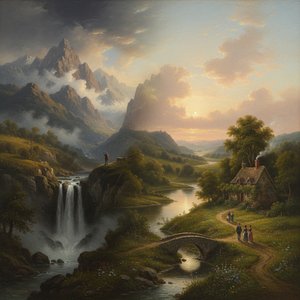
Caspar David Friedrich’s “Beethoven composing the Pastoral Symphony” isn't merely a depiction of a man sketching by a river; it’s a profound meditation on artistic inspiration and humanity’s relationship with the sublime. Painted in 1839, this aquatinta etching after Franz Hegi’s drawing encapsulates the spirit of Romanticism—a movement that prioritized emotion and intuition over rational thought, seeking solace and spiritual understanding within the natural world. Friedrich, deeply influenced by Dutch masters like Jacob van Ruisdael and Jan Vermeer who skillfully captured atmospheric subtleties, meticulously crafted this image to convey a specific mood: quiet contemplation amidst overwhelming grandeur. The Scene and Composition The artwork portrays Beethoven seated on the riverbank, his gaze fixed upwards towards the misty mountains in the background. Crossed legs suggest stillness and focus—a posture mirroring the artist’s dedication to his craft. Surrounding him are trees laden with snow, symbolizing resilience and enduring beauty despite hardship. The careful arrangement of elements contributes to a sense of depth and perspective, guiding the viewer's eye into the expansive landscape. Hegi’s etching skillfully captures the diffused light characteristic of Romantic landscapes—a technique designed to evoke feelings of awe and wonder. Friedrich’s Artistic Style and Technique Friedrich’s distinctive style is immediately recognizable by its muted palette dominated by blues, greys, and browns. These colors aren't intended to represent reality faithfully but rather to convey an inner emotional state—the melancholic contemplation that accompanies profound artistic endeavor. The etching process itself demanded considerable precision, requiring painstaking layering of ink to achieve the subtle tonal variations that define Friedrich’s oeuvre. He achieved this effect through meticulous hatching and cross-hatching—techniques that create texture and depth without resorting to vibrant hues. Historical Context: Romanticism's Embrace of Nature “Beethoven composing the Pastoral Symphony” emerged during a pivotal moment in European art history—the Romantic era. Following the Enlightenment’s emphasis on reason and scientific inquiry, Romantic artists rejected these conventions, instead prioritizing subjective experience and emotional intensity. Friedrich’s fascination with nature stemmed from a deep spiritual conviction—a belief that God resided within the natural world and that contemplation of its beauty could elevate the human soul. The painting reflects the broader Romantic preoccupation with themes of solitude, melancholy, and the sublime—concepts explored extensively by poets like William Wordsworth and Samuel Taylor Coleridge. Symbolism and Emotional Impact The solitary figure of Beethoven embodies humanity’s yearning for transcendence—a desire to connect with something larger than oneself. The misty mountains symbolize both obstacles and opportunities—representing the challenges faced in pursuing artistic creativity while simultaneously suggesting the boundless potential for spiritual growth. Ultimately, Friedrich invites viewers to contemplate the profound beauty and mystery of existence, prompting reflection on the role of art in fostering inner peace and illuminating the sublime truths of nature. This artwork continues to resonate with audiences today because it speaks directly to our deepest emotions—a testament to Friedrich’s enduring artistic vision.Spørsmål og svar
Hvor kjent er "Beethoven komponerer Pastorsymphonien" av Franz Hegi?
"Beethoven komponerer Pastorsymphonien" er klassifisert som Ikonisk.
Hvor bør en reproduksjon av "Beethoven komponerer Pastorsymphonien" av Franz Hegi henges opp?
Portrettformat-formatet til "Beethoven komponerer Pastorsymphonien" av Franz Hegi anbefales for et Stue og oppholdsrom. Format og romfølelse fungerer sammen som en veiledning for plassering av en reproduksjon.
Hvordan beskrives fargepaletten i "Beethoven komponerer Pastorsymphonien" av Franz Hegi?
Fargepaletten i "Beethoven komponerer Pastorsymphonien" av Franz Hegi beskrives som Nøytrale toner. Det er en kortfattet beskrivelse av verkets farger.
Kunstnerbiografi
A Master of Line and Light
The artistry of Franz Hegi resides in the delicate intersection of precision and atmosphere, a realm where the etched line breathes life into the landscapes of Switzerland. Born in Lausanne, Switzerland, Hegi’s journey was one of movement and apprenticeship, shaped by the rich traditions of European printmaking. His early years were marked by a profound connection to the craft, beginning with an apprenticeship under the etcher Matthias Pfenninger. It was here that he mastered the nuanced technique of aquatint, a method capable of producing tonal gradations that mimic the soft washes of watercolor, allowing him to capture the ephemeral qualities of light and shadow across the Swiss terrain.
As his talent matured, Hegi’s work became an essential visual chronicle of his era. His movements through Basel and eventually back to Zürich allowed him to immerse himself in the cultural fabric of these regions. Working alongside figures such as the painter and publisher Peter Birmann, Hegi developed a keen eye for the architectural soul of Swiss towns and the intricate details of local costume. His prints were not merely aesthetic objects but historical documents, capturing the essence of Swiss architecture and the dignity of traditional dress with an almost ethnographic devotion.
The Chronicles of Zürich and Beyond
Hegi’s creative output reached a particular zenith through his dedication to documenting the cultural and historical substance of Zürich. His work often transcended simple landscape depiction, venturing into the realm of historical subjects and the preservation of memory. Through his etchings and aquatints, he brought to life the stories embedded in the city's monuments and its very streets. This passion for detail extended to his collaborations, such as his studies of the Codex Manesse, where he sought to honor the deep historical roots of the region.
The breadth of his technical skill is evident in the variety of his subjects:
- Landscape Views: Capturing the serene and rugged beauty of the Swiss countryside through masterful tonal control.
- Architectural Studies: Providing a detailed visual record of Swiss buildings and urban structures, particularly within Zürich.
- Costume Depictions: Documenting the intricate textures and cultural significance of traditional attire.
- Historical Illustrations: Contributing to almanacs, literary works, and publications like the Helvetischer Almanach, ensuring that history remained visually accessible to the public.
Beyond his individual prints, Hegi’s legacy is woven into the very fabric of Swiss visual heritage. His ability to blend the technical rigor of engraving with a romantic sensibility for nature ensured that his works would find a permanent home in prestigious institutions, including the Swiss National Library and the Kunsthaus Zürich. Through his meticulous hand, the landscapes and histories of his homeland were preserved, rendered in a timeless language of ink and light that continues to resonate with those who seek the true spirit of Switzerland.

Franz Hegi
1774 - 1850 , Switzerland
Kort om kunstneren
- Artistic Movement Or Style: Aquatint, engraving, and etching
- Artists Who Influenced This Artist: ['Matthias Pfenninger']
- Full Name: Franz Hegi
- Nationality: Swiss
- Notable Artworks:
- Views of Swiss landscapes
- Swiss architecture and costume studies
- Place Of Birth: Lausanne, Switzerland
- Date Of Birth: 1774
- Date Of Death: 1850
Relaterte artikler

Romantiske landskap: Topp 10 mesterverk for hjemmet – Kunst fra OriginalUniqueArt.com
Oppdag de 10 mest ikoniske romantiske landskapsmaleriene! Fra Caspar David Friedrich til Turner – utforsk kunsthistorien, stemningen og fargepalettene. Finn museumskvalitets reproduksjoner på OriginalUniqueArt.com.

The Sublime and the Picturesque: Exploring Emotion & Nature in Romantic Landscape Painting
Explore the emotional power of Romantic landscape painting! Discover the sublime & picturesque traditions, key artists like Friedrich & Cole, and find your perfect artwork at OriginalUniqueArt.

Evocations of Place: A Historical Journey Through Landscape Art
Explore the rich history of landscape art with OriginalUniqueArt. Discover renowned artists, movements like Impressionism & Romanticism, and expert guidance for collecting timeless pieces. Find your perfect serene escape today!
The Sublime and the Picturesque: Exploring Emotion & Nature in Romantic Landscape Painting
Explore the emotional power of Romantic landscape painting! Discover the sublime & picturesque aesthetics, key artists like Friedrich & Cole, and lasting influence on art history. Find your perfect piece at OriginalUniqueArt.

John Constable: Topp 25 Maler – Engelsk Landskapskunst i Ditt Hjem
Opplev John Constables 25 mest ikoniske malerier! Fordyp deg i engelsk romantikk, landskapskunst og atmosfæriske scener. Finn museumskvalitets reproduksjoner & interiørinspirasjon på OriginalUniqueArt.com. Utforsk samlingen online!
