
 Bestill trykk Bestill maleri
 Send
Send
 Del med andre
 Vis detaljer
 Legg til i favoritter

 Last ned bildet
 Liknende objekter
 Røntgenundersøkelse
 Lysbildefremvisning
Harlequin


 Vis hele teksten
Kjøp et høyoppløselig, forbedret digitalt bilde som er langt bedre enn forhåndsvisningen på nettet.
Hver fil er omhyggelig klargjort av våre egne spesialister ved hjelp av avanserte verktøy og profesjonell manuell retusjering. Vi sørger for at hvert bilde har eksepsjonell klarhet, presis fargegjengivelse og fine detaljer.
Den endelige filen leveres via e-post innen 72 timer, optimalisert for umiddelbar bruk i profesjonelle, redaksjonelle og trykte miljøer. Dette er den samme kvaliteten som benyttes av ledende designstudioer, utgivere og gallerier.
Digitalt bilde
Last ned en høyoppløselig fil for personlig bruk, utskrift og kreative prosjekter.
Inkludert i alle bestillinger av digitale bilder
Ekspert digital levering, garantert
Når du velger OriginalUniqueArt.com, får du ikke bare et bilde – du mottar et profesjonelt forbedret digitalt kunstverk, skapt med presisjon og med en garantert tilfredshetsgaranti. Her er alt som automatisk følger med din bestilling:

Rask digital levering
Din høyoppløselige digitale bildefil sendes til din e-post innen 72 timer etter bestilling – klar til umiddelbar bruk.

KI-forbedret digital fil
Ditt kunstverk blir profesjonelt optimalisert ved hjelp av avanserte AI-verktøy og manuell redigering, noe som sikrer maksimal detaljrikdom, klarhet og fargegjengivelse.

Gratis livslang nyutlevering
Har du ved et uhell slettet eller mistet filen din? Ingen bekymring – vi sender den på nytt når som helst, helt gratis.

Ingen importavgifter – noen gang
Nyt ditt kunstverk umiddelbart uten toll, avgifter eller leveringskostnader – digitale nedlastinger er alltid avgiftsfrie.

Garantert fargenøyaktighet
Vi sikrer at ditt digitale bilde gjenspeiler de originale fargene så nøyaktig som mulig ved hjelp av profesjonelle verktøy og fargehåndtering.

60 dagers tilfredshetsgaranti
Hvis du ikke er fornøyd med ditt digitale bilde, vil vi revidere det eller refundere 100% innen 60 dager – uten spørsmål.

100% Penggaranti
Ikke fornøyd? Få full refusjon innen 60 dager etter at du har mottatt din digitale fil – uten spørsmål.

Rabatt ved storkjøp
Kjøp 3 bilder, spar 10% - Kjøp 5, spar 15% - Kjøp 10+, spar 20%. Ideelt for kreative prosjekter, gallerier og byråer.
Beskrivelse av samlerobjektet
The Spirit of Rococo Performance
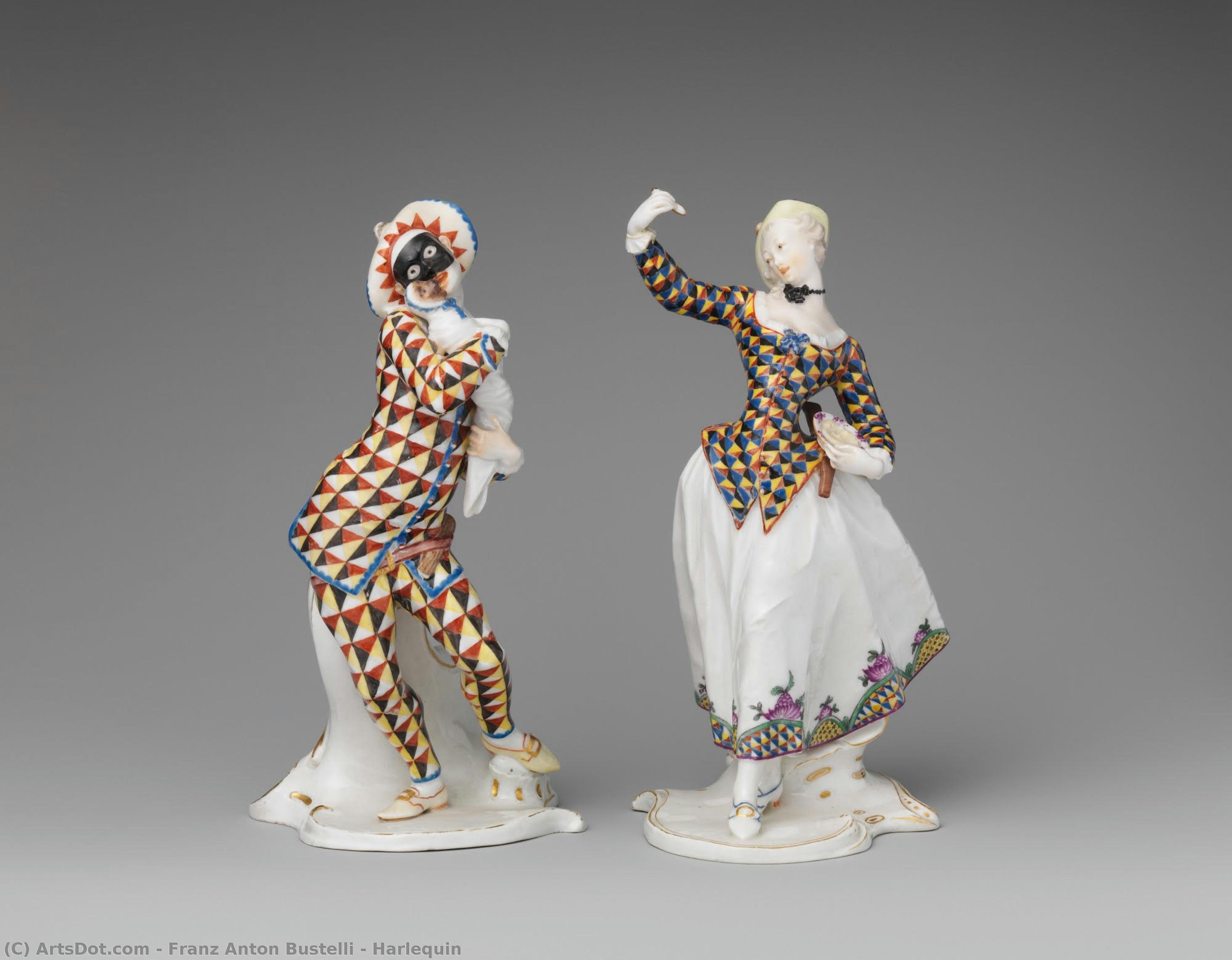
To gaze upon "Harlequin" by Franz Anton Bustelli is to step directly into the glittering, ephemeral world of the eighteenth-century salon. This porcelain masterpiece captures not merely two figures, but a moment suspended in time—a breath caught between steps on a grand stage. The composition itself sings with the energy of performance; the man, embodying Harlequin, seems poised mid-pirouette, his form radiating mischievous vitality, while the ballerina balances an air of graceful melancholy. Bustelli, the maestro of Rococo porcelain, understood that true art lies in capturing movement. Here, the vibrant clash of reds, yellows, and blues against the creamy white expanse of the porcelain does more than decorate; it narrates a story of gaiety, flirtation, and the dazzling spectacle of courtly life.
Mastery in Porcelain: Technique and Detail
The technical brilliance displayed here is nothing short of breathtaking. The medium itself—porcelain painting—demands an almost impossible level of delicacy from its creator. One can trace the meticulous handwork, imagining the fine brushes loaded with enamel paints that brought these costumes to life. Observe the contrast between Harlequin’s costume, a geometric explosion of diamonds and squares suggesting the playful chaos of commedia dell’arte, and the flowing, organic lines adorning the ballerina's skirt. The artist has achieved a textural illusion; though the surface is glossy and smooth, the folds in the fabric, the delicate lace on the sleeves, and the weight suggested by the drapery all imply tangible depth. It is a testament to Bustelli’s unparalleled skill that such vibrant narrative detail could be rendered so permanently upon fired ceramic.
Symbolism of Play and Artistry
The subject matter anchors us firmly in the realm of theatrical tradition. Harlequin, forever the trickster figure, symbolizes unbridled joy and wit—the spirit that refuses to be contained by rigid social structures. Paired with the ballerina, who represents disciplined beauty and ethereal grace, they create a perfect dialectic: the wild energy meeting controlled elegance. This pairing speaks volumes about the Rococo sensibility itself—a period obsessed with pleasure, artifice, and the exquisite balance between structured society and personal abandon. Owning this piece is to invite that very dialogue into your own space; it suggests an appreciation for life lived vibrantly, where performance, whether on stage or in conversation, is paramount.
A Touch of Eighteenth-Century Romance
For the collector or designer seeking a focal point imbued with history and romance, "Harlequin" offers unparalleled depth. It transcends mere decoration; it functions as an heirloom narrative. The soft, diffused lighting captured by Bustelli ensures that while the colors are bold, the overall emotional impact remains one of delicate nostalgia. Imagine this piece gracing a mantelpiece or displayed in a curated cabinet—it does not shout for attention, but rather invites closer inspection, rewarding the viewer with layers of historical context and artistic admiration. It is an enduring echo of Rococo splendor, perfectly preserved for modern contemplation.
Om kunstneren
Franz Anton Bustelli: The Maestro of Rococo Porcelain
Franz Anton Bustelli (12 April 1723 – 18 April 1763) stands as a singular figure in the annals of eighteenth-century art, revered primarily for his unparalleled mastery of porcelain modeling during the Rococo period. While biographical details remain scarce—a testament to the ephemeral nature of artistic lives—his legacy persists through the exquisite figurines produced under his stewardship at Nymphenburg Porcelain Manufactory and beyond, cementing his place as arguably the greatest sculptor of porcelain in Europe.
Born in Locarno, Switzerland, Bustelli’s origins are shrouded in relative obscurity. However, evidence suggests he possessed a German upbringing, possibly fostered by familial connections to Bavaria—a region that would become inextricably linked with his artistic career. His formative training likely centered on wood carving, reflecting the prevalent artisanal traditions of his time and providing him with foundational skills for sculpting delicate materials like porcelain.
Bustelli’s journey into the world of ceramics began in 1754 when he joined the Neudeck Porcelain Manufactory in Munich. Recognizing his exceptional talent, Sigmund Graf von Haimhausen swiftly elevated him to Modellmeister—head modeller—a position that afforded him considerable creative autonomy and propelled him to the forefront of porcelain artistry.
The Nymphenburg Legacy
The relocation of the manufactory to Nymphenburg Palace in 1761 proved pivotal for Bustelli’s artistic output. Situated amidst the opulent surroundings of Maximilian III Joseph's court, Nymphenburg became a crucible for innovation and aesthetic refinement. Bustelli’s contribution to this burgeoning porcelain tradition was transformative; he spearheaded the creation of approximately 150 new models—a staggering achievement considering the prevailing techniques of the era.
His initial designs embraced classical motifs – gods and putti – mirroring the stylistic currents circulating throughout Europe at the time. However, Bustelli swiftly moved beyond mere imitation, delving into more nuanced explorations of human emotion and narrative. The “Street Vendors” series exemplifies this shift, capturing the dynamism and vibrancy of urban life with remarkable precision. Furthermore, his foray into Orientalism—particularly his depictions of Chinese figures—demonstrates a keen awareness of contemporary artistic trends and reflects the fascination with Eastern cultures prevalent in the Rococo era.
The Commedia dell’Arte: A Pinnacle of Artistic Expression
Perhaps Bustelli's most celebrated achievement resides in his masterful interpretation of the Commedia dell’arte—the Italian theatrical tradition renowned for its improvisational performances and stylized characters. The eight pairs of figurines portraying figures from this genre – “The Lovers” – represent a pinnacle of Rococo artistry, characterized by subtle gestures and expressive facial expressions that convey complex emotions.
These sculptures are not merely representations; they embody the spirit of the Commedia dell’arte—a celebration of wit, humor, and theatrical illusion. Bustelli's ability to distill the essence of this performance tradition into porcelain is a testament to his artistic genius and underscores the enduring power of art to capture human experience.
Influence and Significance
Franz Anton Bustelli’s influence extended far beyond Nymphenburg, shaping the aesthetic sensibilities of subsequent generations of porcelain sculptors. His meticulous attention to detail, coupled with his masterful command of Rococo style—characterized by asymmetry, delicate ornamentation, and a luminous palette—established a benchmark for excellence that continues to inspire artists today.
His work serves as an invaluable window into the cultural landscape of eighteenth-century Bavaria and Europe, reflecting the prevailing tastes for elegance, sophistication, and imaginative storytelling. Bustelli’s legacy endures not only in the surviving porcelain figurines but also in the enduring admiration he commands as one of the most accomplished sculptors of his time—a true luminary of Rococo art.

franz anton bustelli
1723 - 1763 , Schweiz
Kort om kunstneren
- Artistic Movement Or Style: Rococo
- Artists Or Movements Influenced By This Artist: ['Meissen Porcelain Manufactory']
- Artists Who Influenced This Artist: ['Johann Joachim Kändler']
- Date Of Birth: April 12, 1723
- Date Of Death: April 18, 1763
- Full Name: Franz Anton Bustelli
- Nationality: Swiss-German
- Notable Artworks:
- King Vulture
- Plaque: The Geese of Brother Phillippe
- Place Of Birth: Locarno, Switzerland

