Se i rommet
 Del som digitalt kort
 Del
Del
 Detaljer
 Studentguide

 Last ned
 Liknende objekter
 Røntgen
 Lysbildefremvisning
 Besøksstatistikk
Frans Hals
 Oil
Oil- WallArt
- Dutch Golden Age
 1650
1650- Early Modern
 33.0 x 28.0 cm
 Metropolitan Museum of Art
 Les mer
Giclée / Kunsttrykk
Giclée- eller lerretsprint av museumskvalitet med rask produksjon og fleksible valgmuligheter for etterbehandling. ( Bestill håndmalt reproduksjon Gå til digitalt bilde)




P118B Nkr10

P118H Nkr10

P118W Nkr10

P438Z Nkr10

P508JH Nkr12

P508YH Nkr12

P805H Nkr10

P805Z Nkr10

P919BZ Nkr10

P919G Nkr10

P919XJ Nkr10

P959ZH Nkr10

P968JZ Nkr12

W106C Nkr8

W218G Nkr10

W218JH Nkr8

W218Y Nkr10

W307PJ Nkr10

W316G Nkr10

W316PJ Nkr8

W316Y Nkr10

W398PJ Nkr8

W4111J Nkr10

W500HY Nkr15

W500JH Nkr15

W692G Nkr12

W849H Nkr8

W940BG Nkr15

W953PJ Nkr8




Velg mellom våre forhåndsdefinerte størrelser som bevarer kunstverkets opprinnelige proporsjoner.

Skriv inn bredden og høyden du trenger, slik at den passer til din ramme eller vegg. Et trykk kan kun beskjæres, aldri gjøres større enn bildet, så et format med en annen form vil miste en del av motivet. Vi sender deg en digital mockup for godkjenning før vi trykker noe som helst. Bildet som vises på denne siden viser ikke den faktiske beskjæringen — det er kun mockuppen som gjør det.
Verdensomspennende levering () på 2 uker i stedet for standard 4/5 uker. (24 October)

Gratis ekspressfrakt over hele verden

Lerretsduk av høykvalitets lin

Full transportforsikring

Garanti for refusjon av toll og importavgifter

Garantert fargeekthet

100 dagers returrett ved fabrikasjonsfeil

100% pengene tilbake-garanti

Mengderabatt
 Glassalternativet er kun tilgjengelig i størrelser under 110 cm

Frans Hals
Giclée / Kunsttrykk
Format på reproduksjon
-


Totalpris
Nkr 760
A Glimpse into Haarlem’s Golden Age
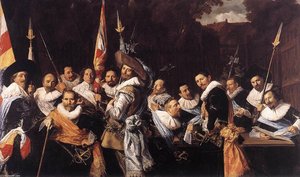
To gaze upon this masterful portrait by Frans Hals is to step through a portal into the vibrant, bustling heart of the Dutch Golden Age. Painted during an era of unprecedented economic prosperity and cultural flourishing, the work captures more than just a likeness; it captures the very soul of seventeenth-century Haarlem. The subject, a distinguished man adorned with a black hat and a delicate white ribbon, commands the viewer's attention with a gaze that feels remarkably immediate, as if he has only just paused his contemplations to acknowledge our presence. This sense of spontaneity is the hallmark of Hals, an artist who possessed the rare ability to freeze a fleeting moment of human existence and preserve it for eternity.
The composition breathes with a life force that transcends the boundaries of the canvas. While the man in the foreground serves as our primary anchor, the subtle presence of figures in the background adds layers of narrative depth, suggesting a larger world of social interaction and communal vitality. This is not a static, frozen icon, but a window into a living, breathing society where every brushstroke whispers stories of status, character, and the quiet dignity of the merchant class.
The Revolutionary Language of the Brush
What truly elevates this piece for the discerning collector or art enthusiast is Hals’s radical departure from the meticulous, almost photographic realism favored by many of his contemporaries. Instead of hiding his hand behind layers of smooth, invisible glazes, Hals embraced a technique defined by visible, energetic brushstrokes. This "loose" style creates a palpable texture that mimics the movement of light and the tactile reality of fabric and skin. There is an incredible rhythm to the application of paint; one can almost feel the swift, decisive motion of the artist's hand as he captured the sheen of the ribbon and the rugged texture of the beard.
For those looking to integrate such a piece into a sophisticated interior, this technique offers a dynamic visual energy. The interplay of light and shadow—the chiaroscuro effect—provides a dramatic focal point that can anchor a room, offering both a sense of historical weight and a modern, expressive flair. It is a technique that celebrates the process of creation itself, making the painting feel less like an object and more like an event.
Symbolism and Emotional Resonance
Beyond the technical brilliance lies a profound emotional depth. In the context of the Dutch Golden Age, portraiture served as a vital medium for expressing identity and social standing. The careful rendering of the man's attire—the stark contrast of the black hat against the white ribbon—speaks to a refined taste and a controlled elegance. Yet, beneath this veneer of formality, Hals injects a sense of psychological intimacy. There is an unmistakable warmth in the subject's expression, a hint of the human spirit that invites the viewer into a silent dialogue.
For the interior designer or art lover, acquiring a high-quality reproduction of such a work means bringing more than just decoration into a space; it means introducing a legacy of humanity and resilience. This painting serves as a reminder of a time when art was used to celebrate the beauty of everyday life and the profound dignity found in the individual. It is an investment in atmosphere, providing a sophisticated touch of history that resonates with timeless elegance and emotional truth.
Spørsmål og svar
Hva har "Frans Hals" til felles med resten av Frans Hals sin produksjon?
I Frans Hals sitt kunstnerskap befinner "Frans Hals" seg innenfor Dutch Golden Age-stilen, sammen med temaene baroque style, dignified portraiture, guild tradition, humanism values, haarlem legacy.
Hvem har skapt "Frans Hals"?
"Frans Hals" tilskrives Frans Hals.
Hvilket rom passer til fargene i "Frans Hals" av Frans Hals?
Med sine Monochrome farger, anbefales "Frans Hals" for et Living Room.
Kunstnerbiografi
Frans Hals I: A Life in Paint
Frans Hals I was a Dutch painter born in Antwerp, Belgium, around 1580. Though his early life remains somewhat shrouded in mystery, he rose to become one of the most important figures of the Dutch Golden Age, celebrated for his innovative portraiture and genre scenes. He moved away from rigid formality towards a more naturalistic and expressive style, leaving an enduring legacy on the art world.Early Life and Training
Details surrounding Hals’s formative years are scarce. It is believed he received initial artistic training in Antwerp, a prominent center for painting at the time. However, due to religious and political turmoil, his family relocated to Haarlem in the Netherlands. He became a member of the Haarlem Guild of St. Luke in 1610, marking the formal beginning of his professional career. Hals’s brother, Dirck Hals (1591–1656), followed in his brother Frans’ footsteps and became a painter; a third brother, Joost (died before October 16, 1626), apparently worked as an artist as well, but no works by him have been identified. According to the anonymous biographer of Karel van Mander (1548–1606), Hals trained under him, but Van Mander himself makes no mention of this in his *Schilderboek*of 1604.Artistic Style and Development
Hals distinguished himself through a remarkably fresh and spontaneous style. Unlike many of his contemporaries who favored meticulous detail, Hals employed a loose and expressive brushstroke. This technique imbued his paintings with a sense of immediacy and vitality, capturing the personality and character of his subjects in a way that was revolutionary for its time. His portraits weren’t simply likenesses; they were psychological studies. He excelled at depicting fleeting moments – laughter, conversation, or contemplation. Hals's use of light and shadow added depth and drama to his compositions. He influenced artists such as Adriaen Brouwer and Johannes Vermeer. His emphasis on capturing personality paved the way for more intimate and psychological portraits. Later artists, including the Impressionists, admired his loose brushwork and focus on light.Notable Works
While Hals produced a wide range of works, he is best known for his portraits. Some of his most celebrated paintings include:- The Laughing Cavalier (1624) – A quintessential example of his ability to capture character and movement.
- Malle Babbe (c. 1633-1635) – A striking portrayal of an elderly woman, showcasing Hals’s skill in depicting age and personality.
- Portraits of the Regents of the Old Men's Home in Haarlem (1664) - Demonstrating his mastery of group portraiture.
He also created compelling genre scenes – depictions of everyday life – that offered glimpses into Dutch society.
Influences and Legacy
Determining Hals’s direct influences is challenging, as he developed a highly individual style. However, it's likely he was aware of the work of earlier Flemish painters like Pieter Bruegel the Elder. His innovative approach to portraiture profoundly impacted subsequent generations of artists. He influenced artists such as Adriaen Brouwer and Johannes Vermeer. His emphasis on capturing personality paved the way for more intimate and psychological portraits. Later artists, including the Impressionists, admired his loose brushwork and focus on light. Today, his paintings are highly sought after and can be found in major museums worldwide, including the Frans Hals Museum in Haarlem, which houses the largest collection of his work. His contributions continue to inspire artists and captivate audiences centuries later.
Frans Hals
1580 - 1585 , Belgia
Kort om kunstneren
- Artistic Movement Or Style: Dutch Golden Age
- Artists Or Movements Influenced By This Artist:
- Adriaen Brouwer
- Johannes Vermeer
- Artists Who Influenced This Artist: ['Pieter Bruegel den Äldre']
- Date Of Birth: 1580
- Full Name: Frans Hals I
- Nationality: Nederlandsk
- Notable Artworks:
- Lerens Ridder
- Malle Babbe
- Portraits av Regents
- Place Of Birth: Antwerp, Belgium
Relaterte artikler

Frans Hals I: Innovation, Intimacy & the Dutch Golden Age Portrait
Explore the revolutionary portraiture of Frans Hals I, a master of the Dutch Golden Age. Discover his innovative techniques, captivating character studies & lasting impact on art history. Learn more at OriginalUniqueArt.

De 10 Mesterverkene som Definerte den Nederlandsk Gyldne Tidsalder – Kunst & Interiør
Oppdag de 10 ikoniske mesterverkene fra den nederlandske gullalderen! Lær om Rembrandt, Vermeer og andre store kunstnere. Finn inspirasjon til klassisk interiørdekorasjon og kjøp museumskvalitets reproduksjoner på OriginalUniqueArt.com.
Illuminating Realism: Exploring the Dutch Golden Age of Painting (1600-1700)
Explore the Dutch Golden Age of painting (1600-1700) with OriginalUniqueArt. Discover Rembrandt, Vermeer & other masters. Learn about techniques, history & find museum-quality reproductions.

Illuminating Innovation: Exploring the Dutch Golden Age of Painting
Explore the Dutch Golden Age of painting with OriginalUniqueArt. Discover Rembrandt, Vermeer & other Masters. Learn about key characteristics, iconic artworks, and lasting influence. Expert insights for collectors & enthusiasts.

Golden Light & Dutch Skies: The Timeless Magic of Dutch Golden Age Landscapes
Discover the breathtaking beauty of Dutch Golden Age landscapes. Explore the mastery of light, chiaroscuro, and 17th-century realism through an expert art history lens, celebrating the enduring legacy of the Dutch Masters for discerning collectors and art lovers.