

 Se i rommet
 Del som digitalt kort
 Del
Del
 Detaljer
 Studentguide

 Last ned
 Liknende objekter
 Røntgen
 Lysbildefremvisning
 Besøksstatistikk
The Unexpected Arrival


 Les mer
Håndlaget oljereproduksjon
Håndmalt olje på lerret i din valgte størrelse og ramme, laget på bestilling av våre kunstnere. ( Bytt til trykkversjon Gå til digitalt bilde)




P118B Nkr10

P118H Nkr10

P118W Nkr10

P438Z Nkr10

P508JH Nkr12

P508YH Nkr12

P805H Nkr10

P805Z Nkr10

P919BZ Nkr10

P919G Nkr10

P919XJ Nkr10

P959ZH Nkr10

P968JZ Nkr12

W106C Nkr8

W218G Nkr10

W218JH Nkr8

W218Y Nkr10

W307PJ Nkr10

W316G Nkr10

W316PJ Nkr8

W316Y Nkr10

W398PJ Nkr8

W4111J Nkr10

W500HY Nkr15

W500JH Nkr15

W692G Nkr12

W849H Nkr8

W940BG Nkr15

W953PJ Nkr8




Velg mellom våre forhåndsdefinerte størrelser som bevarer kunstverkets opprinnelige proporsjoner.

Skriv inn bredden og høyden du trenger, slik at den passer til din ramme eller vegg. Dette er håndmalt, så for en størrelse med en annen form kan kunstneren male litt mer rundt bildet, eller beskjære det noe — du velger selv. Vi sender deg en digital mockup for godkjenning før maleriet påbegynnes. Bildet som vises på denne siden viser ikke det faktiske resultatet — kun mockuppen gjør det.
Etter bestilling vil OriginalUniqueArt.com-teamet sende e-post til kunden for instruksjoner og sende et utkast (mockup) som forhåndsvisning.
Verdensomspennende levering () på 3–4 uker i stedet for standard 5 uker. (26 October). Ingen kompromisser med kvaliteten.

Gratis ekspressfrakt over hele verden

Lerretsduk av høykvalitets lin

Full transportforsikring

Garanti for refusjon av toll og importavgifter

Garantert fargeekthet

100 dagers returrett ved fabrikasjonsfeil

100% pengene tilbake-garanti

Mengderabatt
 Glassalternativet er kun tilgjengelig i størrelser under 110 cm

The Unexpected Arrival
Reproduksjonsmetode
Format på reproduksjon
-


Totalpris
Nkr 4520
A Golden Moment in Italian Realism
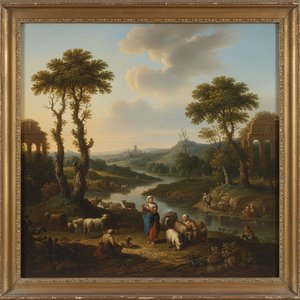
In the vast, sun-drenched expanse of Francesco Lojacono’s 1883 masterpiece, The Unexpected Arrival, the viewer is immediately transported to a moment of profound stillness within the Italian countryside. This monumental oil on canvas serves as more than just a landscape; it is a window into the soul of the late 19th-century rural experience. The composition is defined by an immense, reverberating brightness, where a brilliant light blue sky, punctuated by soft, drifting clouds, meets a sea of undulating golden fields. As the eye wanders across the horizon, one encounters a group of figures—likely laborers or farmers—whose presence provides a poignant human anchor to the overwhelming scale of nature. The painting captures a sense of quietude and shared experience, evoking a mood that oscillates between peaceful contemplation and a subtle, lingering melancholy.
The historical significance of this work is as grand as its physical scale. Originally purchased by the sovereigns of Italy in 1883 during the Fine Arts Exhibition in Rome for the prestigious Savoy collections, the painting was destined for the Royal Villa of Monza before eventually finding its place in the Quirinal Palace. This lineage of ownership underscores the artist's standing within the Italian art canon; Lojacono, a master of his craft, was even honored with the title of Commander of the Crown of Italy. Often referred to by critics as a subject of the Risorgimento—or more evocatively as The Return of the Conscript—the work carries the weight of national identity, reflecting the social shifts and the enduring spirit of the Italian peasantry during a transformative era in European history.
Mastery of Light and Texture
Technically, Lojacono demonstrates an extraordinary command over the medium of oil paint, utilizing a meticulous approach to realism that breathes life into every blade of grass and fold of fabric. The artist employs a sophisticated palette of muted earth tones—deep browns, soft greys, and weathered blues—which harmonize beautifully with the vibrant gold of the harvest and the ethereal azure of the sky. There is a deliberate play between the horizontal dominance of the landscape and the subtle verticality found in the figures and distant structures, creating a balanced, rhythmic composition that guides the viewer’s gaze through the depth of the field. The texture of the painting is particularly captivating; through visible yet controlled brushstrokes, Lojacono creates a tactile sensation of the rough grasses and the heavy, sun-warmed clothing of the subjects.
For the discerning collector or interior designer, The Unexpected Arrival offers an unparalleled opportunity to introduce a sense of historical grandeur and atmospheric depth into a space. The painting’s ability to command attention through its sheer scale and luminous quality makes it a breathtaking centerpiece for any curated collection. Whether placed in a formal gallery setting or used to anchor a sophisticated contemporary room, the artwork provides a timeless connection to the beauty of the natural world and the dignity of human labor. It is an evocative piece that does not merely decorate a wall but invites a continuous dialogue between the viewer and the golden light of a bygone era.
Spørsmål og svar
Hvor gammel var Francesco Lojacono da "The Unexpected Arrival" ble skapt i 1883?
Da "The Unexpected Arrival" ble skapt i 1883, var Francesco Lojacono – født i 1838 – 45 år gammel.
Hvilken orientering har "The Unexpected Arrival" av Francesco Lojacono?
"The Unexpected Arrival" av Francesco Lojacono har et Panoramic-format. Formatet beskriver komposisjonens proporsjoner.
Hvordan laster jeg ned bildet av "The Unexpected Arrival" av Francesco Lojacono?
Bildet av "The Unexpected Arrival" av Francesco Lojacono kan lastes ned fra verkets Last ned-side: nedlasting av et digitalt bilde i høy oppløsning.
Kunstnerbiografi
A Life Shaped by Light and Land
In the sun-drenched streets of Palermo, a young boy watched his father, Luigi, translate history and portraits onto canvas. This early immersion in the family studio provided Francesco Lojacono with his first lessons in the weight of a brush and the nuance of shadow. His path was not merely one of quiet study; it was marked by the sudden, sharp realities of political upheaval. When the revolution broke out in 1860, he set aside his brushes to join Garibaldi’s expedition, following the march toward Rome alongside his father and brother. The struggles of war left their mark on him, as he faced imprisonment at Aspromonte after the clash of forces. These turbulent years of service eventually gave way to a renewed devotion to the landscape, a pursuit that would define his entire existence.
The search for artistic truth led him far from the familiar sights of Sicily. In 1856, a gold medal won in Palermo provided the means to travel to Naples, where he entered the school of the brothers Giuseppe and Filippo Palizzi. This period of training was transformative. He moved away from the rigid structures of historical painting toward a more direct engagement with nature. Later, his travels took him to Florence, where the influence of the Macchiaioli painters introduced new ways of seeing. Through these various schools and cities, he gathered the tools to capture the specific atmosphere of his native land.
The Painter of the Sicilian Sun
Lojacono possessed a singular ability to translate the heat and clarity of the Mediterranean onto a flat surface. He became known by names that spoke to this luminosity, often referred to as the "Sun Painter" or even the "Sun Thief." His eyes were trained to catch the precise moment when the sky at dawn meets the sea, or how the heavy, torrid light of a summer afternoon settles over the earth. Whether he was painting the rugged coasts near Palermo or the sweeping plains around Agrigento, his work focused on the subtle sensations of the environment—the scent of salt, the movement of wind, and the weight of dust.
His technique relied on a meticulous command of oil paint to render the textures of the Sicilian landscape. He could paint every pebble in a stream or the way light reflects off a quiet sea with such precision that his work often felt like a window into a real, breathing world. This clarity was particularly evident in his later years, as he developed a style of Vedutism that approached a photographic purity. His compositions often featured:
- The brilliant, clear light of the Mediterranean basin.
- The shifting shadows of twilight and the glare of midday.
- The simple, dignified rhythms of rural and coastal life.
Legacy and Recognition
As his reputation grew, so did the reach of his work. His canvases found homes in the most prestigious collections of Europe. In 1883, Queen Margherita of Savoy purchased The Unexpected Arrival for the Quirinal Palace, a moment that solidified his standing among the great artists of his era. Other notable patrons included King Umberto I, who acquired The Summer, and various aristocrats who sought to possess a piece of the Sicilian light. His success was not limited to Italy; he presented his visions at international exhibitions in Vienna, Paris, and London, earning respect far beyond the borders of his home province.
Beyond the easel, Lojacono dedicated much of his later life to passing on his knowledge. He held a professorship of landscape at the Naples Institute of Fine Arts and later taught at the Palermo Academy of Fine Arts. Through his teaching, he influenced a new generation of painters, including Michele Catti, who would go on to become part of the celebrated triad of Sicilian landscape artists. When he passed away in Palermo, he left behind a body of work that remains a profound record of a specific time and place, captured through a lens of light and enduring devotion.

Francesco Lojacono
1838 - 1915
Kort om kunstneren
- Artistic Movement Or Style: Romantic Realism
- Artists Or Movements Influenced By This Artist:
- Michele Catti
- Ettore De Maria Bergler
- Artists Who Influenced This Artist:
- Luigi Lojacono
- Salvatore Lo Forte
- Filippo Palizzi
- Full Name: Francesco Lojacono
- Nationality: Italian
- Notable Artworks:
- The Unexpected Arrival
- View of Acquasanta, Palermo
- Rocks in the Sea
- Pond with leaves
- Place Of Birth: Palermo, Italy
- Date Of Birth: 1838
- Date Of Death: 1915
Relaterte artikler
Nicolaes Berchem: Dutch Golden Age Pastoralism & the Evolution of Landscape Painting
Explore the captivating world of Nicolaes Berchem, a leading Dutch Golden Age painter. Discover his idyllic landscapes, masterful technique & lasting influence on art history. Learn more at OriginalUniqueArt.

Romantiske landskap: Topp 10 mesterverk for hjemmet – Kunst fra OriginalUniqueArt.com
Oppdag de 10 mest ikoniske romantiske landskapsmaleriene! Fra Caspar David Friedrich til Turner – utforsk kunsthistorien, stemningen og fargepalettene. Finn museumskvalitets reproduksjoner på OriginalUniqueArt.com.

John Constable: Topp 25 Maler – Engelsk Landskapskunst i Ditt Hjem
Opplev John Constables 25 mest ikoniske malerier! Fordyp deg i engelsk romantikk, landskapskunst og atmosfæriske scener. Finn museumskvalitets reproduksjoner & interiørinspirasjon på OriginalUniqueArt.com. Utforsk samlingen online!

Evocations of Place: A Historical Journey Through Landscape Art
Explore the rich history of landscape art with OriginalUniqueArt. Discover renowned artists, movements like Impressionism & Romanticism, and expert guidance for collecting timeless pieces. Find your perfect serene escape today!

Cultivating Visions: A Historical Journey Through Rural Landscapes in Art
Explore the rich history of rural landscape painting with OriginalUniqueArt. Discover Impressionist masterpieces, key artists & movements. Find your perfect serene artwork and bring nature's beauty home.