Oljeversjon
 Alt om Stalingrad







































 For kunstverk eller reproduksjoner som er større enn 105 cm (ca. 41 tommer) på noen side, vil rammen bli sendt som et sett som må monteres. Denne metoden sikrer trygg levering og forhindrer skader under transport.


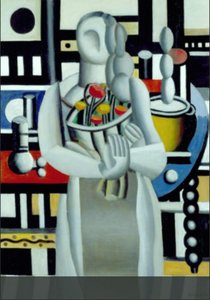
The Creation of Stalingrad by Fernand Léger
In 1924, Fernand Léger turned his gaze toward the heavy, rhythmic pulse of industrial labor. His painting, Stalingrad, emerged from this fascination with the intersection of man and machine. The canvas captures a moment of intense industrial collaboration, where the human form and the mechanical tool become inseparable. It is a scene of construction and movement, a study of how steel and muscle work in tandem to reshape a landscape.
The work is rooted in the language of Cubism, utilizing fragmented planes to organize the chaos of the machine age. At the same time, it carries the simplified, direct clarity often associated with Naïve Art. This duality allows the subject matter to remain grounded. The heavy machinery and the workers are not mere decorations; they are the structural bones of the composition. Fernand Léger sought to translate the energy of the modern era into a visual reality of intersecting lines and solid forms.
Steel pistons and heavy cranes define the space. The work exists in the tension between the organic and the manufactured. It is a quiet record of strength.
Artistic Movements and Stylistic Influences
The canvas is anchored in the fractured logic of Cubism. It follows the path cleared by the pioneers of the movement, breaking the world into a sequence of overlapping planes and geometric shards. This is not a soft dissolution of form, but a structural dismantling. The artist’s own hand developed a specific variation of this language, often called Tubism, which emphasizes cylindrical, tubular shapes. These rounded, mechanical volumes replace the organic curves of the natural world with the hard, rhythmic precision of the machine age.
There is a heavy, industrial pulse within these shapes. The work looks toward the future, acting as a forerunner to the Pop Art movement that would emerge decades later. By treating modern, mechanical subjects with such directness, the artist bridges the gap between fine art and the objects of a consumer society. The painting captures a moment where the human figure and the machine become inseparable parts of a single, moving mechanism. Steel and shadow define the new reality.
Spørsmål og svar
Er Stalingrad malt for hånd eller er det et trykk?
Håndmalt: en utdannet kunstner kopierer Stalingrad i olje på linlerret.
Hvilken størrelse bør jeg velge for Stalingrad?
Originalen måler 32 x 50 cm. Størrelsene varierer fra 29.9 x 33.4 cm (Nkr2362) til 217.2 x 242.6 cm (Nkr18568); tabellen på denne siden viser de viktigste alternativene og deres priser.
Hvor lang tid tar leveringen?
Levering tar 4 til 5 uker med gratis ekspressfrakt over hele verden; en mulighet for hurtigproduksjon tilbys på denne siden. Du kan returnere varen innen 100 dager for full refusjon, uten betingelser.
Hvilket medium brukte Fernand Léger for Stalingrad?
Oil On Canvas
 Forhåndsvisning

 Send
 Del
 Vis detaljer
 Faktablad


 Last ned bilde
 Liknende objekter
 Røntgenundersøkelse
 Lysbildefremvisning
 Spørsmål og svar

 Statistikk