Cubist · 1948
Mechanical Elements on a blue background (Fernand Léger, 1948)
Fernand Léger (1881–1955) har laget Mechanical Elements on a blue background. Den er fra 1948. Det tilhører Cubist-bevegelsen. Den er laget i Collage. Mål: 65 × 50 cm
- 1948
- Collage
- 65 × 50 cm

 Forhåndsvisning

 Håndmalt oljemaleri
 Send
 Del
 Faktablad


 Last ned bilde
 Liknende objekter
 Røntgenundersøkelse
 Lysbildefremvisning
 Spørsmål og svar

 Statistikk
Mechanical Elements on a blue background, kort fortalt
- Tittel
- Mechanical Elements on a blue background
- Kunstner
- Fernand Léger (1881–1955)
- Kunstner født i
- Argentan, Frankrike
- Dato
- 1948
- Medium
- Collage
- Dimensjoner
- 65 × 50 cm
- Bevegelse
- Cubist
- Periode
- Modern
- Motiv
- mechanical forms, collage, gears, bird, texture, assemblage
Hva forestiller Mechanical Elements on a blue background?
A Symphony of Gears and Birdsong
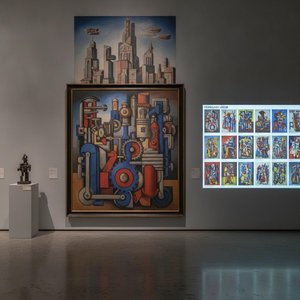
In the quiet tension of Fernand Léger’s 1948 masterpiece, Mechanical Elements on a blue background, we encounter a visual dialogue that transcends the mere arrangement of shapes. This work, often referred to as part of his "Composition VIII" series, serves as a profound embodiment of the anxieties and aspirations defining post-reconstruction Europe. As the world grappled with the debris of World War II, Léger sought to find beauty within the industrial fragments of a rebuilding civilization. The canvas explodes with a calculated chaos of interlocking circles, squares, and triangles, all set against a deep, atmospheric blue that provides both a sense of infinite space and a somber, reflective weight.
What makes this composition truly captivating for the modern observer is the unexpected intrusion of the organic into the mechanical. Amidst the rigid logic of gears, screws, and metallic fragments, a single bird perches atop a central structure. This delicate juxtaposition establishes a poignant tension between the cold, unyielding precision of machine construction and the fragile, ephemeral beauty of nature. It is a moment of dreamlike irrationality—a Surrealist whisper within a Constructivist shout—that invites the viewer to contemplate whether technology serves to suppress life or to provide a new stage upon which it might flourish.
The Art of Industrial Alchemy
Léger’s technique in this period was nothing short of revolutionary, moving beyond traditional brushwork to embrace the tactile reality of the machine age. He employed a sophisticated collage-like approach, meticulously assembling fragments that mimic metal sheeting and industrial components. This method was not merely decorative; it was an essential conceptual tool used to bridge the gap between fine art and the physical world. By integrating textures that suggest steel and iron onto the canvas, Léger transforms the act of painting into an act of engineering, creating a sense of depth and complexity that draws the eye into its intricate layers.
For the discerning collector or interior designer, this piece offers a unique aesthetic versatility. Its style—a masterful blend of Constructivist abstraction and Surrealist whimsy—allows it to anchor a room with its bold, geometric energy while maintaining a sophisticated, contemplative mood through its cool color palette. The interplay of blue and grey tones provides a calming foundation, making it an ideal centerpiece for contemporary spaces that value intellectual depth and structural elegance. To possess a reproduction of this work is to bring into one's home a piece of history that celebrates the resilience of the human spirit amidst the relentless march of progress.
Høyoppløselige bilder av Mechanical Elements on a blue background
Fritlig eiendom: kunstneren døde i 1955.
Fernand Léger, Mechanical Elements on a blue background (1948). Felleseie
Spørsmål om Mechanical Elements on a blue background, besvart
I hvilket år ble "Mechanical Elements on a blue background" av Fernand Léger skapt?
"Mechanical Elements on a blue background" dateres til 1948. Denne datoen plasserer verket innenfor Fernand Léger sin karriere og sin epoke.
Hvilket medium er "Mechanical Elements on a blue background" av Fernand Léger utført i?
Fernand Léger brukte Collage-teknikken i "Mechanical Elements on a blue background". Teknikken definerer det materielle uttrykket til det originale verket.
Hva er målene på det originale verket "Mechanical Elements on a blue background" av Fernand Léger?
Det originale verket "Mechanical Elements on a blue background" av Fernand Léger måler 65 x 50 cm.
Hva forestiller "Mechanical Elements on a blue background" av Fernand Léger?
Motivene i "Mechanical Elements on a blue background" er mechanical forms, collage, gears, bird, texture, assemblage, industrial age.
Er bildet av "Mechanical Elements on a blue background" av Fernand Léger i det frie domene?
Opphavsrettslig status for "Mechanical Elements on a blue background" av Fernand Léger: verket er fritt tilgjengelig – opphavsretten har utløpt. Dette avgjør om det er tillatt å lage frie reproduksjoner av bildet.
Hvilken kunstner kan "Mechanical Elements on a blue background" tilskrives?
"Mechanical Elements on a blue background" ble skapt av Fernand Léger. Informasjonen på denne siden beskriver Fernand Léger sitt originale verk.
Hvilken stilart tilhører "Mechanical Elements on a blue background"?
"Mechanical Elements on a blue background" av Fernand Léger tilhører Cubist-retningen. Denne retningen gir det stilistiske kontekstet til verket.
Hvilken periode i Fernand Léger sin karriere tilhører "Mechanical Elements on a blue background"?
"Mechanical Elements on a blue background" tilhører Mature Period i Fernand Léger sin karriere. Denne klassifiseringen knytter verket til kunstnerens utvikling.
Hvor gammel var Fernand Léger da hen laget "Mechanical Elements on a blue background"?
Fernand Léger var 67 år gammel da Mechanical Elements on a blue background ble skapt i 1948. Alderen er beregnet ut fra kunstnerens fødselsår, 1881.
Om kunstneren, Fernand Léger

1881–1955, Frankrike
Fernand Léger
Livet til Fernand Léger Historien om Fernand Léger begynner i landsbyen Argentan, som ligger i Orne-regionen i Nedre Normandie. Han trådte inn i denne verden den 4. februar 1881 som enebarn. Hans tidlige år ble formet av stillheten på den franske landsbygda og nærværet til hans mor, Marie-Adèle Daunou.
Også av Fernand Léger
 Byen1919
 Den Mekaniker1920
 Tre Kvinner1921
 Nattbilder i Skogen1910
Essays om Mechanical Elements on a blue background
 Industriell Stemning i Kunsten: Topp 10 Maler for Ditt Hjem | OriginalUniqueArt.comUtforsk 10 ikoniske malerier som fanger industriell stemning! Fra ekspresjonisme til kubisme – oppdag historien bak kunstverkene og finn in…
 Mastering the Machine Age: The 25 Best Artworks by Fernand LégerImmerse yourself in the vibrant world of Fernand Léger. Explore 25 iconic masterpieces of Cubism and Tubism, from bold geometric forms to m…
 10 Iconic Masterpieces to Elevate Your Coworking Space DesignTransform your workspace with timeless elegance. Discover 10 iconic masterpieces, from Impressionist classics to modern abstracts, curated …