Cubist Style
Mechanical Elements (Fernand Léger)
Fernand Léger (1881–1955) har laget Mechanical Elements. Det tilhører Cubist Style-bevegelsen. Den er laget i Oil On Canvas. Verket er bevart ved Metropolitan Museum of Art i New York, USA.
- Oil On Canvas
- Metropolitan Museum of Art, New York

 Forhåndsvisning

 Håndmalt oljemaleri
 Send
 Del
 Faktablad


 Last ned bilde
 Liknende objekter
 Røntgenundersøkelse
 Lysbildefremvisning
 Spørsmål og svar

 Statistikk
Mechanical Elements, kort fortalt
- Tittel
- Mechanical Elements
- Kunstner
- Fernand Léger (1881–1955)
- Kunstner født i
- Argentan, Frankrike
- Medium
- Oil On Canvas
- Hvor det kan ses
- Metropolitan Museum of Art, New York, USA
- Bevegelse
- Cubist Style
- Periode
- Modern
- Motiv
- mechanical elements, cubism, geometry, industrial design, abstraction, assemblage
Hva forestiller Mechanical Elements?
A Vision of Industrial Harmony
Fernand Léger’s “Mechanical Elements,” painted in 1924, stands as a striking testament to the burgeoning fascination with technology during the interwar period. More than just a depiction of gears and pipes—though undeniably prominent—the artwork embodies Léger's ambitious goal: to synthesize Cubist fragmentation with the dynamism of the machine age, creating an aesthetic that simultaneously challenged artistic conventions and reflected the transformative realities of modern life.
Born Joseph Fernand Henri Léger in Argentan, Normandy, 1881, Léger embarked on a journey from rural landscapes to the epicenter of Parisian avant-garde. Initially drawn to architecture, his artistic path swiftly pivoted toward painting after arriving in Paris around 1900, fueled by an unwavering conviction that art could engage with the complexities of its time.
Cubism Revisited: Geometric Precision
Léger’s stylistic evolution is inextricably linked to Cubism. Influenced profoundly by Picasso and Braque, he adopted the fractured perspective and simultaneous viewpoints characteristic of this revolutionary movement—a deliberate rejection of traditional representation in favor of exploring spatial relationships through geometric forms. However, Léger didn't simply replicate Cubist principles; he pushed them further, distilling them into a simplified vocabulary of circles, squares, and lines.
“Mechanical Elements” exemplifies this approach brilliantly. The canvas is dominated by interlocking geometric shapes—primarily circles and squares—arranged in a rhythmic pattern that evokes the precision and repetition found in industrial machinery. These forms aren’t merely decorative; they actively contribute to conveying a sense of movement and energy, mirroring the ceaseless pace of urban life.
Symbolism Beyond Mechanism
While the artwork's visual language speaks directly to the influence of technology, Léger imbued “Mechanical Elements” with deeper symbolic resonance. The repetition of geometric shapes isn’t merely a stylistic device; it represents an attempt to capture the impersonal logic and order inherent in industrial processes—a deliberate contrast to the organic forms favored by Impressionism and Post-Impressionism.
Furthermore, Léger's use of color – predominantly shades of gray punctuated by vibrant accents – underscores this thematic preoccupation. Gray symbolizes the materiality of metal and concrete, while bursts of color represent human vitality and creativity—a harmonious blend reflecting Léger’s belief that art could coexist with technological advancement without sacrificing beauty or emotional depth.
A Legacy of Innovation
"Mechanical Elements" cemented Léger's position as a pioneer of Tubism – a variant of Cubism developed by Léger himself—characterized by the use of tubular forms to represent objects and figures. This innovative technique anticipated developments in Pop Art decades later, demonstrating Léger’s enduring influence on subsequent generations of artists.
Today, reproductions of “Mechanical Elements” continue to captivate audiences with their bold aesthetic and intellectual ambition. They serve as a powerful reminder that art can not only reflect the spirit of its time but also actively shape our understanding of it—a timeless masterpiece celebrating both geometric precision and human resilience.
Hvilket museum har Mechanical Elements?
Metropolitan Museum of Art
New York, USA
Opprinnelsen og historien til Metropolitan Museum of Art Metropolitan Museum of Art sprang ut av en visjon delt av en gruppe forretningsmenn, finansfolk og fremstående kunstnere og tenkere. Etter stiftelsen i 1870 søkte institusjonen et permanent hjem for sine stadig voksende anskaffelser. Før museet slo seg ned på sin nåværende lokasjon, hadde det en kort periode i Douglas Mansion-eiendommen på West 14th Street.


Høyoppløselige bilder av Mechanical Elements

Fritlig eiendom: kunstneren døde i 1955.
Andre størrelser, beskjæringer og sitering →Fernand Léger, Mechanical Elements, Metropolitan Museum of Art. Felleseie
Fargene er tilpasset originalen av en digital ekspert, og filen er finjustert for å være tro mot kunstnerens penselstrøk.
Kjøp høyoppløselig filSpørsmål om Mechanical Elements, besvart
Hvilket museum har det originale verket "Mechanical Elements"?
Originalen av "Mechanical Elements" av Fernand Léger oppbevares i Metropolitan Museum of Art, New York, USA. En reproduksjon gjør det mulig å stille ut verket i eget hjem.
Hvilket medium er "Mechanical Elements" av Fernand Léger utført i?
"Mechanical Elements" av Fernand Léger er utført i Oil On Canvas. Reproduksjonene har som mål å gjengi utseendet til denne teknikken.
Hva forestiller "Mechanical Elements" av Fernand Léger?
"Mechanical Elements" av Fernand Léger avbilder: mechanical elements, cubism, geometry, industrial design, abstraction, assemblage, modern art.
Er bildet av "Mechanical Elements" av Fernand Léger i det frie domene?
Opphavsrettslig status for "Mechanical Elements" av Fernand Léger: verket er fritt tilgjengelig – opphavsretten har utløpt. Dette avgjør om det er tillatt å lage frie reproduksjoner av bildet.
Hvem er kunstneren bak "Mechanical Elements"?
"Mechanical Elements" ble skapt av Fernand Léger. Informasjonen på denne siden beskriver Fernand Léger sitt originale verk.
Hvilken kunstretning tilhører "Mechanical Elements" av Fernand Léger?
"Mechanical Elements" av Fernand Léger tilhører Cubist Style-retningen. Denne retningen gir det stilistiske kontekstet til verket.
Hvilken fase av Fernand Léger sin kunstneriske utvikling representerer "Mechanical Elements"?
"Mechanical Elements" representerer Fernand Léger sin Mechanical Period.
Hva er årsaken til opphavsrettssituasjonen for "Mechanical Elements" av Fernand Léger?
Opphavsrettslig status for "Mechanical Elements" – fritt tilgjengelig – opphavsretten har utløpt – følger av kunstnerens dødsår, 1955.
Ble "Mechanical Elements" værende i kunstnerens hjemland?
Nei – kunstverket oppbevares i utlandet. Fernand Léger ble født i Frankrike, og originalen av "Mechanical Elements" oppbevares i et museum i USA.
Om kunstneren, Fernand Léger

1881–1955, Frankrike
Fernand Léger
Livet til Fernand Léger Historien om Fernand Léger begynner i landsbyen Argentan, som ligger i Orne-regionen i Nedre Normandie. Han trådte inn i denne verden den 4. februar 1881 som enebarn. Hans tidlige år ble formet av stillheten på den franske landsbygda og nærværet til hans mor, Marie-Adèle Daunou.
Også av Fernand Léger
 Byen1919
 Den Mekaniker1920
 Tre Kvinner1921
 Nattbilder i Skogen1910

Essays om Mechanical Elements
 Cubism Unveiled: How Picasso and Braque Redefined Modern Art through Geometric RevolutionExplore the revolutionary world of Cubism. Discover how Pablo Picasso and Georges Braque dismantled perspective to redefine modern art thro…
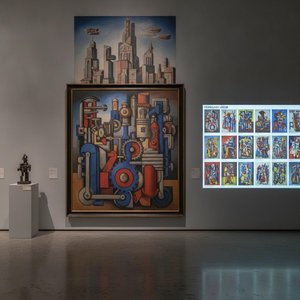 Mastering the Machine Age: The 25 Best Artworks by Fernand LégerImmerse yourself in the vibrant world of Fernand Léger. Explore 25 iconic masterpieces of Cubism and Tubism, from bold geometric forms to m…
 Industriell Stemning i Kunsten: Topp 10 Maler for Ditt Hjem | OriginalUniqueArt.comUtforsk 10 ikoniske malerier som fanger industriell stemning! Fra ekspresjonisme til kubisme – oppdag historien bak kunstverkene og finn in…