Bytt til trykk
 Vis hele teksten







































 For kunstverk eller reproduksjoner som er større enn 105 cm (ca. 41 tommer) på noen side, vil rammen bli sendt som et sett som må monteres. Denne metoden sikrer trygg levering og forhindrer skader under transport.


A Window into Expressionist Angst
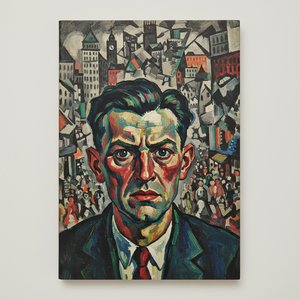
Ernst Ludwig Kirchner’s Portrat Gewecke, painted in 1914, stands as a cornerstone of German Expressionism—a movement born from the turbulent anxieties of its time and characterized by an uncompromising commitment to conveying inner emotion over objective representation. This portrait is far more than a mere depiction of a man’s face; it is a visceral exploration of psychological depth, rendered with a technique that anticipates the stylistic innovations of the coming decades. The artwork focuses on a male figure presented head and shoulders, capturing his gaze with an unwavering intensity that pulls the viewer into his private world. Kirchner eschews idealized beauty, opting instead for a raw portrayal reflecting a preoccupation with vulnerability and isolation.
The style and technique employed in this piece are quintessential to the Expressionist impulse. Distortion is evident throughout the facial features—eyes slightly widened and a mouth subtly downturned—to convey a palpable sense of unease. The surface of the painting is dominated by thick, impasto brushstrokes that create a tactile texture, amplifying the emotional impact through physical presence. By deliberately disrupting traditional perspective and flattening the image, Kirchner prioritizes psychological resonance over spatial accuracy. This reduction of form draws the eye directly to the subject's face and torso, emphasizing the essential elements of his internal struggle.
Color, Composition, and the Shadows of History
The color palette of Portrat Gewecke contributes significantly to its somber and intense atmosphere. Dominated by earthy browns and muted greens, the scheme is punctuated by sudden, jarring flashes of crimson and yellow. These colors do not merely decorate the canvas; they serve as emotional triggers within a simplified geometric composition. The primarily vertical orientation of the work reinforces the focus on the subject's presence, while the darkened green background acts as a powerful symbol of repression and isolation, mirroring the psychological landscape of the man portrayed.
Created during the burgeoning artistic fervor of 1914, this work reflects the broader anxieties surrounding Europe’s impending conflict. Kirchner’s masterpiece embodies the desire to confront uncomfortable truths about the human experience, acting as a reaction against the perceived complacency of bourgeois society. Beyond its formal brilliance, the painting resonates with a profound symbolic significance; the masterful brushwork communicates a yearning for connection amidst overwhelming uncertainty. For collectors and interior designers, owning a reproduction of such a seminal work offers a remarkable opportunity to experience this enduring legacy—a piece that invites contemplation on themes of identity, emotion, and the enduring complexities of the human condition.
Spørsmål og svar
Hvordan kan jeg se "Portrat Gewecke" av Ernst Ludwig Kirchner som en lysbildefremvisning?
Du kan se diaporamabildet av "Portrat Gewecke" på verkets Bildekarusell-side.
Er det mulig å laste ned "Portrat Gewecke"?
Bildet av "Portrat Gewecke" av Ernst Ludwig Kirchner kan lastes ned fra verkets Last ned digitalt bilde-side: nedlasting av et digitalt bilde i høy oppløsning.
Hvilken stemning uttrykker "Portrat Gewecke" av Ernst Ludwig Kirchner innenfor Expressionism?
"Portrat Gewecke" har en Melancholic emosjonell tone innenfor Expressionism-retningen.
 Forhåndsvisning
 Send
Send Del
Del
 Vis detaljer
 Utskriftsvennlig guide

 Last ned bilde
 Liknende objekter
 Røntgenundersøkelse
 Lysbildefremvisning
 Spørsmål og svar
 Statistikk